
 4.9 (400+
reviews)
4.9 (400+
reviews)
Introduction
Picture this: you call your eye doctor’s office at 9 PM, expecting voicemail, but instead you get your appointment booked right away. Or you send a quick text asking, “Do you have my new lenses ready?” and get an instant response without waiting for the next morning. That’s how AI agents are transforming optometry practices right now.
These AI tools work like super-smart virtual assistants designed just for eye clinics. They answer phones, book slots, send reminders, and even handle common questions about exams or glasses. For staff, that means less phone tag and paperwork. For patients, it feels like the clinic is always open and ready to help.
It’s smoother, faster, and a lot less stressful on both sides. Optometrists get more time to focus on care, and patients get the kind of experience that keeps them coming back. In this blog, we’ll explore what AI agents in optometry actually are, the everyday challenges they solve, and the many ways they’re already reshaping modern eye care!
What Are AI Agents in Optometry?
Now that you’ve gotten a glimpse of how AI agents in optometry clinics feel in action, let’s unpack what they really are. Think of them as intelligent digital team members built specifically for eye care. They’re not just generic chatbots. They’re trained to understand the language of optometry. So when a patient asks about a contact lens refill, or says they’re noticing floaters, the AI knows how to guide the conversation.
These agents live on the channels patients already use — calls, texts, or chat. They can confirm appointments, handle reschedules, send patient intake forms, or share follow-up instructions. They also work in the background, filling cancelled slots with patients from a waitlist, chasing missing paperwork, or reminding someone to pick up their new glasses.
And the impact isn’t just theoretical. In one ophthalmology clinic, adding simple automated SMS reminders cut missed appointments by nearly 38%. That’s a huge shift for practices that juggle full calendars and patients who need timely care.
The point isn’t to replace the optometrist’s medical expertise. That will always need a human touch. Instead, these AI agents for eye care practices free up staff from routine admin so the team can focus on what really matters: delivering great eye care.
The Challenge with Traditional Optometry Practices
Running an optometry clinic sounds simple, but anyone in the field knows it’s a daily juggling act. Patients want quick answers, staff are swamped with admin, and things still slip through the cracks. Let’s walk through some of the most common struggles that make old-school setups tough to manage.
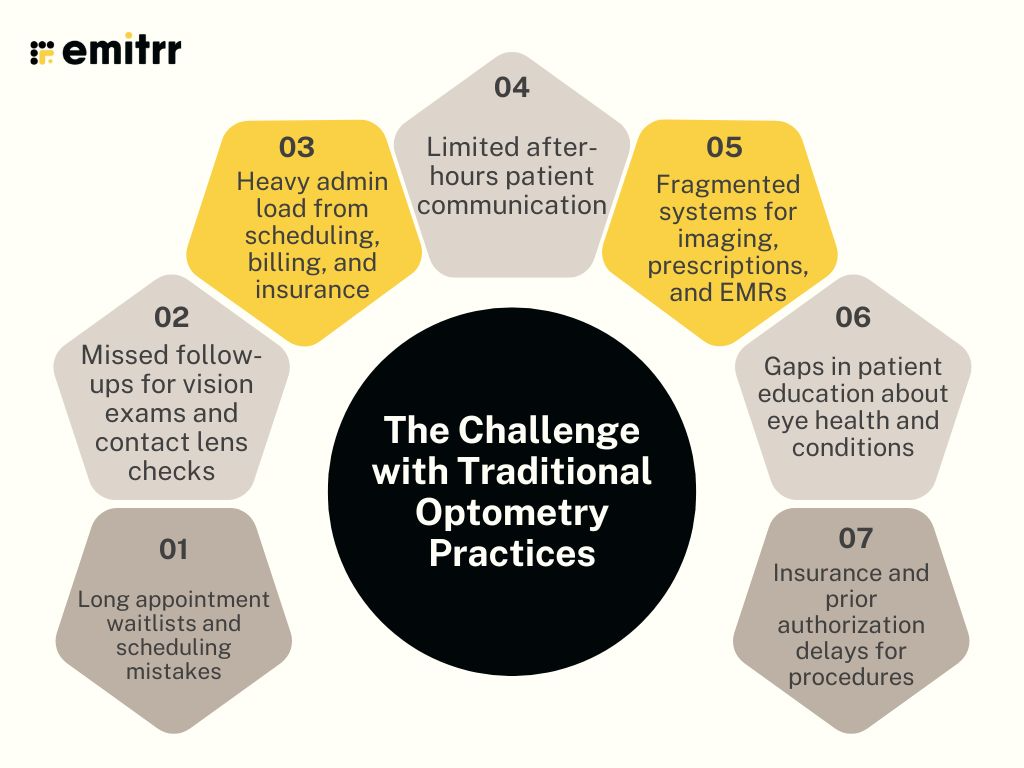
Long appointment waitlists and scheduling mistakes
Patients often call, hoping for a quick slot, only to be told the next exam is weeks away. Staff are stuck juggling phones, calendars, and sticky notes, which makes double bookings and wrong dates pretty common. Cancellations sometimes go unnoticed, leaving open spots that could’ve helped someone else. And when patients sit on hold during peak hours, frustration builds. It’s no wonder some end up calling another clinic instead. The truth? Manual scheduling just isn’t built for today’s pace.
Missed follow-ups for vision exams and contact lens checks
Follow-ups are key in eye care – annual exams, glaucoma checks, lens reviews. But they often get lost in the shuffle. Staff mean to call patients, but busy days push it down the list. Patients themselves forget too, and suddenly a year has gone by without that exam. Missing these visits isn’t just inconvenient. It can actually put eye health at risk. Think of a glaucoma patient who skips monitoring – the condition can worsen quietly. Without a strong appointment reminder system, practices lose both patients and opportunities for preventive care.
Heavy admin load from scheduling, billing, and insurance
Behind the scenes, staff are buried in paperwork. Scheduling, insurance checks, billing, updating records, it all adds up fast. A single benefits check can take 15 minutes, and multiply that by dozens of patients. Meanwhile, phones are ringing and people are waiting at the desk. It’s a recipe for stress, mistakes, and tired teams. Instead of focusing on patients, most of the day gets swallowed up by clerical work.
Limited after-hours patient communication
Most offices close their doors by early evening, but that’s exactly when patients have time to call. A parent might notice their kid’s eye irritation on Saturday, or someone might need to reschedule late at night. But the only option is voicemail, and many don’t even bother leaving one. Many calls to medical practices go unanswered, and every missed call could be a missed patient. For people who expect 24/7 convenience, this feels outdated fast.
Download ready-to-use voicemail scripts for appointments, after-hours calls, and prescription updates—built for eye care clinics.
Fragmented systems for imaging, prescriptions, and EMRs
Optometry clinics use all kinds of tools – imaging devices, EMRs, prescription software. But they often don’t connect. Staff end up typing the same info into multiple systems, which wastes time and increases errors. Maybe the doctor writes a follow-up in the EMR, but it never makes it into the scheduler. Or a prescription is updated in one place but not another. These silos create confusion and slow everyone down.
Gaps in patient education about eye health and conditions
Optometrists try their best to explain things during visits, but patients often forget most of it once they leave. There’s usually not enough time to answer every question in detail. Handouts or brochures help a little, but they often get tossed aside. Patients may not fully understand why yearly diabetic eye exams are so critical, or how to use their drops correctly. Without ongoing education, compliance suffers, and outcomes take a hit.
Insurance and prior authorization delays for procedures
Insurance is one of the biggest bottlenecks. Getting approval for specialty lenses or expensive imaging can take days, sometimes weeks. Meanwhile, staff spend hours on hold or faxing forms back and forth. Even just verifying coverage eats into valuable time. Patients get stuck waiting, sometimes surprised later with unexpected bills. For practices, this constant back-and-forth slows everything down and creates stress all around.

Benefits of AI Agents in Optometry Practices
AI agents are stepping in to smooth out the rough edges of traditional eye care workflows. By adding AI-powered automation for optometry practices, clinics can make life easier for patients and staff at the same time. Here’s how these tools make a real difference:
Reduced wait times with automated scheduling
Nobody likes sitting on a waitlist for weeks. With AI agents for eye exam scheduling, patients can grab appointments the moment they’re free, without endless hold music. If someone cancels, the AI instantly offers that slot to the next patient on the waitlist. No human scheduler can move that quickly. The calendar also stays neat. No double-bookings or random gaps. For patients, this means reduced wait times. For clinics, it means a steady, full schedule.
Proactive reminders reducing no-shows
Missed appointments are a huge drain on clinics, but AI makes a big dent in this problem. Automated reminders go out by text, email, or even phone, a week before, a day before, and right before the visit. Patients can confirm with a quick reply or reschedule if needed. That steady nudge works. With fewer empty chairs, revenue stays stable and patients stick to their care plans. Staff also save hours every week on reminder calls.
Better communication for follow-ups and instructions
Most patients walk out of the clinic and forget half of what was said. That’s where AI for follow-ups and post-visit care shines. It can text reminders for re-checks, send a quick note with doctor instructions, or even share a lens-care video for new contact wearers. Patients can reply with simple questions too, like “Is it normal for my eyes to stay dilated?” and get answers instantly. These small touchpoints keep patients engaged and confident. Over time, they’re more likely to follow instructions and keep coming back.
Early detection through AI-supported image analysis
AI isn’t just about admin. It’s also changing how conditions are caught early. Algorithms can scan retinal photos or images in seconds, flagging issues like glaucoma or diabetic retinopathy before symptoms show up. One FDA-cleared system already helps detect diabetic eye disease this way. It’s like having an extra pair of expert eyes reviewing every scan. Doctors get an early heads-up, patients get treatment faster, and sight is often saved. This role of AI in optometry raises the standard of care without adding to the workload.
Reduced staff burnout from automation
In most optometry clinics, staff spend hours doing the same repetitive tasks — calling about appointments, checking insurance, answering the same “Are you open Saturdays?” questions. AI assistants for optometrists take those tasks off their plate. Staff can then focus on actual patients instead of paperwork and phone duty. The shift lowers stress, reduces errors, and helps employees enjoy their jobs more. Happier staff often means friendlier patient interactions too! Automation doesn’t replace people — it helps them shine where they matter most.
Boosted clinic reputation with automated review collection
Positive reviews don’t always come in unless you ask. AI agents handle this by sending a polite message after each visit with a direct link to leave feedback. Patients who had a good experience are far more likely to respond when it’s that easy. More reviews mean stronger online visibility and a reputation that attracts new patients. Even negative feedback is helpful because the AI can flag it privately so staff can address it before it goes public. This kind of AI-driven patient engagement in optometry turns everyday visits into long-term reputation growth.
Higher patient satisfaction with consistent updates
Nobody likes being left in the dark. With AI chatbots for optometry clinics, patients get updates at every step, right from confirmations and pre-visit instructions to reminders and check-ins. If the clinic is running late, the AI can send a quick text to let patients know. If someone wonders about their drops at 10 PM, they can message the AI and get an instant reply. These touches make patients feel valued and cared for beyond the exam chair. That consistent patient communication builds trust and keeps them coming back.
How AI Agents Help in Optometry Operations
We’ve talked about the benefits. Now let’s get into the nitty-gritty of AI in eye care patient management and daily operations. How do these tools actually work in a clinic, day-to-day? Here’s what changes when you add an AI assistant to your optometry practice:
24/7 Appointment Booking and Rescheduling
An AI agent never clocks out, so patients can book or change visits anytime. AI agents for eye exam scheduling scan the calendar in real time and lock in the best-fit slot in seconds. If someone needs to reschedule, the AI offers options and updates the schedule instantly. No more voicemail loops or “call us tomorrow” friction. That conversational AI in eye care (phone, chat, web) also captures after-hours inquiries you used to miss. Staff walk into a tidy, up-to-date schedule instead of a morning call pileup.
AI Triage for Vision Issues Before Consultations
Not sure if it’s urgent? The AI assistant for optometrists asks a few smart questions and flags red-flag symptoms fast. Sudden vision loss or “new floaters with flashes”? It escalates or routes to on-call help. Mild dry eye gets a routine slot and self-care tips. This virtual assistants for healthcare specialists triage keeps emergencies from waiting and nudges non-urgent cases to the right spots. It’s like a digital nurse doing first pass. Clinicians start visits with context already gathered.
Automated Reminders for Exams, Glasses, or Lens Pick-ups
Reminders are where AI for optometry scheduling and reminders shine. It recalls annual exams, pings when new glasses are ready, and nudges contact lens refills before patients run out. Patients confirm or reschedule by replying to a text, and done! Nothing slips through the cracks, and the schedule stays full. It’s simple, timely, and feels personal.
Multichannel Engagement through Calls, SMS, and Email
Patients have preferences. Your AI meets them there. AI for optometry practice management can text, call with natural voice, and email, keeping messages consistent across channels. If a call goes unanswered, it follows with a quick SMS. If a text stalls, it sends an email summary. Everything threads back into one inbox that your team can see. This AI-driven patient engagement in optometry makes you reachable 24/7 without extra staff effort.
Promotions for Optical Packages and New Products
Want to spotlight new frames or a summer sunglasses promo? AI for patient communication in optometry segments your patient list and sends timely, friendly offers. It can target folks due for an update or contacts users nearing refill time. Messages are personalized and never spammy. Patients feel looked after, and your optical sales get a lift! Easy win, zero manual list pulling.
Back-Office Automation for Billing and Insurance
Behind the scenes, AI in optometry practices handles invoices, payment links, and gentle follow-ups. It verifies insurance during booking and can pre-check eligibility to avoid surprises. Some systems even prefill prior auth forms so approvals move faster. Fewer typos, fewer denials, fewer “on-hold forever” moments. You get paid sooner, and patients get clarity up front.
Automated Surveys and Feedback Loops
After each visit, the AI sends a quick patient satisfaction survey. Happy patients get a nudge to share a public review. Concerns get flagged privately for your team. Over time, you see trends. What delights, what annoys, what to fix. That loop fuels continuous improvement without extra workload. It’s AI-powered automation for optometry practices, turning everyday visits into actionable insights.
Cost Savings and Revenue Optimization
AI for optometrists adds capacity without adding headcount. Fewer no-shows, better recalls, and 24/7 booking all translate to steadier revenue. Staff shift from phone duty to higher-value work like optical consults and in-person care. Reactivation campaigns fill slow periods automatically. In short, the AI pays for itself by keeping the book full and operations lean.
Key Features to Look for in AI Agents for Optometry
Not all AI solutions are created equal. If you’re adding one to your clinic, make sure it’s built for eye care. Here are some features your AI agent must have for complete digital transformation in optometry practices:
HIPAA Compliance and Secure Image/Data Handling
A HIPAA-compliant AI agent for optometry is a must. Clinics handle sensitive patient info like insurance details, prescriptions, and retinal images, so security has to be airtight. That means encryption, strict access controls, and a signed BAA from the vendor. If the AI processes images, it should do so safely and not hold them longer than needed. In short, the AI should meet the same standards as your EHR, because patient trust depends on it.
Integration with EMR and Imaging Systems (OCT, Fundus Photos)
The best AI tools don’t work alone. They connect with your Ophthalmology Electronic Medical Records (EMR), scheduling software, and imaging systems. This way, they can pull patient history, update notes, or even attach reports to files automatically. At the very least, they should sync with your calendar to avoid double-booking. When systems talk to each other, there’s less manual typing, fewer errors, and smoother care for patients.
AI Trained for Eye-Care Language and Workflows
Generic bots won’t cut it. You need an AI agent that speaks eye care fluently. It should recognize “pink eye” as conjunctivitis, know contact lens brands, and handle complaints like “red eye” with urgency. Even better, it should follow your clinic’s workflow, like reminding new patients about forms. Patients feel like they’re chatting with a smart staff member instead of a clueless chatbot.
Adaptive Learning for FAQs (Glasses, Lenses, Surgeries)
Patients often ask the same things: “Do you take my insurance?”, “How long is the exam?” Good AI in vision care clinics answers these and learn new ones as they come up. If you add a new service, you can teach it once, and it remembers forever. Over time, it builds a reliable FAQ library, giving patients quick answers and saving staff from repeat calls.
Multilingual Support for Diverse Patient Bases
Not all patients prefer English, and that’s where multilingual AI shines. An AI agent with this feature can reply instantly in Spanish, Mandarin, or other local languages. A patient could text “¿Tienen citas el sábado?” and get a natural reply in Spanish. It’s like having a multilingual staff member on duty 24/7. Great for accessibility and patient trust.
Dashboard Insights into Patient Trends and Adherence
A solid AI doesn’t just chat, it gives you insights. With AI-powered optometry practice management, you get a dashboard showing things like bookings made, response rates, and common FAQs. This data helps spot trends. Maybe patients ask about glasses brands or need more reminders. It’s like having a receptionist who also hands you a weekly performance report.
Scalability for Solo and Multi-Location Practices
Your AI should grow with you. Whether you run one office or multiple, a scalable AI in vision care clinics can manage the volume, handle different providers, and route patients correctly. If you expand services like myopia care or vision therapy, it should adapt without extra hassle. That way, you set it up once and keep using it as your clinic evolves.
When to Use Humans Instead of AI in Optometry
With all the great things AI can do, there are still moments where human touch is irreplaceable. AI agents in optometry clinics are perfect for routine tasks, but empathy and clinical judgment are still uniquely human. Here’s where people need to step in.
Sensitive Conversations About Surgeries or Outcomes
If a patient needs to talk about surgery or a serious diagnosis, this belongs to a person, not a bot. Imagine being told you need cataract surgery – you’d want a calm, supportive human voice, not a script. An AI agent can share instructions, but it can’t comfort someone who’s scared. Patients remember how they felt in these conversations more than the details. That’s why the role of AI in optometry should be logistics, while humans lead the sensitive talks.
Complex Diagnoses Requiring Clinical Judgment
Sometimes eye problems are not straightforward. A patient may have overlapping symptoms or test results that don’t clearly point to one issue. Intelligent automation for eye doctors can help by flagging possible problems, but it can’t weigh lifestyle, history, and subtle clinical clues. When cases are complicated, AI should pass it to a doctor and step back. It’s a tool for support, not a replacement for expertise.
Building Trust with First-Time Patients
First impressions matter most with new patients. A friendly hello from staff or the doctor is what builds comfort and trust. AI assistants for optometrists can’t replicate eye contact, a smile, or a reassuring chat. A receptionist’s small talk makes a huge difference in easing nerves. Once that bond is built, patients are far more open to the automated parts of your service.
Handling Escalations or Complaints Empathetically
When a patient is upset, empathy matters more than efficiency. A staff member can listen, apologize, and even adjust policies to fix things. Virtual assistants for healthcare specialists should quickly hand over these cases instead of trying to resolve them with canned lines. Human empathy doesn’t just solve the problem, it shows the patient that your practice genuinely cares. That’s something AI can’t mimic.
Explaining Side Effects or Post-Procedure Care
After treatments like dilation or LASIK, patients often have detailed, personal questions. Is it normal that their vision is still blurry? Can they wear makeup yet? AI in eye care workflows can share standard post-op info, but only a human can sense confusion and explain again in a way that reassures. These conversations are best done person-to-person, with AI supporting through reminders.
Guiding Patients with Chronic or Emotionally Charged Conditions
Chronic eye conditions like glaucoma or retinal disease can feel overwhelming. These patients don’t just need reminders, they need encouragement and someone who truly cares. AI in vision care clinics can help with scheduling and nudges, but it can’t share in fears or offer reassurance. That personal connection is what builds long-term trust. For ongoing care, humans provide the heart while AI supports in the background.
Real-World Implementations of AI Agents in Optometry
Here are some real-world cases where AI agents in optometry are already making a difference:
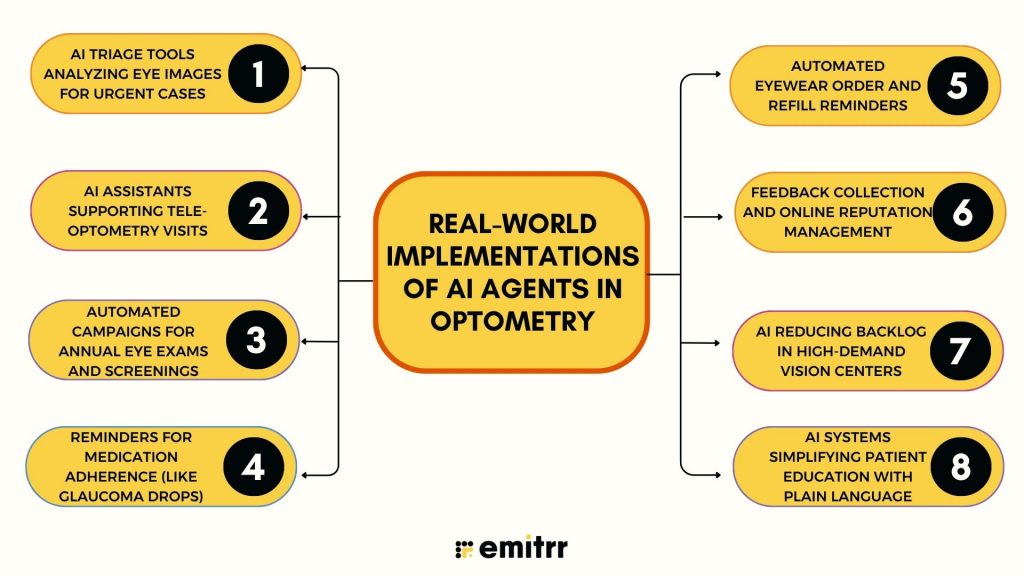
AI Triage Tools Analyzing Eye Images for Urgent Cases
Patients can now upload photos of their eyes when they notice something unusual, like sudden floaters or redness. AI-powered triage tools can analyze these images and flag urgent problems such as retinal detachment or bleeding. If something serious is detected, the patient can be contacted right away and directed to emergency care. On the flip side, minor issues can be scheduled for routine visits, saving unnecessary ER trips.
AI Assistants Supporting Tele-Optometry Visits
Tele-optometry is growing fast, and AI is playing a big support role. Before a video consult, the AI assistant can collect patient history or run simple screening questions. During the visit, it can fetch records or images, acting like a digital scribe. Afterwards, it sends patients a clear summary of the next steps. No more forgetting what the doctor said. By combining telehealth platforms and AI, clinics can extend quality care to rural or underserved areas.
Automated Campaigns for Annual Eye Exams and Screenings
Many patients forget their yearly eye exams, and that’s where automation steps in. AI agents can scan patient lists and send timely reminders, like “It’s been a year since your last exam, click here to book.” These messages feel personal and usually come with an easy booking link. Clinics running such campaigns have seen major improvements in reactivating lapsed patients. It’s like having a recall coordinator who never forgets and never takes a day off.
Reminders for Medication Adherence (Like Glaucoma Drops)
Glaucoma treatment often depends on patients remembering daily drops, and many forget. AI agents can send daily reminders, sometimes even asking for a quick reply to confirm the dose was taken. If patients skip too often, the AI can alert the clinic to follow up. It feels like having a friendly coach making sure patients stick to their care plan. By using AI for patient follow-ups and post-visit care, clinics improve outcomes between visits.
Automated Eyewear Order and Refill Reminders
Contact lenses and glasses need timely updates, but patients often delay. AI agents track purchase timelines and send reminders before supplies run out. “You’re almost out of contacts, ready to reorder?” is all it takes to avoid gaps. For glasses, reminders may highlight new styles or suggest an exam if the prescription is old. These nudges don’t just drive revenue, they also ensure patients don’t go without vision correction.
Feedback Collection and Online Reputation Management
AI makes collecting reviews easy and consistent. After visits, it automatically sends patients a short survey or a polite review request. Positive responses can be routed straight to Google or Yelp, boosting online reputation. If feedback is negative, the AI quietly captures it and alerts staff so issues can be fixed privately.
AI Reducing Backlog in High-Demand Vision Centers
Busy clinics often struggle with backlogs and long waits. AI helps by optimizing schedules, predicting no-shows, and even overbooking smartly when patterns suggest a cancellation. Some systems also act as AI scribes, drafting visit notes so doctors can see patients faster. The result is more patients seen without overwhelming the staff. Clinics using this approach often free up dozens of extra slots each month.
AI Systems Simplifying Patient Education with Plain Language
Patients often forget what was explained during their visit. AI helps by being available 24/7 to answer questions in plain language. Instead of using medical jargon, it explains conditions in easy terms and even shares tips like the 20-20-20 rule for screen time. This way, patients stay informed and engaged while staff spend less time repeating the same answers.
How Does Emitrr Help Optometry Practices with an AI Agent?
Emitrr acts like a smart, always-on AI agent for optometry practices, handling the busywork so your team can focus on patient care.
- Always available: No more missed calls or voicemails, Emitrr answers patients 24/7 across calls, texts, and email.
- Smart scheduling: Patients can instantly book, confirm, or reschedule eye exams with no phone tag.
- Automated reminders & recalls: From annual vision checks to lens refills, Emitrr reduces no-shows with timely nudges.
- Digital intake forms: Emitrr uses AI for patient intake in optometry. Patients complete forms online, and the AI organizes everything neatly before the visit.
- Instant FAQs: Common queries like insurance accepted, hours, or post-dilation care are answered on the spot.
- Insurance & billing help: Emitrr verifies coverage during booking and follows up with secure payment reminders like a billing virtual assistant.
- Real-time schedule optimization: Last-minute cancellations are auto-filled from the waitlist, keeping calendars full.
- Scales with your practice: From solo optometrists to multi-location clinics, Emitrr grows with you.
- Reputation growth: Feedback surveys and review requests go out automatically, boosting online ratings.
- HIPAA-compliant AI agent: All patient data and images are encrypted, ensuring healthcare-grade privacy.
- Affordable plans: Emitrr offers cost-effective pricing that fits practices of all sizes, so you don’t need a big IT budget.
- Dedicated customer support: The Emitrr team helps with setup, training, and troubleshooting, making sure your clinic runs smoothly at all times.
In short, Emitrr is like having a superstar AI-powered receptionist, scheduler, and patient coordinator rolled into one. It keeps your clinic efficient, your staff less stressed, and your patients happier.
Future Trends in AI-Powered Optometry Care
The intersection of AI and optometry is only getting more exciting. As tech evolves, smarter tools will make eye care more proactive, connected, and personal.
Predictive AI for Monitoring Chronic Eye Conditions (Glaucoma, AMD)
AI is moving from spotting problems to predicting them. For glaucoma or AMD, it can analyze scans and history to forecast progression. This helps doctors decide sooner whether to act aggressively or just monitor closely. The role of AI in optometry here is proactive care – stopping issues before they worsen.
AI Agents Integrating with Smart Glasses and Eye Health Wearables
Smart glasses and contact lenses are starting to track vision changes and eye pressure. AI could sync with these devices, turning daily data into alerts or reminders for patients and doctors. It’s like having eye care that follows you outside the clinic, keeping watch 24/7.
Patient Journey Mapping for Long-Term Vision Outcomes
AI can connect the dots across a patient’s journey, from exams to lifestyle habits. By spotting patterns, it can flag risks early and keep patients on track with recalls or screenings. It feels like having a personalized roadmap for your eyesight, not just a one-off appointment.
Agentic AI Coordinating Care with Ophthalmologists and Other Specialists
Referrals and co-management often get messy, but AI can smooth it out. It could prep referral notes, send secure texts, and make sure follow-ups happen on time. The role of AI in optometry becomes that of a behind-the-scenes coordinator, ensuring patients get the right care without delays.
Frequently Asked Questions
Yes! AI agents for healthcare encrypt data, use secure access, and follow privacy laws, keeping sensitive eye images and health info safe.
It’s like adding a 24/7 team member. Scheduling, reminders, and FAQs get handled, staff stress drops, and patients stay happier.
AI scans retinal photos or (Optical Coherence Tomography) OCTs in seconds to flag glaucoma, AMD, or diabetic retinopathy. It’s like a second set of expert eyes.
Emitrr keeps patients connected through calls, texts, and emails. Instant replies, reminders, and follow-ups make communication super smooth and reliable.
Absolutely! Emitrr collects feedback, nudges happy patients to post reviews, and flags issues privately so you can fix them fast.
Conclusion
AI agents are already reshaping how optometry works. They reduce wait times, keep patients engaged, and even help spot eye diseases earlier, all while easing the workload for staff! But they’re not here to replace people. They give doctors and teams more space to focus on the parts of care where empathy and human judgment really matter.
The future of eye care is about blending human expertise with smart technology. With Emitrr AI, clinics can run smoothly, patients feel supported, and practices deliver a truly modern experience. So, are you ready to let Emitrr AI do the heavy lifting? Book a time with Emitrr AI today and see how simple eye care operations can be!