
Introduction
Care gaps occur when recommended healthcare is overdue, incomplete, inaccessible, or missing from the patient’s record. These gaps may involve preventive screenings, chronic disease monitoring, medication reviews, referrals, follow-up appointments, or care after discharge.
Care gap management helps healthcare organizations identify these gaps and move patients toward the appropriate next step. However, identifying a gap is only the beginning. Teams must validate the information, prioritize patients, assign responsibility, coordinate care, engage the patient, and confirm whether the recommended care was completed.
This guide explains what qualifies as a gap in care, how care management supports care gap closure, and the step-by-step process for identifying, tracking, and closing gaps. It also covers care management models, care-team responsibilities, common challenges, and how communication automation can support workflow execution.
AI Summary
- Care gap management identifies, validates, prioritizes, tracks, and resolves missing or incomplete care.
- Care management is the broader framework, while care gap management addresses specific unmet care needs.
- Common gaps involve preventive care, chronic conditions, medications, referrals, follow-ups, and care transitions.
- The care gap workflow includes defining, identifying, validating, prioritizing, assigning, engaging, coordinating, documenting, tracking, and improving.
- Care plans help align recommended actions with each patient’s needs, preferences, and barriers.
- Technology can identify and track gaps, but coordinated workflows and patient participation are required to complete care.
- Emitrr supports reminders, follow-ups, scheduling, patient communication, and workflow execution.
What is Care Gap Management and How Does it Help Close Gaps in Care?
Care gap management is the systematic process of identifying missing, overdue, incomplete, or undocumented care and coordinating the actions needed to resolve it. It connects an identified need with a patient-level action, such as scheduling a screening, completing a laboratory test, attending a referral appointment, or receiving a medication review.
Care gap identification does not mean the gap has been verified. A service may have been completed outside the organization, a result may not have reached the electronic health record (EHR), or the patient may qualify for an exclusion. The care team must confirm that the gap is valid before beginning follow-up.
Similarly, patient contact does not equal care gap closure. Sending a reminder or scheduling an appointment shows that the workflow is progressing, but the recommended care may still be incomplete. Care gap tracking should continue until the organization can classify the outcome as completed, declined, deferred, excluded, completed elsewhere, or unresolved.
Closing gaps in care involves both clinical and operational responsibilities. Clinicians determine whether a service is appropriate and review clinical questions. Care managers, coordinators, referral teams, pharmacists, nurses, medical assistants, and administrative staff support patient contact, scheduling, coordination, documentation, and follow-up.
What Counts as a Gap in Care?
A gap in care exists when recommended or planned healthcare is overdue, incomplete, inaccessible, or absent from the available record. The requirement may come from clinical guidelines, payer quality measures, an individualized care plan, or an organization’s approved protocols.
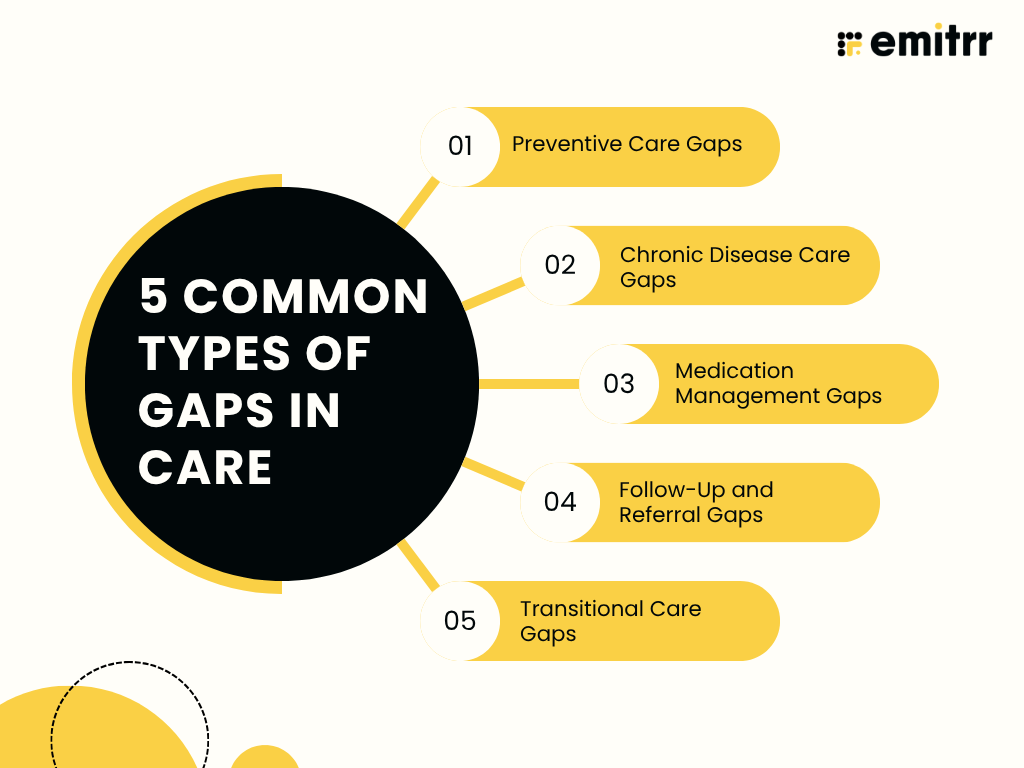
However, an apparently open gap is not always a genuine care gap. A patient may have completed the service elsewhere, an external result may be delayed, or duplicate records may have created an inaccurate flag. Validating the information before contacting the patient reduces unnecessary outreach and helps teams work from a more reliable patient list.
Preventive Care Gaps
Preventive care gaps involve services intended to support prevention or early detection. Common examples include:
- Overdue screenings
- Missing vaccinations
- Incomplete annual wellness visits
- Missed preventive examinations
- Delayed early-detection services
Teams should confirm that the patient remains eligible for the service and check for previous results, documented exclusions, or care completed outside the organization.
Chronic Disease Care Gaps
Chronic disease care gaps involve missing monitoring or follow-up for an ongoing condition. Examples include:
- Missing monitoring appointments
- Overdue laboratory tests
- Follow-up needed after an uncontrolled measurement
- Incomplete condition-specific services
- Delayed specialist involvement
The appropriate action may involve an appointment, laboratory work, medication review, updated care plan, or clinical escalation. The workflow should direct the patient to qualified staff when a clinical decision is required.
Medication Management Gaps
Medication management gaps can develop when prescribing, monitoring, reconciliation, or follow-up is incomplete. Examples include:
- Overdue medication refills
- Missing medication reconciliation
- Unresolved adherence concerns
- Missing medication-related monitoring
- Incomplete clinical review
Some medication requests can be managed through approved protocols, while others require laboratory results, a recent visit, or clinician review. Automation can collect information and route requests, but it should not make independent clinical decisions.
Follow-Up and Referral Gaps
Follow-up and referral gaps occur when a recommended next step does not lead to completed care or returned information. Examples include:
- Missed follow-up appointments
- Unscheduled specialist referrals
- Incomplete diagnostic testing
- Missing referral results
- Referrals that were never closed
Placing a referral order does not confirm that the patient scheduled or attended the visit. Referral tracking should continue through scheduling, attendance, results retrieval, clinical review, and documentation.
Transitional Care Gaps
Transitional care gaps may occur when a patient moves between a hospital, rehabilitation facility, primary care practice, specialist, home health service, or another setting. Examples include:
- Missing post-discharge contact
- Delayed follow-up appointments
- Incomplete medication reconciliation
- Unresolved discharge instructions
- Missing coordination between care settings
These gaps can be time-sensitive because the patient may be managing new medications, instructions, appointments, or changes to the care plan.
How Care Management Provides the Framework for Care Gap Closure
Care management is the broader process of organizing and coordinating a patient’s ongoing needs. It can include care planning, education, monitoring, medication management, follow-up, care coordination, and support as the patient’s circumstances change.
Care gap management is one operational function within that framework. It focuses on a defined difference between recommended and completed care and tracks the actions required to resolve it.
The two processes connect through care plans, assigned teams, patient engagement, coordination, and shared documentation. A care gap may become a priority within the patient’s care plan, while the broader care management process ensures that the action remains appropriate for the patient’s overall situation.
| Area | Care Management | Care Gap Management |
| Primary objective | Coordinate ongoing support around the patient’s health needs and goals | Resolve specific missing, overdue, incomplete, or undocumented care |
| Scope | Broad and longitudinal | Focused on defined gaps and actions |
| Patient population | Patients requiring organized or ongoing support | Eligible patients with an identified gap |
| Core activities | Care planning, education, monitoring, medication support, coordination, and reassessment | Identification, validation, prioritization, outreach, scheduling, tracking, and documentation |
| Responsible teams | Clinicians, care managers, nurses, coordinators, pharmacists, and support teams | The team assigned to validate, address, and document the gap |
| Completion point | Continues while the patient requires coordinated support | Ends when the gap reaches an accepted resolution status |
| Outcomes measured | Patient goals, continuity, engagement, utilization, and clinical or operational outcomes | Closure rates, completion time, unresolved gaps, and verified care delivery |
Care management also extends beyond care gap closure. A patient may still need education, monitoring, medication support, or coordination after an individual gap has been resolved.
The Role of Care Gap Management in Population Health Management
Population health management identifies needs, priorities, and patterns across a defined group of people. Care gap management converts relevant population-level findings into actions for individual patients.
For example, population health analysis may reveal low screening completion within a particular group. The care gap workflow identifies eligible patients, validates their records, assigns follow-up, supports access to the service, and documents the outcome.
Aggregate gap patterns can also reveal where needs are concentrated. Organizations may find differences across provider panels, locations, payer groups, language groups, or other population segments. These findings can guide resource allocation and workflow improvement.
Care gap closure is only one part of the larger population health strategy. Organizations that need the complete framework can review what population health management is and how it works.

The Care Management Process for Identifying and Closing Gaps in Care
The care management process should treat gap closure as a continuous workflow. Each identified need moves through defined stages until the care is completed or another valid outcome is documented.
1. Define the Care Gap
Establish the clinical, contractual, quality-related, or organizational requirement behind the gap. Define which patients are eligible, when the action is due, and what evidence is required to confirm care gap closure.
The workflow should also define possible statuses, such as open, scheduled, completed, declined, deferred, excluded, or unresolved. Clear definitions prevent teams from measuring closure differently.
2. Identify Patients With Open Gaps
Use relevant clinical, payer, referral, pharmacy, laboratory, or appointment information to create a list of patients with potential gaps. These may include preventive, chronic disease, medication, referral, diagnostic, or follow-up needs.
Confirm that each patient belongs to the eligible population. This step should identify potential gaps without becoming a detailed data-aggregation or risk-scoring exercise.
3. Validate the Gap
Check whether the recommended care was completed elsewhere, whether documentation is delayed, or whether an exclusion applies. Duplicate records and outdated information should also be resolved.
Validation prevents inaccurate outreach and allows staff to focus on patients with genuine unmet needs.
4. Prioritize Patients for Follow-Up
Prioritize open gaps according to urgency, clinical importance, due date, patient risk, and available resources. Urgent clinical needs should be separated from routine preventive opportunities.
Prioritization determines the order and level of follow-up. It does not replace clinical judgment or require the care gap workflow to perform its own detailed risk scoring.
5. Assign Ownership
Route each gap to the appropriate clinician, care manager, coordinator, referral team, pharmacist, nurse, or administrative team. The workflow should identify who is responsible for contacting the patient, who must complete clinical review, and when the case should be escalated. Every unresolved path needs a named owner.
6. Engage the Patient
Explain the recommended next step in clear language and give the patient an opportunity to ask questions. Staff should also identify barriers that may make the action difficult to complete.
Patient outreach should make scheduling or accessing care easier and support shared decision-making. Communication channels and timing should reflect consent, urgency, accessibility needs, and patient preferences.
7. Coordinate the Required Care
Connect the appointments, referrals, diagnostic tests, medication needs, services, and providers involved in addressing the gap.
Relevant information should be shared among authorized care-team members. Symptoms, medication questions, treatment decisions, and other clinical concerns should be escalated to qualified professionals.
8. Document the Outcome
Record whether care was completed, scheduled but still pending, declined, deferred, excluded, or blocked by an unresolved barrier. Unsuccessful contact attempts and care reported outside the organization should also be documented.
Updating the appropriate clinical and operational systems creates a reliable history and prevents duplicate work.
9. Track the Gap Until Resolution
Monitor scheduled services through completion. Follow up after cancellations, no-shows, incomplete tests, and unreturned referrals.
If completion cannot be verified, the gap should remain open or be reopened. A scheduled appointment or successful contact should not be reported as completed care.
10. Measure and Improve
Review closure rates, completion times, unresolved gaps, referral completion, and workflow bottlenecks. Compare results across relevant populations, providers, teams, and locations.
Care gap analytics should help explain where the process is breaking down. Low response may indicate a communication problem, while high scheduling and low completion may point to access, reminder, or follow-up issues.
Organizations can use these findings to refine ownership, escalation rules, patient communication, and care management workflows. A broader population health management implementation plan can help connect these improvements with organization-wide processes.
Care Management Programs and Models That Support Gap Closure
Different care management models support different patient populations and needs. An organization may use several models, with each incorporating relevant care gap workflows.
Preventive Care Management Programs
Preventive care management programs organize screenings, vaccinations, wellness visits, preventive examinations, and early-detection services. They focus on eligible patients with preventive care gaps and help move them toward the required service.
Case Management
Case management provides individualized support for patients with complex clinical, functional, financial, or social needs. The case manager coordinates services and monitors unresolved needs across the patient’s complete situation rather than concentrating on one isolated gap.
Disease Management
Disease management provides condition-specific support for populations with diabetes, hypertension, asthma, heart disease, or other ongoing conditions. It combines standardized monitoring expectations with follow-up based on the individual patient’s needs.
Chronic Care Management
Chronic care management supports patients with multiple chronic conditions through longitudinal care planning and coordination. Care gaps become part of the broader care plan alongside regular follow-ups, medication management, and communication among care-team members.
Transitional Care Management
Transitional care management provides short-term coordination following discharge or another change in care setting. It may involve timely contact, medication reconciliation, follow-up scheduling, and escalation of unresolved concerns.
Complex Care Management
Complex care management provides intensive multidisciplinary support for patients with substantial clinical or utilization needs. Teams prioritize multiple connected gaps and coordinate services across providers, settings, and organizations.
How Patient-Centered Care Plans Guide Care Gap Closure
A patient-centered care plan records the patient’s goals, priorities, needs, responsibilities, and agreed-upon next steps. It helps care teams consider an identified gap within the patient’s complete clinical and personal situation.
The plan may include medication, referral, preventive, chronic disease, and follow-up needs. It should clarify which actions require clinical decisions, which team members are responsible, and how progress will be reviewed.
Patient preferences and circumstances can change the appropriate action. Language, transportation, financial concerns, appointment availability, work schedules, and caregiver responsibilities may all affect whether and how care can be completed.
Two patients with the same care gap may therefore need different workflows. One may be able to schedule independently, while another may need language support, transportation assistance, caregiver involvement, or a clinician discussion.
Care plans should be updated when patient needs or circumstances change. This prevents teams from applying the same care gap workflow to every patient without considering whether it remains appropriate.
How Care Teams and Care Coordination Support Gap Closure
Care gap closure is often a shared responsibility, but every stage should have a clearly assigned owner. Defined roles prevent duplicated outreach, missed handoffs, and uncertainty about the next action.
Clinicians
Clinicians validate clinical needs, confirm exclusions, review medication or treatment decisions, and approve appropriate interventions. They address questions that cannot be resolved through administrative or protocol-based workflows.
Care Managers
Care managers maintain care plans, monitor ongoing patient needs, prioritize unresolved gaps, and coordinate longitudinal support. They connect individual gaps with the patient’s broader health goals.
Care Coordinators
Care coordinators arrange appointments, referrals, tests, and services. They track completion across providers and care settings and escalate unresolved coordination problems.
Nurses and Medical Assistants
Nurses and medical assistants may conduct protocol-based reviews, collect patient information, complete approved follow-up, and escalate concerns requiring clinician involvement.
Referral Teams
Referral teams monitor referral scheduling, track consultation completion, retrieve results, and close the referral loop. Their involvement prevents referrals from being treated as complete when only the order has been placed.
Pharmacists
Pharmacists support medication reconciliation, identify adherence concerns, review medication-related gaps within their scope, and coordinate with clinicians when further review is required.
Administrative Teams
Administrative teams support scheduling, maintain contact information, send nonclinical reminders, and document operational outcomes. They also route patient responses to the appropriate team.
Patients and Authorized Caregivers
Patients participate in care decisions, communicate preferences and barriers, and complete agreed-upon actions. Authorized caregivers may support communication, scheduling, transportation, and follow-through when the appropriate permissions are in place.
Common Care Gap Management Challenges
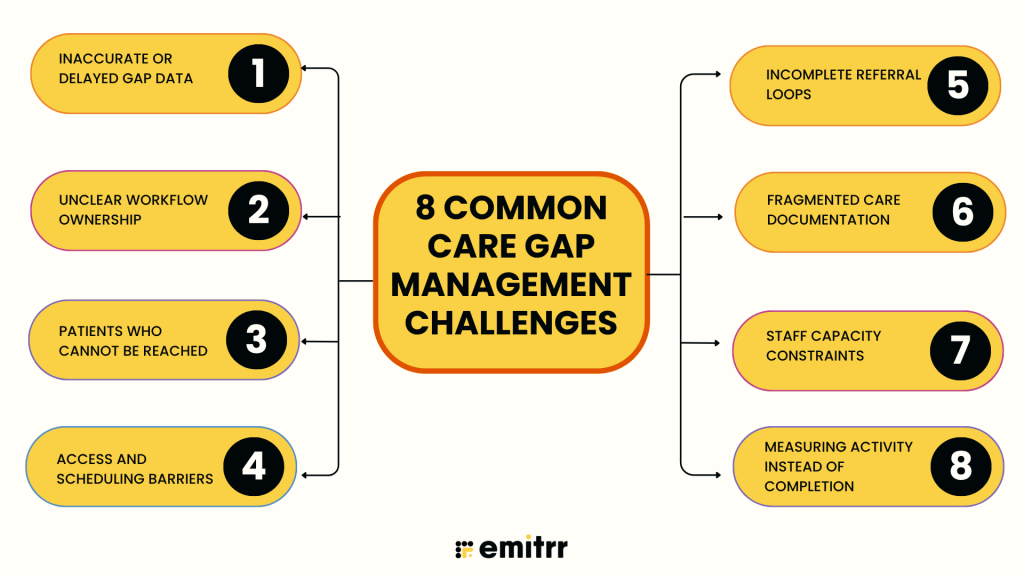
Care gap workflows often break down when data, ownership, access, and documentation are disconnected.
Inaccurate or Delayed Gap Data
Completed care may appear open because laboratory results, claims, specialist reports, or outside records have not reached the responsible system. Missing information can also produce inaccurate patient lists.
Teams should validate and reconcile information before launching outreach.
Unclear Workflow Ownership
Gaps may remain unresolved when responsibilities are divided across teams without a clear owner. The workflow should assign each action and define an escalation route when follow-up fails.
Patients Who Cannot Be Reached
Outdated contact details, low response rates, language barriers, and inaccessible communication channels can prevent patient engagement. Teams should maintain communication preferences and use permitted alternative channels when the primary method fails.
Access and Scheduling Barriers
Transportation, cost concerns, limited appointment availability, work schedules, caregiver responsibilities, and geographic access can prevent patients from completing care. Documenting these barriers separately from nonresponse helps teams identify the type of support required.
Incomplete Referral Loops
A referral may be placed without confirmation that the patient scheduled or attended. The specialist visit may also occur without documentation returning to the referring organization. Referral workflows should track scheduling, attendance, results retrieval, clinical review, and closure.
Fragmented Care Documentation
Results may be distributed across EHRs, payer portals, laboratories, pharmacies, and external provider systems. This fragmentation can make completed care difficult to verify. Interoperability can help, but teams still need a process for reconciling delayed or unavailable records.
Staff Capacity Constraints
Large patient lists can exceed available staff capacity and produce inconsistent follow-up. Prioritization, automation, and exception-based work queues can help teams focus on cases requiring direct attention.
Measuring Activity Instead of Completion
Messages sent, calls attempted, and appointments scheduled are process measures. They do not confirm that recommended care occurred.
Care gap outcomes should distinguish outreach, response, scheduling, completion, and verified closure. This is one reason the broader benefits of population health management depend on both reliable information and effective execution.
How Emitrr Automates Communication Within Care Management Workflows
Emitrr supports the communication and workflow-execution stage of care gap management. It helps healthcare organizations turn EHR events, patient lists, APIs, appointment information, and uploaded files into structured communication workflows.
Depending on the organization’s configuration and available integrations, teams can use Emitrr to:
- Automate patient reminders
- Run recall and reactivation campaigns
- Send follow-up communication
- Support two-way patient texting
- Provide appointment scheduling and rescheduling
- Convert missed calls into text conversations
- Use AI voice and SMS for scalable inbound and outbound interactions
- Send digital forms and collect required information
- Support multilingual patient communication
- Route responses through a shared inbox
- Organize work with assignments, tags, internal notes, and automated routing
- Track delivery, responses, calls, campaigns, and team performance
- Write supported information back to integrated systems where available
For example, a validated patient list can initiate an approved reminder or recall workflow. Patients can respond, ask for help, or move toward scheduling. Their replies can then be routed to the appropriate team member for clinical review, coordination, or administrative support.
A missed call related to a referral or follow-up can also trigger a text conversation instead of becoming an untracked task. Assignments and shared inboxes give teams visibility into which conversations remain unresolved.
AI can help healthcare organizations manage higher communication volumes, but it should operate within defined rules and escalation paths. The broader role of these capabilities is explored in how AI is changing population health management.
Emitrr supports patient communication and operational workflow execution. It does not provide native clinical risk scoring, replace the EHR, determine which care is appropriate, or replace clinicians and care teams.
Key Takeaways
- Care gap management connects identified needs with completed and documented care.
- Potential gaps should be validated before patient follow-up begins.
- Effective closure requires prioritization, ownership, engagement, coordination, tracking, and documentation.
- Care management provides the broader framework within which individual gaps are resolved.
- Patient-centered care plans align recommended actions with individual needs, preferences, and barriers.
- Technology can identify and track gaps, but operational workflows determine whether care is completed.
- Care gap analytics should measure verified completion instead of outreach volume alone.
- Automation can make reminders, follow-ups, scheduling, routing, and patient communication more consistent.
Frequently Asked Questions
Care gap management is the process of identifying missing, overdue, incomplete, or undocumented care and coordinating the actions needed to resolve it. The process continues until care is completed or another valid outcome is documented.
Care management coordinates a patient’s broader and ongoing health needs. Care gap management is a focused part of that process that addresses specific differences between recommended and completed care.
Preventive care gaps commonly include overdue screenings, vaccinations, wellness visits, and preventive examinations. Chronic disease care gaps may include missing monitoring visits, laboratory tests, medication reviews, or condition-specific follow-ups.
Care management workflows define the steps, responsibilities, statuses, and escalation rules needed to resolve a gap. They help teams coordinate patient contact, scheduling, services, documentation, and follow-up.
Organizations may use EHRs, population health platforms, care management software, payer quality tools, registries, referral systems, analytics platforms, and patient communication tools. The right combination depends on whether the organization needs gap identification, clinical review, care planning, tracking, outreach, or workflow execution.
Automation can support repeatable tasks such as reminders, follow-ups, scheduling communication, response routing, and escalation. It works best when gaps have been validated, communication requirements are followed, and unresolved cases are assigned to a human team member.
Conclusion
Care gap management is a continuous process that begins with identifying a potential need and continues until the outcome is verified and documented. Successful care gap closure depends on accurate information, clear ownership, coordinated workflows, patient-centered care, and patient participation.
Technology can make communication, scheduling, tracking, and follow-up more consistent, but it must support rather than replace clinical judgment and care-team responsibilities.
Emitrr serves as the communication and workflow-execution layer within care management. Book a demo with Emitrr to see how it can automate reminders, follow-ups, scheduling, and patient communication across your care gap management workflows.

 4.9 (400+
reviews)
4.9 (400+
reviews)