
 4.9 (400+
reviews)
4.9 (400+
reviews)

Hospitals deal with hundreds—even thousands—of people daily. One missed message can lead to a no-show, a delay in treatment, or worse, a frustrated patient.
Traditional communication methods just don’t cut it anymore. People respond to texts faster than emails or phone calls. But if you’re picking a texting service, you need to get it right—HIPAA compliance, integration support, delivery speed, all of it matters.
This guide compares 10 reliable texting services for hospitals—what they offer, where they fall short, and which one might make life easier for your staff and patients.

Features to Look for in Hospital Texting Software
When choosing a text service for your hospital, it’s critical that the platform you select has the appropriate set of features to satisfy both the regulatory requirements of healthcare and the operational requirements of your facility.
These are the primary features to find in HIPAA-compliant texting software:

HIPAA Compliance
Protects all patient messages from being viewed by others, ensuring strict privacy requirements and confidentiality of sensitive health information, which helps build trust. Crucial to legal compliance and safe, confidential communication in healthcare facilities.
Two-Way Patient Texting
Facilitates direct, real-time communication among providers and patients. Two-way communication enhances engagement, improves satisfaction, and streamlines scheduling, questions, and notices—avoiding unneeded office visits and improving patient experience overall.
EHR/EMR Integration
Syncs messaging systems with others such as Epic and Athenahealth in order to accelerate communication, avoid manual entry, and provide a consistent and reliable patient record through administrative and clinical processes.
Auto-Reminders and Scheduling
Provides auto-appointment reminders, confirmations, and follow-ups via text. Lowers no-show rates, increases the rate of visits, and diminishes the load of administrators through the automation of patient scheduling as well as increased communication overall.
Staff Communication Features
Facilitates secure, real-time messaging among healthcare professionals. Enforces shift coordination, patient notifications, and emergency notifications, ensuring smooth internal communications and increased hospital efficiency and quality of care.
Voice and SMS Support
Blends text and voice options in one platform, allowing patients to use their preferred communication mode. Enhances flexibility, convenience, and satisfaction among different patient populations and preferences.
Templates and Automation
Provides reusable templates and automated messages for frequent patient interactions. Saves staff time, streamlines communication, and facilitates efficient, scalable outreach without compromising personalization or professionalism.
Opt-In/Opt-Out Management
Streamlines consent management for SMS messaging. Maintains TCPA compliance by making it simple for patients to opt in or opt out, safeguarding privacy, and honoring patient communication preferences.
Analytics and Reporting
Offers real-time metrics on engagement, delivery, and patient response. Facilitates optimization of messaging strategies, monitoring of performance, and improvement of communication effectiveness through data-driven decisions.
Multilingual Messaging
Enables sending of texts in different languages, ensuring that patients are delivered critical information in their own language. Enhances accessibility, engagement, and satisfaction among linguistically diverse healthcare populations.
Security & Compliance Requirements for HIPAA-compliant Texting Apps
Hospitals manage a huge volume of sensitive patient information, and therefore, any texting service they utilize must be compliant with strict security and compliance regulations. Below is a comprehensive analysis of the main security and compliance requirements of HIPAA texting apps:
HIPAA-Compliant Messaging
HIPAA-compliant messaging guarantees that every patient communication is under the cover of firm security protocols, ranging from encryption during transmission to encryption while stored. The protection shields critical data like medical records, diagnoses, and treatment plans from breach or unauthorized access.
If you want a clearer picture of how HIPAA-compliant texting works in practice, this short video explains the essentials.
Role-Based Access Control (RBAC)
Role-Based Access Control (RBAC) restricts access to patient information according to the user’s role in the organization. This implies that only approved staff—e.g., healthcare professionals or administrators—can view sensitive data, minimizing the chances of internal data breaches and maintaining data security.
Data Encryption
Encryption of data keeps any text messages that have confidential information safe from interception and in storage within the system. The encryption keeps such information away from unauthorized access to allow only those people who should see the message, like the patients or health professionals.
Audit Trails and Reporting
Audit trails and reporting give a comprehensive record of all communications sent and received through the texting platform. These records are necessary for compliance audits, enabling hospitals to remain transparent and monitor all interactions to ensure patient privacy is maintained at all times.
TCPA Compliance
The Telephone Consumer Protection Act (TCPA) requires that patients be able to opt in or opt out of receiving text messages. Compliance with this regulation avoids potential legal problems and ensures that patients are in control of the kind of communication they receive from healthcare providers.
Business Associate Agreements (BAAs)
A Business Associate Agreement (BAA) is a binding legal agreement between the hospital and the texting service provider. It obliges the provider to comply with HIPAA guidelines, protecting patient information and ensuring that the provider will be liable for any violation or leakage of privacy rules.
Integrations Required for Hospital Texting Platforms
For a HIPAA-compliant apps to make life easier for hospital teams, it needs to plug into your existing systems, not work in isolation. The right integrations help automate communication, reduce manual work, and keep everything in sync.
Here are the key integrations that matter:
- EHR/EMR Systems: Integrates with systems such as Epic, Athenahealth, and DrChrono to enable simple management of patient information and communication.
- CRM Systems: Integration with CRM solutions like Salesforce Health Cloud or Zoho CRM aids in managing patient interactions and maintaining a single patient database.
- RCM (Revenue Cycle Management): Integration with RCM software can enable billing and payment reminder automation, improving revenue cycle management.
- Telemedicine Platforms: Telemedicine has become popular, and most hospitals are using telemedicine, which makes integration with telehealth software necessary for uncomplicated communication with patients.
- Online Scheduling Systems: Integration with scheduling software allows hospitals to remind and confirm appointments with automated reminders and messages.
- Survey Tools: Integration with tools such as Zonka Feedback or Survicate can enable hospitals to collect patient feedback via text messages.
- Custom APIs: Custom APIs enable hospitals to integrate text messaging services with proprietary systems and customize workflows to their unique requirements.
How Texting Software Helps Hospitals?
HIPAA-compliant texting platforms offer several benefits to hospitals, changing the way healthcare professionals communicate with patients. Some of the main ways that HIPAA-compliant texting for medical professionals software is useful are:
Reduces Appointment No-Shows
One of the strongest benefits of HIPAA-compliant text messaging apps is decreasing no-shows for appointments. Text reminders, automatically sent to patients before appointments, prevent forgetfulness.
Text reminders provide patients with plenty of time to rebook or confirm appointments, decreasing no-show rates by as much as 38%. This benefits hospital revenues and minimizes wasted resources.
Reduces Admin Workload
Hospital personnel usually spend a significant amount of time sending reminders manually for appointments, test results, and follow-ups. Texting platforms eliminate this through automation, which cuts down on administrative time.
The system frees up precious time for healthcare personnel to devote themselves to direct patient care with automated appointment or follow-up reminders, enhancing operational efficiency overall.
Boosts Patient Engagement and Satisfaction
Patients appreciate the convenience and instantaneity of receiving text messages. Whether a reminder for an upcoming appointment, lab result, or health advice, HIPAA-compliant texting app allows for a direct channel of communication that’s efficient and quick.
This improves patient satisfaction by providing a more personal, convenient, and timely communication channel. Text messaging also leads to improved engagement since patients are more likely to read a text than an email or phone call.
Enables Quicker Clinical and Billing Communication
Texting allows for quicker communication between patients and healthcare providers. Whether it is alerting a patient to their test results, transmitting clinical instructions, or providing billing notifications, the efficiency and speed of texting software make both clinical and administrative workflows faster.
This ensures that essential information is transmitted to patients quickly, eliminating delays and enhancing the overall patient experience.
Supports Emergency Broadcasting and Remote Consultation
During emergencies, including breaking health alerts or lab results, texting software offers a safe method to instantaneously inform a sizable group of patients or employees. Text messaging enables hospitals to send crucial information in real-time, informing all concerned parties instantly.
Additionally, texting enables remote consultations, enabling patients and physicians to converse efficiently and safely, particularly where in-person consultations are impractical.
Scalable Communication
Text messaging software also makes scalable communication possible for tasks such as clinical trial recruitment and mass health alerts. Hospitals can send a broad audience important information in a short time, including the availability of new clinical trials or public health notices.
This is especially useful for research reasons and public health campaigns, facilitating easier involvement of broader people.

How to Choose the Right Texting Software for Hospitals
Choosing the appropriate texting software for hospitals necessitates a thorough analysis to verify that the solution fits your hospital’s needs, objectives, and operational processes. The following are the most important factors to be considered when choosing HIPAA-compliant messaging apps:
Patient Volume and User Count
Select a platform that will be able to manage your hospital’s patient volume and support an increasing user base. Look at software scalability so that it can keep pace with the needs of your hospital as patient volumes and user numbers grow with time.
Automation and Workflow Features
Search for texting software with strong automation features for tasks such as appointment reminders, patient follow-ups, and test results. Automation is a time-saver, minimizes human error, and enhances overall operational efficiency through automating mundane communication tasks. AI is making big waves in healthcare. If you’re wondering what that actually looks like, where it helps, where it struggles, and how it impacts patient care, this video offers a clear breakdown.
Customer Support
Assess the customer onboarding and support procedures of the texting platform. A good support system, training materials, and quick helpdesk support guarantee problem-free implementation and troubleshooting, essential for ensuring business continuity.
Reviews by Other Healthcare Providers
Before making the decision, read reviews and comments from other healthcare providers on platforms like G2 and Capterra. This kind of information offers valuable feedback regarding the performance, ease of use, and customer satisfaction of the software, allowing you to make an informed decision.
Budget and Scalability
Look at both the cost structure and scalability features of the texting software. Ensure the solution is within your hospital’s budget and offers the ability to scale in the future without having to pay unnecessary expenses, particularly for growth.
Top 10 Texting Services for Hospitals Compared
Hospitals are embracing texting services to enhance real-time communications, patient engagement, and operations. These services provide HIPAA-compliant messaging, integration with EHRs, and secure patient and staff communication.
Below is a brief summary of the top 10 hospital texting services, as well as their features, advantages, disadvantages, and cost to assist you in choosing the one that suits your needs.
1. Emitrr : Best Texting Competitor

Emitrr is one of the best HIPAA-compliant text messaging app, intended to automate communication . Multiple channels of communication are supported through the service, including voice calls, email, and SMS, and so the platform would suit hospitals looking to communicate with patients in volume.
Features:
- Multi-channel communication: Coordinates SMS, voice calls, email, and social media communication from one dashboard.
- Appointment reminders and follow-ups: Gives reminders to patients for appointments and follow-ups to minimize no-shows.
- EHR integration: Syncs with leading Electronic Health Records (EHR) systems to make patient communication seamless.
- HIPAA-compliant: Presents secure messaging adhering to HIPAA guidelines for patient privacy and data security.
- Feedback and survey tools: Gather patient feedback and satisfaction surveys to enhance care delivery.
- Multi-language support: Accommodates multiple languages to facilitate improved communication with culturally diverse patient populations.
Pros:
- Comprehensive multi-channel communication.
- Seamless EHR integration.
- Easy setup and customization with no need for advanced technical expertise.
- Improves patient engagement and reduces administrative workload.
Cons:
- Some advanced features may require additional configuration and setup.
- Limited customization for certain communication flows.
Pricing Plans:
- Standard Plan: $20/user/month. Includes 1,000 minutes, mobile app, call routing, queues, recording, and business hours routing. Best for teams needing essential call management without extra cost.
- Professional Plan: $25/user/month. Adds IVR, call transcription, auto-text for missed calls, conference calling, and HIPAA compliance. Ideal for businesses that need advanced tools for better service and secure communication
Reviews: 4.7 out of 5 stars on G2
2. Artera (formerly WELL Health)

Artera, formerly WELL Health, is a hospital communication platform designed to increase patient engagement and optimize healthcare workflows. It provides a broad set of features, ranging from appointment reminders to real-time messaging and patient surveys.
Features:
- Two-way texting: Facilitates safe communication between patients and healthcare providers.
- Appointment scheduling and reminders: Automates appointment reminders, confirmations, and follow-ups.
- Integration with EHR systems: Enables seamless integration with top EHRs, including Epic and Cerner.
- Patient surveys: Captures patient feedback to measure satisfaction and enhance quality of care.
- HIPAA-compliant: Provides secure, encrypted messaging.
Pros:
- Robust EHR integration and workflow automation.
- Easy-to-use interface and intuitive setup.
- High patient engagement through SMS and patient surveys.
Cons:
- Some users report a steep learning curve during initial setup.
- Limited reporting capabilities.
Pricing:
Pricing is not publicly listed. Contact Artera’s sales team to get a custom quote based on your hospital’s needs and scale.
Reviews: 4.9 out of 5 stars on G2
3. QliqSOFT

QliqSOFT provides a secure, HIPAA-compliant communication platform for healthcare organizations. It facilitates SMS, email, and secure messaging, in addition to real-time updates and appointment reminders.
Features:
- HIPAA-compliant secure texting.
- Telemedicine support: Enables virtual consultations and messaging with patients.
- Automated appointment reminders and follow-up messages.
- EHR and CRM integration.
- Multi-user support with role-based access controls.
Pros:
- Easy to integrate with existing EHR systems.
- Comprehensive telemedicine and messaging features.
- High levels of security for patient data.
Cons:
- Initial setup and configuration can be complex for smaller practices.
- Reporting features may not be as advanced as competitors.
Pricing:
Pricing details are not publicly available. You’ll need to contact QliqSOFT’s team to get a quote customized to your organization’s requirements.
Reviews: 4.6 out of 5 stars on G2
4. Dialog Health

Dialog Health, a HIPAA text messaging app, provides safe messaging and communication solutions specific to the healthcare sector. This system supports safe text communication for hospitals, enhancing patient interaction and decreasing administrative burden.
Features:
- Secure, HIPAA-safe messaging.
- Real-time patient communication for appointment reminders, medication, and lab results.
- EHR system integration for effective data management.
- Automated workflows for enhanced patient outreach and communications.
Pros:
- Simple user interface.
- Cost-effective and suitable for smaller healthcare organizations.
- Seamless integration with EHR systems.
Cons:
- Limited customization options for advanced workflows.
- Basic reporting capabilities.
Pricing:
Dialog Health does not list pricing publicly. To receive a personalized quote tailored to your organization’s size and communication needs, you’ll need to contact their sales team directly.
Reviews: 5 out of 5 stars on Capeterra
5. Curogram

Curogram is a HIPAA-compliant text messaging app that enables hospitals and clinics to manage SMS, email, and voice communication in a HIPAA-compliant manner. It supports appointment scheduling, reminders, and patient follow-ups.
Features:
- Secure texting with full HIPAA compliance.
- Integrated patient appointment scheduling and reminders.
- Two-way SMS for direct patient-provider communication.
- EHR and CRM integrations.
- Automated workflows for patient engagement and follow-ups.
Pros:
- User-friendly interface with easy implementation.
- Comprehensive communication features for managing patient interactions.
- Highly customizable for different healthcare workflows.
Cons:
- Some advanced features may require additional costs.
- Limited customer support during off-hours.
Pricing:
Curogram doesn’t display pricing on its website. Plans vary based on your practice size and required features. You’ll need to request a custom quote from their sales team to get exact pricing tailored to your needs.
Reviews: 5/5 stars on Capterra
6. OhMD
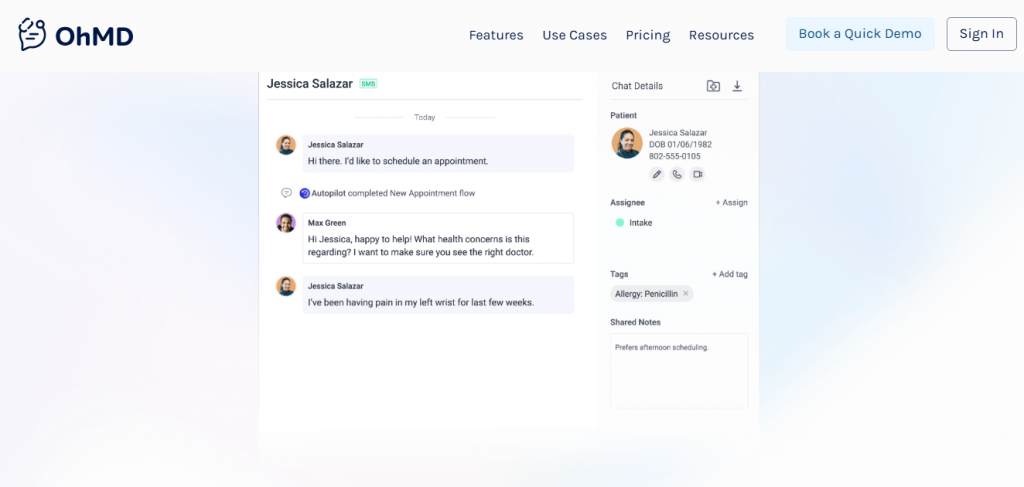
OhMD is a secure HIPAA-compliant messaging app for hospitals that allows seamless communication with patients via SMS, email, and secure messaging. It is designed to be HIPAA-compliant and offers features for appointment reminders, patient follow-ups, and engagement.
Features:
- HIPAA-compliant messaging.
- Appointment reminders and confirmations.
- Secure two-way texting for patient-provider communication.
- Integration with EHR systems for seamless workflow.
- Automated patient surveys for feedback and improvement.
Pros:
- Simple and intuitive interface.
- Ideal for small to medium-sized healthcare practices.
- Robust customer support and onboarding resources.
Cons:
- Lacks some advanced reporting and analytics features.
- Limited customization for certain communication templates.
Pricing Plans:
- Basic Plan: Free and best suited for smaller practices just getting started with secure communication. It includes unlimited in-app messaging between providers and patients (patients must download the OhMD app), supports up to 15 team members, and offers both desktop and mobile access.
- Reach Plan: OhMD pricing starts from $250/month. Built for practices that need more flexibility and patient accessibility. It enables two-way SMS texting—no app download required—along with text-from-landline functionality, live website chat, and automated message workflows.
Reviews: 4.8/5 stars on G2.
7. RocketChat

RocketChat is an open-source communication platform that offers HIPAA-compliant secure messaging. It allows healthcare organizations to communicate with patients and staff via text, voice, and video calls, all within a single platform.
Features:
- Open-source platform with HIPAA-compliant secure messaging.
- Video and voice calls for telemedicine.
- Integration with EHR and CRM systems.
- Customizable workflows and automation.
- Multi-channel communication via text, voice, and video.
Pros:
- Open-source flexibility and customization.
- Suitable for large healthcare organizations with technical expertise.
- Offers voice, video, and text communication.
Cons:
- Requires technical expertise for setup and management.
- It may not be as intuitive for non-technical users.
Pricing:
- Starter Plan: Free. Includes modern chat features (text, audio/video messaging, reactions, file sharing), and unlimited chat and file history, among other features. Best for organizations with strict security needs like government or critical infrastructure sectors. Supports up to 50 users.
- Pro Plan: Custom Quote. Includes everything in the Starter Plan, plus advanced hosting options (premium and dedicated), white-label branding, and standard support with a 1-business-day SLA (12×5 via Desk Portal).
- Enterprise Plan: Custom Quote. Includes everything in the Pro Plan, plus privacy-first AI capabilities, guest user access, and premium support add-ons (Support+ and Mission Critical options).
Reviews: 4.2/5 stars on G2.
8. TextUs

TextUs is a messaging platform designed for healthcare providers to communicate with patients securely via SMS. It focuses on real-time messaging for patient reminders, inquiries, and appointment confirmations.
Features:
- HIPAA-compliant secure texting.
- Real-time communication for appointment reminders and inquiries.
- Automated workflows for follow-up messages and patient engagement.
- Multi-user support and role-based access controls.
Pros:
- Easy-to-use interface with fast setup.
- Robust real-time messaging capabilities for patient communication.
- Integrates with various healthcare tools and EHRs.
Cons:
- Limited multi-channel communication options compared to other platforms.
- Basic reporting features.
Pricing:
- Essential Plan: Textus pricing starts from $49/month. Includes 1,000 messages, free incoming texts, two-way messaging, SMS campaigns, shared inboxes, unlimited users/contacts, mobile access, and analytics. Requires a $300/month minimum spend across lines/messages.
- Plus Plan: $69/month. Everything in Essential, plus MMS messaging, branded link shortening, unlimited keywords, automated sequences, integrations, and full API access. Best for growing teams needing advanced messaging automation.
Reviews: 4.7/5 stars on G2.
9. Symplr

Symplr offers a secure communication platform for healthcare organizations, focusing on patient engagement, appointment reminders, and HIPAA-compliant messaging.
Features:
- Secure messaging with HIPAA compliance.
- Appointment reminders and confirmations.
- Patient surveys and feedback collection.
- EHR integration for improved workflow.
Pros:
- User-friendly interface with strong patient engagement tools.
- Integrates with major EHR systems.
Cons:
- Limited customization options for some features.
Pricing:
Symplr doesn’t list pricing publicly. Since solutions are customized based on the size and needs of your healthcare facility, you’ll need to contact their team for a tailored quote and feature package.
Reviews: 4.3/5 stars on G2.
10. TigerConnect

TigerConnect is a secure messaging platform designed for healthcare providers to improve communication and streamline patient care. It offers encrypted messaging, appointment reminders, and real-time updates.
Features:
- HIPAA-compliant secure messaging.
- Real-time messaging and appointment reminders.
- Integrates with EHR systems for seamless communication.
- Patient satisfaction surveys and feedback.
Pros:
- Strong security features for HIPAA compliance.
- Integrates with a variety of healthcare systems.
- User-friendly interface.
Cons:
- Limited customer support for small practices.
Pricing:
TigerConnect offers customized pricing based on the number of users and required features. To receive an accurate quote, you’ll need to contact their sales team for a personalized demo and pricing package.
Reviews: 4.5 out of 5 stars on G2
Why Emitrr Is the Best Hospital Texting Software?
Emitrr is the leading texting software for hospitals due to its being specifically designed to serve the intricate communication requirements of the healthcare sector. The following explains why Emitrr is the first choice:

Specifically Designed for Healthcare Workflows
Emitrr is created with healthcare-focused communication workflows in mind, ranging from appointment reminders, patient follow-ups, lab result alerts, and staff coordination. It optimizes hospital communication without interrupting clinical workflow.
HIPAA, TCPA, and SOC-2 Compliant
Emitrr maintains complete adherence to essential healthcare regulations. Its HIPAA, TCPA, and SOC-2 certifications ensure that patient information is processed with maximum security, privacy, and legal compliance.
Seamless EHR/CRM/RCM Integrations
The software seamlessly integrates with Electronic Health Records (EHRs), Customer Relationship Management (CRM) software, and Revenue Cycle Management (RCM) software. This enables hospitals to consolidate patient messaging and data handling within their current tools.
Committed Customer Success and Rapid Setup
Emitrr provides white-glove onboarding and proactive customer success support. Hospitals can quickly get up and running with little IT involvement, making the process seamless and streamlined for healthcare staff.
Enables Patient Education, Surveys, Reviews, and More
In addition to basic reminders, Emitrr helps hospitals provide educational content, gather post-visit surveys, handle online reviews, and deliver targeted outreach—all through SMS or voice—increasing patient engagement and satisfaction.
Strong Ratings and Aggressive Pricing
Emitrr consistently enjoys 4.7+ star ratings across platforms such as G2 due to ease of use, support, and rich feature set. With tiered pricing options with flexibility suited to hospitals, it provides aggressive value without the quality or compliance compromises.
Frequently Asked Questions (FAQs)
Secure patient data sharing, faster communication, improved patient engagement, and operational efficiency.
It enables real-time, responsive conversations with patients, reducing no-shows and increasing satisfaction.
Compliance, automation, EHR integration, multilingual messaging, analytics, and opt-in/out management.
Implementation typically takes 1–4 weeks, depending on integrations and staff training needs.
While it can replace most non-urgent communication, voice calls may still be necessary for emergencies or detailed discussions.
For shift coordination, clinical updates, emergency alerts, and secure team communication.
Conclusion
Hospitals today must prioritize secure, fast, and reliable communication tools. HIPAA-compliant texting platforms have become indispensable in delivering quality patient care, reducing admin tasks, and staying compliant with regulations.
From enterprise-grade solutions like Artera and TigerConnect to healthcare-focused platforms like Emitrr and Curogram, the right texting service for hospitals will depend on your budget, size, and existing systems.
For an all-in-one, healthcare-native texting solution that excels in compliance, support, and integration, Emitrr is the top recommendation. Get started with a free demo and see how it transforms your hospital communication.