

Introduction
A clinician recommends an MRI, a new medication, or a planned procedure. Before care moves forward, the practice may need the patient’s health plan to review the request. This is prior authorization: a review of selected care before it is provided to determine whether it meets the plan’s applicable criteria.
For practice teams, that review involves more than sending a form. Someone must confirm the requirement, gather the right records, submit the request, respond to questions, and explain the next step to the patient. A missing document or an unclear handoff can leave both the team and the patient waiting. This blog explains what prior authorization is, why plans require it, who handles it, the main steps, required information, common delays, and what happens after a decision.
AI Summary
- Prior authorization is a health plan’s review of selected services, treatments, medications, or equipment before they are provided.
- The ordering or prescribing provider usually initiates the request, supported by staff who coordinate information and submission.
- Requests generally need current insurance details, information about the requested care, and supporting clinical documentation.
- The process moves through requirement checks, preparation, submission, payer review, a decision, and patient notification.
- Approval applies to specified care under stated conditions. It does not guarantee payment or eliminate patient costs.
- Missing information and unclear ownership can delay progress. Patients need confirmed updates and a clear next action.
What is Prior Authorization in Healthcare
Prior authorization, often shortened to PA, is a health insurer’s review of certain proposed care before the patient receives it. A payer, meaning the health plan or organization responsible for paying covered claims, evaluates the request against applicable coverage and medical necessity criteria. Medical necessity means the clinical basis for why a patient needs the requested care.
Plans may also use terms such as pre-authorization, prior approval, or pre-certification. Check how the patient’s plan defines the requirement rather than relying on the label alone.
For example, a clinician orders an MRI to investigate a patient’s symptoms. The practice checks the patient’s specific insurance plan, finds that authorization is required for the scan, and submits the requested clinical records. The payer reviews those records before issuing a decision.
PA is one part of utilization management, the broader process plans use to review the use and appropriateness of healthcare services. It is separate from the clinician’s decision to recommend care. Approval also does not guarantee claim payment: eligibility, benefits, the care actually delivered, and other claim requirements still matter. Patients may still owe deductibles, copayments, or coinsurance. When the care involves another provider, authorization is one checkpoint within healthcare referral management, alongside coordinating records, scheduling, and follow-up.
Why Insurance Plans Require Prior Authorization
Insurance plans use prior authorization to review selected care against their coverage rules and clinical criteria. This can include checking the reason for treatment, the requested setting, or whether required alternatives have been tried. The review also creates administrative work for practices, especially when different plans request different evidence.
Medical Necessity Review
The payer reviews clinical information that explains why the recommended service or treatment is needed. Depending on the request, this may include symptoms, examination findings, test results, and previous treatment responses.
A clinician’s recommendation supplies the medical basis for the request. The payer’s authorization decision determines whether that request meets the criteria applicable to the patient’s plan. Staff can assemble records, but clinical explanations and responses to medical questions belong with the care team.
Coverage Criteria for Selected Treatments
Some requests must meet additional service-specific or drug-specific requirements. A medication request may need evidence that a preferred drug was ineffective or unsuitable. A procedure request may require records supporting the proposed treatment or location.
A formulary is a plan’s list of covered medications, often with different coverage conditions. Formulary rules and previous treatment requirements can affect medication prior authorization, but they do not apply identically to every drug or patient. Two plans from the same insurer may have different requirements for the same care. For practices using Epic, Epic EMR e-prescribing provides context on medication ordering and coverage checks. Sending a prescription electronically does not, by itself, satisfy a payer’s authorization requirement.

Prior Authorization vs Referral vs Insurance Verification
Prior authorization, referrals, and insurance verification answer different questions. A patient may need all three before a specialist visit or procedure, and completing one does not replace the others. Let’s understand the difference between all three of them:
| Process | Purpose | Typical responsible party | What it does not confirm |
| Prior authorization | Obtain the payer’s decision on whether specific proposed care meets applicable authorization criteria. | Ordering or prescribing provider, supported by practice staff; payer reviews the request. | Guaranteed payment, full coverage of costs, or approval for care outside the authorization’s conditions. |
| Referral | Direct a patient to another provider or meet a plan’s requirement for access to specialist care. | Referring provider or primary care practice, depending on the plan. | That the service has prior authorization or that insurance will pay for it. |
| Insurance verification | Check active insurance coverage and relevant benefits for the planned care. | Front desk, registration, billing, or eligibility team. | That a required authorization has been approved or that a future claim will be paid. |
For example, a patient may have active coverage and a referral to an imaging center while the MRI authorization is still pending. Each result should be recorded separately so staff can identify what remains outstanding. During referral intake, record the referral, coverage check, and authorization status separately rather than treating receipt of the referral as approval for care.
Who Initiates Prior Authorization
The ordering or prescribing provider usually initiates the need for a prior authorization request. Practice staff often handle the administrative work, while the payer or its designated reviewer makes the decision. When care involves a referral, healthcare referral management also requires coordination between the ordering practice and the organization delivering care. For referral intake in specialty clinics, confirm which team owns the authorization request before preparation begins.
Ordering Providers Supply the Clinical Basis
The provider identifies the recommended care and supplies the diagnosis, relevant records, and explanation of medical necessity. If the payer asks why a treatment is appropriate or whether an alternative was tried, the clinician or qualified clinical team responds.
Administrative staff should not fill gaps in clinical justification by guessing. A diagnosis code alone may not explain why the requested treatment meets the payer’s criteria.
Practice Teams Coordinate the Request
Authorization specialists, referral coordinators, billing staff, or nurses may gather information, prepare the submission, follow up, and record the outcome. The responsible role depends on the practice’s staffing and the request type.
When another location will perform the service, both organizations should confirm who submits the request, who provides records, and who receives the decision. During referral intake, teams should record who will handle the authorization request. Sending a referral does not establish that the receiving organization has accepted that responsibility.
Payers Make the Authorization Decision
The health plan or its designated reviewer assesses the request. It may approve the care, deny it, or ask for more information before making a decision. Staff need to monitor the channel through which those responses arrive, such as a payer portal, fax, or phone call.
Patients help by providing current insurance information, requested documents they hold, and responses to practice outreach. They are not responsible for producing the clinician’s medical necessity explanation. A patient can ask for updates or help correct insurance details without taking over the clinical submission.
Services That May Require Insurance Prior Authorization
Insurance prior authorization can apply to several types of care. The following are common examples, not a universal list of services requiring approval:
- Imaging: Selected magnetic resonance imaging (MRI) or computed tomography (CT) scans.
- Procedures or surgery: Certain planned interventions or treatment settings.
- Medications: Selected prescriptions or specialty drugs, sometimes subject to formulary or previous treatment requirements.
- Therapy: Initial treatment courses or additional physical, occupational, or other therapy visits where required.
- Equipment: Selected durable medical equipment, such as particular mobility or respiratory devices.
Medication authorization can also arise during prescription refill workflows. A clinician’s approval to continue a medication and a payer’s coverage decision are separate checkpoints.
The requirement depends on the patient’s plan, requested service, and applicable rules. An insurer’s general list can help identify possible requirements, but staff should confirm the patient-specific requirement before acting on it. Emergency care follows different protections and rules; routine authorization steps should not be used to delay emergency evaluation.
Prior Authorization Requirements
A request is ready for review when it identifies the patient, the requested care, the relevant providers, and the clinical evidence the payer requires. Prior authorization requirements vary, so a practice checklist should support preparation without replacing the payer’s current instructions.
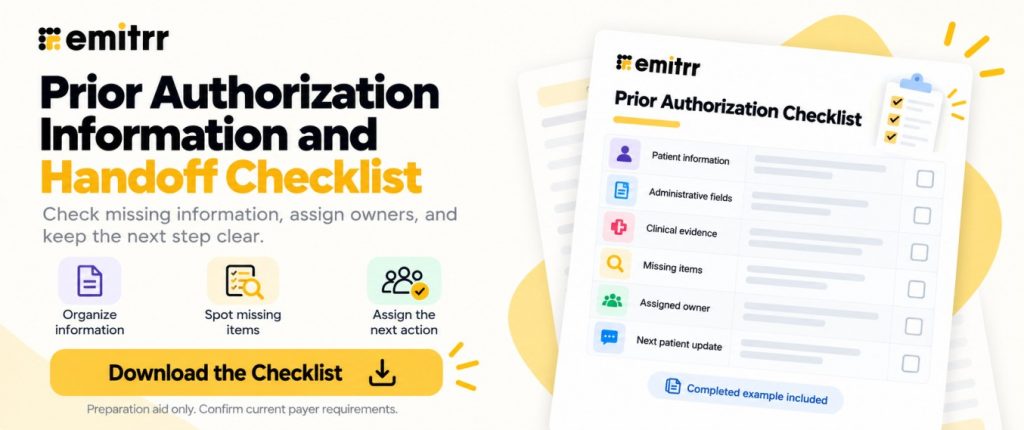
Patient Information Required for Prior Authorization
Start with the patient’s name, date of birth, insurer, member identification number, and relevant plan details. Confirm that the insurance information is current and matches the records used for the request. Keep a reliable phone number or preferred contact method for follow-up. When collecting these details digitally, use HIPAA-compliant online forms with appropriate access and privacy safeguards.
Coverage and benefits should also be checked for the planned care. Collecting an insurance card supplies information; it does not by itself verify eligibility or establish whether authorization is needed. Ask the patient about recent coverage changes before relying on an older record.
Want to collect insurance details through digital forms while protecting sensitive patient information? Watch this video to learn what to look for in HIPAA-compliant digital intake forms.
Provider Details Plus Requested Service Information
Identify the ordering provider and, where required, the servicing provider or facility. Include provider identifiers and contact details requested by the payer, along with the service, medication, or equipment being requested.
Requests may require diagnosis codes from the International Classification of Diseases, Tenth Revision (ICD-10), or procedure and service codes from Current Procedural Terminology (CPT) or the Healthcare Common Procedure Coding System (HCPCS). Qualified staff should verify the applicable codes against the clinical order.
Location, requested dates, visit counts, units, or treatment duration may also matter. A medication request may need the drug name, strength, dose, or quantity. Include the details required for that request rather than assuming every form needs the same fields.
Supporting Clinical Documentation
Supporting clinical documentation should explain the reason for the requested care and address the payer’s relevant criteria. This may include recent clinical notes, test results, treatment history, or records of previous therapies and their outcomes.
More pages do not necessarily make a stronger request. Relevant evidence is more useful than a large record set that leaves the payer’s clinical question unanswered. If the needed explanation is absent from the chart, return the question to the clinician before submission.
Payer-Specific Prior Authorization Forms
Use the current form or electronic request requirements for the patient’s plan and service. Confirm the accepted submission channel and any required attachments. Some payers use online questionnaires; others accept specified forms through a portal or fax.
Structured patient information collection can support preparation, but it remains separate from clinical justification. How to Automate Your Patient Intake Process explains how digital collection can help practices gather patient-supplied details before a visit.
How the Prior Authorization Process Works
The prior authorization process moves from checking the requirement to gathering information, submitting the request, responding to payer review, and communicating the result. Each stage should produce a clear record that tells the next person what has happened and what remains to be done.
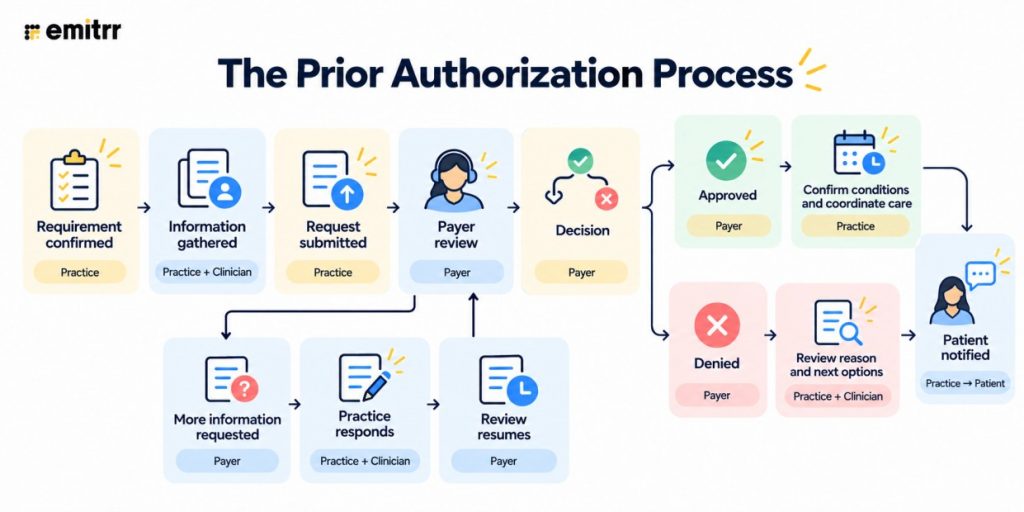
Step 1: Confirm the Authorization Requirement
Check the patient’s specific plan and the requested care using the payer’s current resources. Confirm any service, provider, or location requirements and identify the team responsible for submission.
The result of this step is a documented requirement check. If authorization is not required, record the basis for that finding rather than assuming it also applies to future services.
Step 2: Gather Prior Authorization Information
Collect the administrative details and clinical records required for the request. Compare the available information with the payer’s instructions and identify missing items before submission.
For example, a therapy request may include the proposed visit count but still lack the clinical progress note needed to support additional visits. That gap should go to the appropriate clinical owner. When the request comes through a referral intake workflow, retain the referring practice’s contact details so missing records can be requested from the right source.
Step 3: Complete Prior Authorization Submission
Submit the request through the channel accepted for that plan and service. Depending on the payer, this may be an electronic system, portal, fax, or another specified method.
Record the submission date, destination, confirmation, and reference number where available. A successful upload or fax confirmation page provides a transmission record; it does not establish approval. Check receipt and request status through the payer’s applicable process.
Step 4: Respond to Payer Review
The payer reviews the request against applicable criteria. If it requests additional documentation, identify exactly what is missing and who can supply it.
Route clinical questions to the care team and administrative corrections to the responsible staff member. Keep the request reference with the response so additional information can be matched to the correct case.
Step 5: Record the Authorization Decision
Record the actual decision rather than a verbal shorthand such as “insurance cleared.” For an approval, capture the authorization number and relevant conditions. For a denial, retain the stated reason and available review information.
Pass the decision to the team responsible for scheduling or the next review action. The person who receives the payer response may not be the person coordinating care. For referred patients, closed-loop referral management continues beyond authorization, tracking whether the visit occurred and whether the referring provider received the outcome.
Step 6: Notify the Patient of the Next Step
Explain what the decision means for the planned care. An approval may allow the team to coordinate scheduling within its conditions. A denial may require further review or a clinician-led discussion of available options.
The patient should know who will contact them next, whether they need to respond, and what happens to any appointment already on the calendar. If the practice offers online scheduling for healthcare, explain whether the patient can book now or should wait for the team to confirm the authorization conditions.
Prior Authorization Turnaround Time
There is no single prior authorization turnaround time for every request. The applicable deadline depends on the plan, benefit, service, urgency, and governing rules. The time a payer takes to review a submitted request is also different from the patient’s total wait after care is recommended.
Standard Review vs Expedited Review
Standard review generally applies to non-urgent requests. Expedited review is a faster pathway for requests meeting the applicable urgency criteria. The clinical team should assess urgency and provide supporting information when required. An approaching appointment alone does not establish eligibility for expedited review.
Beginning in 2026, CMS-0057-F sets decision timeframes for non-drug medical items and services for Medicare Advantage organizations, state Medicaid and Children’s Health Insurance Program (CHIP) fee-for-service programs, Medicaid managed care plans, and CHIP managed care entities. Subject to applicable exceptions and extension rules, the maximum timeframes are seven calendar days for standard requests and 72 hours for expedited requests after receipt. Decisions must be made sooner when the patient’s medical condition requires it.
Those timeframes do not apply universally. This rule excludes drugs from these provisions and does not impose these decision timeframes on Qualified Health Plan issuers on the federally facilitated exchanges. Other applicable rules may establish different or shorter deadlines.
Payer Review Time vs Total Elapsed Time
A patient’s wait may begin when the clinician recommends care. Staff may then need time to confirm requirements, obtain records, and prepare the submission before payer review begins.
An information request can add another exchange, but its effect on the decision deadline depends on the applicable rules. Staff should not assume that every request for more records restarts the clock or permits an extension.
For practical follow-up, record when the order was received, when the request was submitted, and the next action due. Confirm the relevant deadline for the plan and request type before promising a decision date. If the patient’s condition changes while waiting, route that concern to the clinical team. For referred care, referral scheduling delays may continue after the payer decides if outreach or scheduling remains incomplete. Track that wait separately from the payer’s review time.
Common Causes of Prior Authorization Delays
Requests can lose momentum before submission, during review, or while the decision is being passed to the next team. Understanding the specific cause helps staff take an appropriate next action.
- Incorrect request details: An outdated member ID, mismatched service code, or incorrect provider detail requires correction.
- Incomplete clinical evidence: Records are attached but do not address the clinical criteria for the requested care.
- Unclear responsibility: The ordering practice and servicing location each assume the other is handling the request.
- Missed information requests: A portal message, fax, or call does not reach the assigned person in time.
- Changes to planned care: Different dates, services, providers, locations, or insurance coverage require confirmation before the team can rely on an existing request or approval.
A status labeled “pending” does not explain which problem exists. Staff need to determine whether the request is awaiting payer review, missing records, or waiting for someone in the practice to act. That distinction also makes the patient update more useful. Practices dealing with fragmented communication in patient intake workflows should check whether missing details or unanswered messages are carried into the authorization request.
What Happens After a Prior Authorization Decision
An approval or denial changes the practice’s next action, but it does not automatically complete the administrative work. Teams must check the decision details, identify the responsible person, and explain what happens next. The table also includes pending and information-request statuses that can appear before a final decision.
| Status | Meaning | Responsible team’s next action | Patient update |
| Pending | The request is awaiting a decision. The payer may use more specific receipt or review labels. | Confirm receipt, record the reference number, and assign the next status check. | Explain that a decision is outstanding, how this affects the appointment, and when another update will be provided. |
| More information needed | The payer needs additional details or documentation to continue review. | Identify missing items, route clinical questions to the clinician, and respond within the applicable deadline. | Explain whether the practice is gathering records or the patient needs to supply information. |
| Approved | The payer has authorized specified care under stated conditions. | Record the authorization number. Check approved services, dates, visits or units, and provider or location restrictions where applicable. Coordinate care within those conditions. | Explain the next scheduling or treatment step. Clarify that approval does not guarantee payment or eliminate patient costs. |
| Denied | The payer has not authorized the requested care and has issued a denial decision. | Review the reason with the appropriate team. Determine whether correction, further review, an appeal, or a clinician-directed alternative is appropriate. | Explain the decision in plain language and identify who will discuss the available next steps. |
| Expired | The authorization’s validity period has ended. | Check whether an extension or new request is required before relying on the authorization for planned care. | Explain what needs to be addressed and how this affects the appointment or treatment plan. |
Prior Authorization Approved
Compare the approval with the planned care. Confirm the authorized service, provider or location where specified, effective dates, and approved visits or units. Record the authorization number where the responsible team can find it. Practices offering online scheduling for healthcare should confirm that the appointment being booked matches those conditions.
For example, an approval for a limited number of therapy visits should not be treated as permission for unlimited treatment. If the plan of care changes, check the authorization’s scope before relying on it. Approval also leaves benefits verification and claim requirements to be addressed separately.
Prior Authorization Denied
Review the stated reason before choosing a response. A denial related to missing information may require a different action from one based on clinical criteria or a benefit exclusion.
Depending on the plan and circumstances, available options may include correcting the request, reconsideration, a peer-to-peer discussion between clinicians, or a formal appeal. These options have different purposes and deadlines. A peer-to-peer discussion should not be assumed to replace an appeal or preserve its deadline.
Clinical questions and treatment alternatives should go to the clinician. Tell the patient who will discuss the next options without implying that further review guarantees approval.
Prior Authorization Expired or No Longer Matches the Planned Care
An appointment moved beyond the approved dates, a different service, or a coverage change can make an authorization unsuitable for the planned care. A provider or location change may also matter if the approval is tied to those details.
Confirm whether the payer requires a modification, extension, or new request. Once the responsible team establishes the next action, update the patient about any effect on scheduling. An old approval should not be carried forward without checking its conditions.
Patient Communication During Prior Authorization
Patients need to understand the current stage, who is acting, and whether they need to do anything. A useful update connects the confirmed status to the planned appointment and gives a clear time for the practice’s next update, even when the payer’s decision date is uncertain.
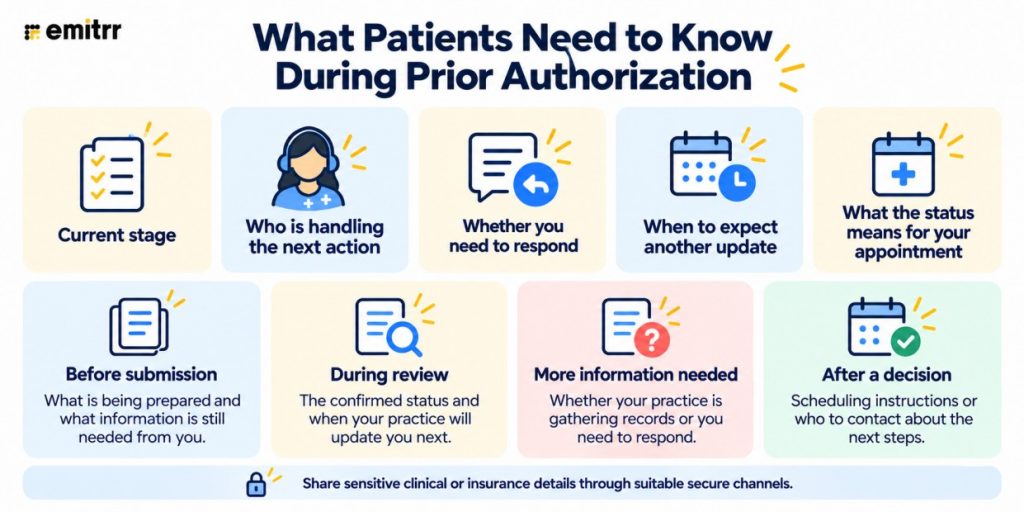
Before submission, explain that the practice is preparing the request. If a patient needs to provide updated insurance information, name that action clearly and offer a suitable way to send it. Avoid saying the request is “with insurance” when it has not been submitted.
During review, report the actual status and the next planned update. For example: “Your request is under review. You do not need to send anything right now. Our authorization team will update you by Thursday, even if the decision is still pending.” The practice should only promise a follow-up it can deliver.
When more information is needed, distinguish a staff task from a patient task. If the clinical team is gathering records, say so. If the patient needs to supply an insurance card, explain how and whom to contact for help. Patients should not have to interpret an unexplained payer status.
After a decision, explain scheduling instructions or identify the person who will discuss further review. Broader patient communication practices, including plain language and a clear response path, also apply during authorization.
Use suitable secure channels for sensitive clinical or insurance details and follow the practice’s privacy procedures and patient communication preferences. A routine notification can direct the patient to a protected conversation without including detailed medical information in an ordinary text.
Struggling with frustrated patients who are waiting for an authorization update? Watch this video for practical ways to set expectations, listen to concerns, and keep the conversation focused on the next step.
How Emitrr Supports Prior Authorization Communication
Emitrr supports the communication surrounding prior authorization: collecting patient-supplied information, organizing conversations, following up on outstanding responses, and explaining next steps from confirmed status information. The payer’s review and decision remain with the payer, while clinical justification remains with the care team.
- Two-way texting: Emitrr’s two-way texting gives patients a way to respond to information requests or ask what happens next without repeated phone calls. Staff can use the conversation to clarify an administrative question and direct sensitive details to an appropriate secure channel.
- AI phone agents: Configured AI phone agents can handle routine questions using practice-approved information, collect patient-supplied details, and route questions needing staff review. An agent should only communicate a case-specific authorization status when that status is confirmed and available through the configured process.
- Digital forms: Emitrr’s digital forms can collect insurance details and other patient-supplied information in a structured format. Staff can review those responses as part of request preparation. The clinician still supplies the medical records and explanation supporting the requested care.
- Secure Chat: Secure Chat provides a protected portal for sensitive exchanges. Routine texts can direct patients to that conversation when appropriate. Emitrr’s HIPAA-Compliant Texting supports secure communication, with the practice responsible for applying suitable procedures under the Health Insurance Portability and Accountability Act (HIPAA).
- Shared inbox with assignment: The shared inbox keeps patient conversations accessible to the responsible team. Assignment, tags, and internal notes help staff identify who owns the next response and what has already been discussed. Conversation history supports coordination alongside the clinical and authorization records maintained in the appropriate systems.
- Automated reminders and follow-ups: Configured automated reminders can follow up on outstanding patient responses, such as a request for updated insurance details. Supported workflow rules can route resulting conversations to the appropriate team. Staff should define when follow-up stops and how unresolved responses are handled; reminder activity does not establish a payer decision.
- EHR-connected communication and scheduling: Supported integrations with electronic health record (EHR) and practice management systems can connect relevant patient context, communication updates, or scheduling actions. Available data exchange depends on the integration and configuration. Teams should verify those capabilities and confirm authorization conditions before using an approval to coordinate care.
Key Takeaways
Prior authorization is easier to manage when teams distinguish the payer’s decision from the information collection and follow-up surrounding it. The essential points are:
- Requirements depend on the patient’s plan and the requested care.
- Complete administrative information supports review; clinical evidence comes from the care team.
- A named owner should coordinate submission, information requests, and follow-up.
- Approval conditions must be checked against the care being scheduled.
- Patients need confirmed status updates and a clear next action.
Frequently Asked Questions
The provider’s team usually coordinates the request, but responsibility can vary by plan and service. Patients should confirm who is handling it, especially when another facility will provide the care. The provider supplies the clinical justification.
No. Claim payment also depends on eligibility, covered benefits, the services delivered, and applicable claim requirements. Approval does not mean the patient has no out-of-pocket costs.
A practice may reserve a tentative appointment under its policies, but scheduling does not establish approval. Confirm applicable payer requirements before the service is provided and tell the patient whether the appointment depends on authorization.
Only if its terms cover that course. An approval may limit dates, visits, units, or services. Additional treatment may require another request or a change to the existing authorization.
Recheck eligibility and the new plan’s requirements. An authorization from the previous plan should not be assumed to transfer. The practice may need a new request before relying on coverage for the planned care.
Yes. Some requirements or approvals are tied to a facility, provider, or care setting. Confirm whether the new location needs an updated authorization or separate request before using the existing approval.
Conclusion
Prior authorization moves from a confirmed requirement to a documented decision, but the work continues until the patient understands the next step. Accurate information, relevant clinical evidence, clear responsibility, and timely follow-up help practice teams keep that process moving.
Emitrr supports the communication around it through patient information collection, shared conversations, reminders, and supported EHR-connected workflows. That helps teams coordinate follow-up while clinicians supply medical justification and payers make authorization decisions. Book a demo with Emitrr.


 4.9 (400+
reviews)
4.9 (400+
reviews)