

Introduction
A referral rarely fails because the receiving practice doesn’t want the patient. It fails because somewhere between the fax landing in the tray and the appointment getting booked, a step got missed, a callback never happened, or nobody noticed the referral had gone quiet.
That gap has a name: referral intake. It’s the first leg of the patient’s journey after they’ve been referred, and it’s also the stage where most of the damage happens. A practice manager can have excellent providers, a full schedule, and happy patients, and still lose a meaningful share of referred patients simply because intake wasn’t built to catch what falls through.
This guide covers what referral intake is, who touches it, where it fits relative to referral management, and why practices that get it right end up with fuller schedules and stronger referring-provider relationships.
AI Summary
- Referral intake is the process of receiving, verifying, and preparing a referral so it can move to scheduling.
- It covers everything from the moment a referral arrives, whether by fax, phone, email, or an EHR queue, through data verification and hand-off to scheduling.
- Intake is often confused with referral management, but the two are different: intake ends once a referral is ready to be scheduled, while management tracks it through to the completed visit and beyond.
- Most referral leakage traces back to weak intake, including missing information, slow follow-up, or referrals nobody is actively watching.
What is Referral Intake in Healthcare?
Definition
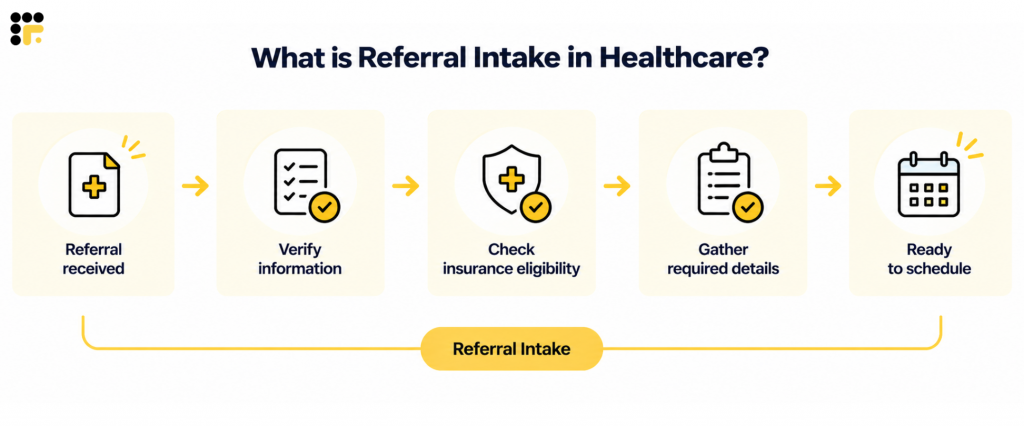
Referral intake is the process of receiving a referral, verifying the patient and clinical details attached to it, and getting that referral into a state where it can be scheduled. For practices handling a high volume of referrals, referral intake software can help organize incoming referrals, centralize patient information, and reduce the manual work involved in verifying and processing each referral. It sits at the very front of the referral journey before triage decisions are finalized, before insurance is confirmed, and long before the patient sits in a waiting room.
Purpose of referral intake
The job of intake isn’t to treat the patient or even to book the appointment. Its job is narrower and more specific: make sure the referral is real, complete, and assigned to the right place before anyone tries to act on it.
That distinction matters more than it sounds. A referral coordinator who tries to schedule a patient before confirming insurance or contact details usually ends up redoing the work later: calling back, correcting a chart, or explaining to a confused patient why their appointment got pushed. Good intake front-loads that verification so scheduling doesn’t inherit someone else’s unfinished work.
Where intake fits in the overall patient journey
Referral intake is the bridge between “a referring provider decided this patient needs to be seen” and “this patient has an appointment on the calendar.” Everything upstream of the referring provider’s decision, the clinical reasoning, and the documentation they send over happens before intake. Everything downstream scheduling, the visit itself, the note sent back to the referring provider happens after.
Because intake sits at that junction, it’s also where a lot of ambiguity shows up. Referrals arrive incomplete. Referring offices use different formats. Patients aren’t always reachable on the first, second, or third attempt. Intake has to absorb that mess before it reaches anyone else in the process.
Want to spot the gaps before they become bigger problems? Watch the video on 12 costly patient intake mistakes and how to avoid them
Referral Intake vs. Referral Management: What’s the Difference?
These two terms get used interchangeably, which causes real confusion when practices talk about fixing “referral problems” without agreeing on which part of the process they mean.
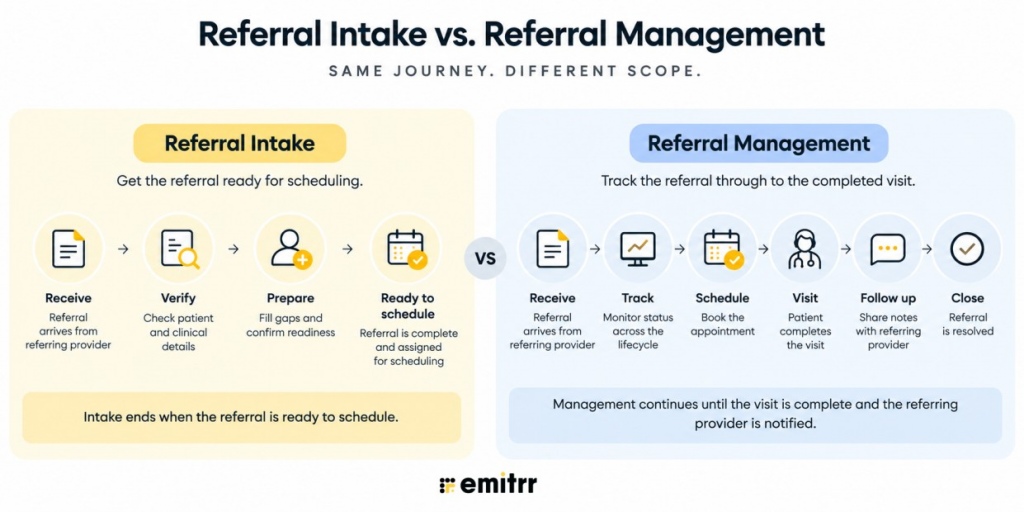
Intake is a subset of management, not a separate track. A practice can have solid intake and still lose referrals later in the process: a patient scheduled but never confirmed, or a patient no-show that nobody follows up on. For a closer look at how the two connect and where automation changes each stage, see our guide to referral intake automation.
Referral Sources and Types of Referrals
Referrals don’t arrive through one clean channel, and that’s a big part of what makes intake harder than it looks on paper.
Common referral sources:
- Fax — still the default for a large share of specialty referrals, particularly from hospital systems and older EHRs
- Email — common for non-PHI communication or as a secondary channel alongside a formal referral document
- Phone or voicemail — direct provider-to-provider referrals, particularly for urgent cases
- EHR-to-EHR or web form — increasingly common where systems are integrated, though far from universal
- Paper — still shows up, particularly from smaller referring offices
Each channel behaves differently. A fax sits in a queue until someone checks it. A voicemail requires someone to listen, transcribe, and act. A web form might land directly in a structured field. When a practice receives referrals through four or five of these channels at once, intake staff end up checking multiple places just to know what’s actually pending, which is often where referrals get missed, not lost.
Common referral types:
- Physician-to-physician — one provider referring directly to a specialist
- Self-referral — a patient seeking out a specialist directly, without a referring provider
- Inbound — referrals coming into the practice
- Outbound — referrals the practice sends to another provider
- Specialist-to-specialist — a referral between two specialty practices, often carrying more clinical documentation
Inbound intake and outbound referrals require different handling. Inbound intake is about receiving and verifying; outbound referrals are about choosing the right provider and getting documentation to them cleanly. Most of the operational pain practices report sits on the inbound side, since that’s where volume, channel fragmentation, and patient outreach all collide.

Who’s Involved in Referral Intake
Referral intake touches more people than most practices initially account for.
- Front-desk or administrative staff typically do the first pass, opening the fax, checking the inbox, and logging what came in.
- Referral coordinators carry most of the operational weight: verifying details, chasing missing information, and getting the referral ready for scheduling.
- Clinicians get involved when a referral needs clinical judgment: is this urgent, does it belong in this specialty, does something about the documentation raise a flag.
- The referring provider’s office is a silent participant throughout. If intake staff need to confirm something, that office becomes part of the back-and-forth, and delays on their end show up as delays on the receiving practice’s end too.
- The patient is obviously central, but often the hardest to reach, especially if the only contact attempt is a phone call during business hours.
- The payer enters the picture wherever insurance eligibility or prior authorization is required, which can quietly stall a referral that looks otherwise complete.
When any one of these people is slow or hard to reach, the whole referral waits. A referral coordinator can do everything right and still be stuck because the payer hasn’t responded, or the patient hasn’t picked up.
The Referral Intake Lifecycle
At a high level, most referral intake processes move through the same core stages, regardless of specialty or practice size:
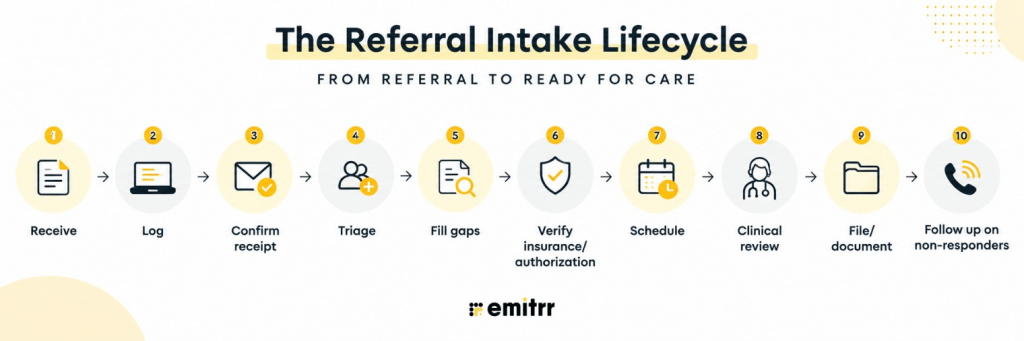
A referral comes in through one of the channels above. Someone logs it into a spreadsheet, an EHR queue, or a shared inbox. Ideally, the referring provider and patient get a quick confirmation that the referral was received, though in a lot of practices that step gets skipped when things are busy. From there, someone decides who should handle it and how urgently. Missing details get chased down. Insurance and authorization get verified. Once the referral is complete, it’s ready for scheduling, a clinical review if needed, and proper documentation in the chart. And if the patient doesn’t respond, someone has to notice that and follow up; otherwise, the referral just sits.
Common Referral Intake Challenges
Most referral intake problems trace back to a handful of recurring issues, and they tend to compound rather than stay isolated.
Fragmented channels
When referrals arrive by fax, email, phone, and web form, staff have to check multiple places just to know what’s pending. Something inevitably sits unnoticed longer than it should.
Manual data entry
Every referral that has to be retyped from a fax or transcribed from a voicemail introduces a chance for a typo, a wrong phone number, a misspelled name, or an incorrect date of birth that causes problems downstream.
Phone tag
Reaching a patient by phone often takes multiple attempts spread across days. Every unanswered call adds another day the referral sits idle, and every day it sits idle makes the patient less likely to still want the appointment.
Incomplete information
A referral missing insurance details or a clear reason for visit can’t move forward. Staff has to pause, reach out to the patient or referring provider, and wait for a response before resuming, which creates another handoff and another point where the referral can stall.
Delayed authorization checks
When insurance and authorization aren’t verified until late in the process, practices sometimes discover a coverage problem only after they’ve already tried to schedule the patient, forcing them to unwind and redo work.
No visibility or tracking
Without a clear view of what’s pending, what’s stuck, and what’s been contacted how many times, it’s hard to know a referral has gone quiet until a referring office calls asking why their patient hasn’t been seen.
Inconsistent follow-up
Chasing non-responders usually depends on someone remembering to circle back. When staff is busy, that follow-up is the first thing to slip.
Referral leakage
All of the above adds up to referral leakage: a referral that never turns into a scheduled visit. The patient may have simply given up, or gone somewhere else that responded faster.
None of these issues is dramatic on its own. A referral that takes an extra day, a phone call that goes to voicemail, a missing insurance field each looks minor in isolation. The problem is volume. Multiply any of these by the number of referrals a practice handles weekly, and small friction becomes a steady, quiet loss.
Benefits of Improving Your Referral Intake Process
Tightening up intake has effects that show up well beyond the intake stage itself.
| Benefit | What It Looks Like in Practice |
| Faster time-to-appointment | A referral verified within a day gets scheduled while the patient still wants the visit, instead of sitting for a week |
| Reduced referral leakage | Fewer referrals stall between receipt and follow-up, so fewer patients disappear before ever reaching a provider |
| Stronger referring-provider relationships | A referring office that hears back quickly and consistently is more likely to keep sending patients your way |
| Better patient experience | A patient who isn’t asked to repeat their information three times forms a very different impression of the practice |
| Revenue protection | Every referral that stalls in intake is a visit, and often a series of follow-up visits, that never happens |
The pattern across all five is the same: intake problems are invisible until they show up as a missed appointment, a frustrated referring office, or a revenue line that’s quietly smaller than it should be. Fixing intake closes that gap before it costs you a patient.
The Growing Role of Automation in Referral Intake
A growing number of practices are rethinking how much of intake needs to depend on a person remembering to do something. Referrals landing in one centralized inbox, rather than scattered across a fax machine, an email account, and a voicemail box, is one of the more common starting points; it removes the “which channel do I check” problem entirely.
From there, practices are layering in digital intake forms that collect missing information directly from the patient instead of requiring a callback, two-way texting that lets staff confirm receipt and gather details without playing phone tag, and self-scheduling links that let the patient pick a time themselves once their referral is ready. Automated appointment reminders and automated follow-up for patients who haven’t responded close out the loop, so a stalled referral gets a nudge instead of quietly aging in a queue.
Instead of a staff member opening a fax and manually typing details into the system, AI can read the referral, pull out the patient information, specialty, and reason for the visit, and drop them into structured fields automatically. The same technology can support referral triage by flagging urgency and routing referrals to the right queue based on the information provided. This allows staff to review an organized, prioritized list instead of starting from a blank inbox.
None of this replaces the judgment calls that intake still requires, deciding how to handle a complicated case, or knowing when a patient needs a more personal conversation. What it does is remove the repetitive, time-sensitive parts of the process that are most likely to slip when staff is stretched thin.
Watch how HIPAA-compliant digital intake forms can speed up your referral process
Key Takeaways
- Referral intake is the process of receiving, verifying, and preparing a referral for scheduling it ends once the referral is ready to move forward, not once the patient is seen.
- Referral intake is a subset of referral management, not a separate process; management covers the full lifecycle through the completed visit.
- Referrals arrive through multiple channels: fax, email, phone, EHR, paper, and that fragmentation is one of the biggest operational challenges in intake.
- Front-desk staff, referral coordinators, clinicians, referring providers, patients, and payers all touch intake, and a delay from any one of them delays the whole referral.
- Most referral leakage comes from small, recurring friction points: incomplete information, slow follow-up, and no visibility, rather than one dramatic failure.
- Improving intake pays off in faster scheduling, fewer lost referrals, stronger referring-provider relationships, and protected revenue.
FAQs
Referral intake is the process of receiving a referral, verifying the patient and clinical details attached to it, and preparing it to be scheduled. It’s the first stage of the referral journey, distinct from the scheduling, visit, and follow-up stages that come after.
Referral intake ends once a referral is verified and ready to schedule. Referral management covers the entire lifecycle, from the moment a referral is received through the completed visit and any communication back to the referring provider.
Fax, email, phone or voicemail, EHR-to-EHR or web form submissions, and paper referrals are the most common channels. Most practices receive referrals through several of these at once.
Front-desk or administrative staff usually handle the initial receipt, while referral coordinators manage verification and preparation. Clinicians get involved for cases that need clinical judgment, and referring provider offices and payers are often part of the process indirectly.
Referral leakage typically comes from a combination of incomplete information, slow or inconsistent follow-up, fragmented communication channels, and a lack of visibility into which referrals are stalled. Individually, these issues seem minor, but across a high volume of referrals they add up to a meaningful number of patients who never get scheduled.
Conclusion
Referral intake doesn’t get the attention that scheduling or clinical workflows do, but it’s often the stage that decides whether a referral becomes a patient at all. The practices that handle it well aren’t necessarily doing anything exotic, they’re just closing the small gaps where referrals typically go quiet: fragmented channels, missing information, and follow-up that depends on someone remembering to make one more call.
Get the fundamentals of intake right, and everything downstream scheduling, patient experience, and the referring-provider relationship gets easier by default. Book a demo to see how a more connected referral intake process could work for your practice.


 4.9 (400+
reviews)
4.9 (400+
reviews)