
Introduction
A referral coordinator can do everything right and still lose a patient. They log the referral, verify the insurance, and schedule the visit, but nobody checks whether the patient actually showed up, and nobody sends a note back to the referring provider confirming the patient was seen. From the referring office’s side, the patient simply disappeared.
That’s the gap closed-loop referral management is built to close. It’s not just about receiving referrals faster or automating a fax queue. It’s about making sure every referral has a status that someone can see, all the way from the moment it arrives to the moment the referring provider gets confirmation that the patient completed their visit.
This guide covers what closed-loop referral management actually requires, what a proper referral tracking system needs to capture at each stage, where referrals typically fall out of the loop, and how to build tracking into your process without adding more manual work for staff.
AI Summary
- Closed-loop referral management means a referral’s status is visible and tracked from receipt through completed visit, with confirmation sent back to the referring provider.
- Most referral leakage happens quietly, in the gap between “referral received” and “someone notices it went stale,” not in one obvious failure point.
- A real referral tracking system needs defined status stages, not just a spreadsheet that gets updated when someone remembers to.
- Some parts of tracking benefit heavily from automation, such as non-responder follow-up and status notifications, while complex or sensitive cases still need a human checking in.
- Practices that close the loop consistently see fewer lost referrals, stronger referring-provider relationships, and better visibility into where referrals actually stall.
What is Closed-Loop Referral Management?
A referral is “closed-loop” when its status is continuously tracked from the moment it’s received until the patient’s visit is complete. The referring provider receives confirmation that it happened. That last part is what separates closed-loop from ordinary referral tracking. Plenty of practices track referrals internally. Far fewer consistently close the loop with the provider who sent the referral in the first place.
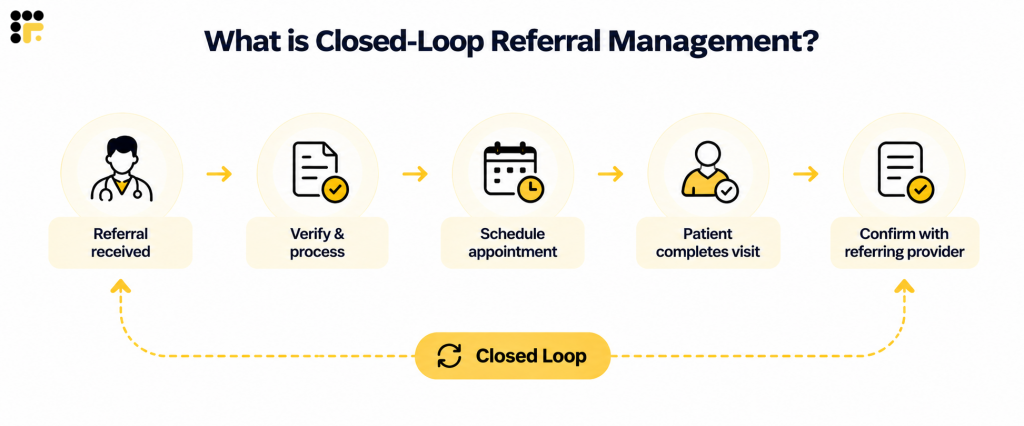
This isn’t the same as referral intake, which ends once a referral is verified and ready to schedule. Closed-loop management picks up from there and follows the referral all the way through the visit and back out again.
Why Referral Tracking Breaks Down as Volume Grows
At low volume, tracking a referral is easy. One coordinator remembers which patients they called, who scheduled, and who they need to follow up with. The system, if you can call it that, lives in someone’s head and a shared spreadsheet.
That approach breaks the moment volume increases, or more than one person is involved. A referral logged by one staff member and followed up by another creates a handoff, and handoffs are where status updates get missed. A coordinator out sick for two days means every referral they were tracking sits untouched until they’re back, and nobody else necessarily knows which ones needed attention. Multiply that across dozens or hundreds of referrals a month, and it becomes almost impossible to know, at any given moment, which referrals are pending, which are stuck, and which have quietly gone cold.
The practices that avoid this usually aren’t doing anything exotic. They’ve just decided that referral status shouldn’t live in someone’s memory or a document nobody else opens.

What a Referral Tracking System Should Capture at Each Stage
A working referral tracking system needs more than a “received” and “scheduled” checkbox. At minimum, it should capture:
- Receipt and timestamp. When the referral arrived and through which channel, so staff can see how long it’s been sitting.
- Outreach attempts and outcomes. How many times the patient has been contacted, through which channel, and what happened each time.
- Missing information status. Whether the referral is complete or still waiting on details like insurance, contact information, or reason for visit.
- Insurance and authorization status. Whether eligibility has been confirmed and whether authorization is pending, approved, or denied.
- Scheduling status. Whether the patient has an appointment booked, and if not, why.
- Visit completion. Whether the patient actually showed up, not just whether they were scheduled.
- Outcome sent to the referring provider. Whether a consult note or status update has actually gone back to whoever sent the referral.
- Closure. When the referral is considered complete and archived into the patient’s permanent record.
Missing any one of these stages doesn’t necessarily kill a referral, but it creates a blind spot. A referral that shows “scheduled” but not “completed” looks fine on a dashboard while the patient quietly no-shows and nobody follows up.
Where Referrals Silently Fall Out of the Loop
Referral leakage rarely happens because of one dramatic mistake. It happens in small gaps nobody is actively watching. A patient who misses the first call rarely gets a second attempt unless something prompts staff to try again. Status updates get skipped when logging progress is optional, since it’s the first thing to slip when staff is busy.
Referral status split across the EHR, a spreadsheet, and an inbox means nobody has the full picture. A booked appointment can still end in a no-show that nobody tracks back into the referral’s status. A referral stuck behind a busy location’s queue can sit untouched while another location has open capacity. And a successful visit that’s never reported back leaves the referring provider unsure the referral even worked.
Before those intake gaps turn into missed patients and wasted staff time, watch the video on 12 costly patient intake mistakes and how to avoid them
What Should Stay a Manual or Human Check Even With a Tracking System
Tracking status automatically doesn’t mean every decision along the way should be automatic.
- Complex or urgent cases still need a person reviewing the details and making a judgment call about priority, not just a rule waiting for a trigger.
- Exception handling, like an insurance denial or a referral missing critical documentation, usually needs staff to actually resolve the underlying issue rather than just flag it.
- Sensitive patient communication, such as discussing a serious diagnosis or addressing a complaint, benefits from a human voice, not an automated message.
- Final verification before closing a referral helps catch errors that a status dashboard alone wouldn’t surface, like a visit marked complete that actually needs a follow-up scheduled.
Automation should surface these cases faster and more consistently. It shouldn’t quietly resolve them without a person checking.
Closed-Loop vs. Open-Loop Referral Handling
| Criteria | Open-Loop (Typical Manual Tracking) | Closed-Loop Referral Management |
|---|---|---|
| Status visibility | Scattered across spreadsheets, memory, or separate systems | Centralized, visible in real time |
| Non-responder follow-up | Depends on staff remembering to re-contact | Triggered automatically on a set cadence |
| Visit completion tracking | Often stops at “scheduled” | Tracks through to actual visit completion |
| Referring provider updates | Sent inconsistently, if at all | Sent as a routine part of the workflow |
| Multi-location visibility | Limited to each location’s own tracking | Centralized across all sites |
| Reporting | Reactive, discovered after a complaint | Proactive, visible before it becomes a complaint |
Benefits of Closed-Loop Referral Management
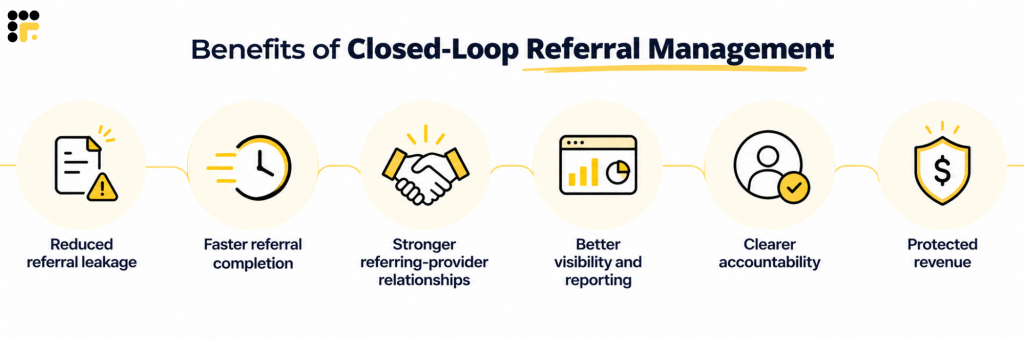
Closed-loop referral management helps practices move beyond simply receiving referrals to actively tracking them through completion. When every referral has a clear status, owner, and follow-up path, practices can reduce leakage, identify bottlenecks earlier, and create a more consistent experience for patients and referring providers.
Best Practices for Building a Closed-Loop Referral Tracking System
- Centralize referral sources first. Tracking is only as good as the system’s visibility into every referral, so bring fax, email, phone, and web form referrals into one place before trying to track them consistently.
- Define clear status stages. Agree on what “received,” “in progress,” “scheduled,” “completed,” and “closed” actually mean, so status updates are consistent across staff.
- Automate non-responder follow-up. Set a cadence for re-contacting patients who haven’t responded, rather than relying on someone remembering to try again.
- Assign clear ownership at each stage. A referral without a named owner is a referral nobody feels responsible for chasing.
- Track completion, not just scheduling. Build no-show and cancellation data back into referral status so a booked appointment isn’t treated as the end of the story.
- Close the loop with referring providers as a standard step, not an occasional courtesy, using automated status updates where possible so it doesn’t depend on staff bandwidth.
- Monitor conversion and leakage metrics regularly. A dashboard that nobody looks at doesn’t prevent leakage any better than no dashboard at all.
- Standardize the process across locations. Multi-location practices need one shared definition of “closed-loop,” not a different version at every site.
How Emitrr Supports Closed-Loop Referral Tracking
Emitrr brings referral status into one centralized view instead of splitting it across a fax tray, an inbox, and a spreadsheet. Referrals land in a shared inbox with a timestamp the moment they arrive, so nothing sits unnoticed in a channel nobody checked that day.
From there, automated status updates and non-responder follow-up keep referrals moving without requiring staff to remember every callback. Two-way texting lets patients confirm receipt and self-schedule, and that same visibility extends to referring providers, who receive automated notifications when their referral is scheduled rather than having to call and ask. Referral data syncs with the practice’s EHR, including athenahealth and eClinicalWorks, so status stays current in the system staff already use, and dashboards give practice managers a real-time view of what’s pending, what’s stalled, and what’s been completed across every location.
The result is a referral process where closing the loop is built into the workflow, not an extra step someone has to remember to take.
Key Takeaways
- Closed-loop referral management tracks a referral’s status from receipt through completed visit, and confirms that outcome back to the referring provider.
- Most referral leakage happens quietly, in gaps between systems and handoffs, rather than in one obvious point of failure.
- A real tracking system needs defined status stages covering receipt, outreach, missing information, insurance, scheduling, completion, and closure.
- Complex cases, exceptions, and sensitive communication still need human judgment, even inside an automated tracking system.
- Practices that consistently close the loop see less leakage, stronger referring-provider relationships, and clearer visibility into where their process breaks down.
FAQs
Closed-loop referral management is the practice of tracking a referral’s status continuously from the moment it’s received through the completed visit, with confirmation sent back to the referring provider once the patient has been seen.
Referral tracking is the mechanism, the actual system or process used to see a referral’s status at any given point. Referral management is the broader discipline that includes tracking, scheduling, communication, and closing the loop with referring providers.
Effective tracking captures receipt, outreach attempts, missing information status, insurance and authorization status, scheduling status, visit completion, and confirmation sent back to the referring provider, ideally in one centralized system rather than scattered across separate tools.
Leakage typically comes from non-responders with no follow-up trigger, status updates that depend on someone remembering to log them, fragmented systems with no single source of truth, and referrals that get scheduled but never confirmed as completed.
To an extent, yes, with a disciplined process and a shared tracking sheet everyone actually updates. But as referral volume grows, manual tracking tends to break down at the same points every time, which is usually when practices start looking at dedicated referral tracking tools.
Conclusion
Closing the loop on a referral isn’t complicated in concept. It just requires knowing, at every point, where a referral stands and who’s responsible for moving it forward. The practices that struggle with referral leakage usually aren’t missing effort. They’re missing visibility.
Building that visibility into your workflow, rather than relying on memory and spreadsheets, is what turns referral tracking from a reactive scramble into a system you can actually trust. Book a demo to see how closed-loop referral tracking works inside Emitrr.

 4.9 (400+
reviews)
4.9 (400+
reviews)