
Introduction
“Please stop calling me.” A patient says it during an automated reminder call and expects your practice to act. The conversation ends, but has anything changed? If their calling preference has not been updated, another scheduled call could reach them tomorrow.
Effective TCPA call opt out handling means more than ending the conversation. Your calling system needs to accept the request, record the preference, and prevent further automated calls within the supported scope. Otherwise, patients may have to repeat a request they expected you to honor the first time.
In this blog, we’ll help you understand what call opt-out requests mean, how they relate to the Telephone Consumer Protection Act, and what should happen when a patient asks you to stop calling. We’ll also explain how Emitrr automatically accepts the request, marks the contact call opted out, ends the call, and prevents further automated AI calls.
AI Summary
- A call opt-out means someone has asked an organization to stop further calls. The request and context help establish what they want stopped.
- Ending the current call alone does not prevent another scheduled call or retry.
- Emitrr accepts the request, marks the contact call opted out, ends the call, and prevents further automated outbound AI calls.
- This behavior runs automatically for outbound calls made by the AI agent. Nothing needs to be configured on the platform.
- Opt-out handling supports TCPA compliance without replacing other applicable calling requirements.
- Opting out of calls does not itself cancel an appointment or resolve an outstanding patient task.
What a Call Opt-Out Request Means
A call opt-out request tells your organization that someone does not want further calls. To respond appropriately, you need to distinguish that instruction from a declined appointment offer, a callback request, or another update.
Requests to stop future calls
Patients usually express their preferences in everyday language. A voice call opt out might sound like:
- “Stop calling me.”
- “Please stop automated calls from your office.”
- “I don’t want any more automated calls.”
- “Stop AI calls. I’ll contact the office myself.”
These statements express a preference about future calling. Patients should not have to understand technical terms to communicate what they want.
The related legal term is TCPA consent revocation, which refers to withdrawing previously provided consent for communications covered by the applicable requirements. A spoken request may communicate that withdrawal, although its scope depends on the request and governing rules.
Do Not Call requests made directly to your practice are also different from registration on the National Do Not Call Registry. Your team needs to address the request it receives rather than treating registry enrollment as a prerequisite.
Responses that are not clear opt-outs
“I don’t want an appointment” and “Don’t call me again” ask for different actions.
During patient recall, a patient may decline an appointment because they are unavailable or do not want to book right now. That response does not necessarily withdraw permission for future calls.
Likewise, “Call me tomorrow” requests a different time. “I already booked that visit” provides a scheduling update. Neither statement clearly asks to revoke consent for automated calls. When the meaning is unclear, clarify the patient’s preference rather than assuming that every negative response is an opt-out.
Call preferences and appointment status
Patient call preferences tell you how someone wants to be contacted. Appointment status tells you whether a visit is scheduled, confirmed, canceled, or completed. A patient who asks you to stop calling may still plan to attend tomorrow’s appointment. Do not cancel the visit simply because they opted out of calls. Similarly, an unresolved referral or billing question remains open until someone addresses it.

Why Opt-Out Handling Matters for AI Outbound Calls
AI outbound calls can run through scheduled campaigns, retries, and separate workflows. If a stop request does not affect future calling, the patient could receive another call even though the first conversation ended correctly.
Scheduled calls and retries can continue
Your practice may use appointment reminder calls, patient recall calls, and routine follow-up outreach for the same patient. Without an applied calling preference, one workflow could continue contacting someone who opted out during another conversation.
For example, a patient might ask to stop calls during a reminder while remaining on an overdue recall list. When reviewing automated appointment reminders, check how a patient’s preference affects subsequent outreach rather than looking only at whether the current call ends.
The same question applies to automated patient follow-up: will the next call be prevented after the patient asks to stop?
Repeated calls damage patient trust
A patient who receives another automated call after opting out may reasonably feel ignored. They may repeat the request to your front desk, complain, or become less willing to answer future outreach.
Being overdue for care does not erase a communication preference. Practices using patient recall software need to distinguish patients who need follow-up from patients who should receive automated calling. That distinction helps your team pursue outstanding work while respecting how patients want to communicate.
Automatic handling reduces manual updates
A manual process depends on someone identifying the request, finding the contact record, and updating it before the next call attempt. If that work is delayed, another call may go out.
Automatic handling removes the need for a separate manual update for the documented behavior. For automated healthcare calls, this helps ensure that a request made during the conversation affects subsequent automated calling.
Want to see how an AI receptionist fits into your practice’s communication workflow? Watch this introduction to Emitrr’s healthcare AI receptionist:
How TCPA Applies to AI Call Opt-Out Requests
The Telephone Consumer Protection Act, or TCPA, regulates certain calls and texts. For this topic, you need to understand two separate responsibilities: having an appropriate basis to initiate a call and handling a later request to stop.
AI-generated voices fall within the TCPA framework
The Federal Communications Commission, or FCC, has confirmed that AI-generated human voices fall within the TCPA’s artificial or prerecorded voice framework. AI-generated voice calls are therefore not outside the rules simply because the system produces speech during a live conversation.
When assessing AI calling compliance, consider the actual calling technology and purpose. A conversational experience does not remove the relevance of restrictions on artificial voice calls.
Calling consent and consent revocation are separate
Automated calling consent concerns the permission or applicable basis for initiating a call. TCPA call opt-out handling concerns what happens when the recipient subsequently asks to stop.
Your calling process should address both:
- Before calling: Determine the appropriate basis for the outreach and the requirements that apply.
- When a stop request is received: Identify what the person wants stopped and apply the request appropriately.
- Before further outreach: Check the relevant preference rather than relying only on the permission previously recorded.
Accepting an opt-out does not establish that the original call met every requirement. Previously obtaining consent also does not remove the need to address a later withdrawal.
TCPA compliance for AI calls therefore involves more than recognizing “stop calling.” Outbound call compliance may also involve caller identification, call purpose, and applicable opt-out mechanisms.
Healthcare calls are not universally exempt
Healthcare messages have specific provisions and exemptions, but there is no blanket exemption for every call made by a healthcare organization. Requirements depend on factors such as the call, the number contacted, consent, and the conditions of any exemption.
For AI voice compliance, evaluate the actual outreach. A routine appointment reminder and a promotional offer should not automatically be treated the same way.
Also distinguish a product’s suppression behavior from the legal scope of a request. If a patient asks to stop calls or change channels, assess what that means for other outreach separately. TCPA SMS compliance remains relevant when considering subsequent text messages.
Common Opt-Out Situations During Patient Calls
To choose the right next action, first identify what the patient is asking you to do. These examples distinguish a clear outbound call opt-out from other common responses.
| Call purpose | Patient response | Meaning | Next action |
| Reminder call | “Stop calling me” | A clear request to stop further calls | Apply opt-out handling. Keep appointment status separate. |
| Recall call | “I don’t want an appointment” | Declines the offer without necessarily withdrawing calling permission | Handle the declined offer and clarify any additional calling preference. |
| Follow-up call | “Call me tomorrow” | Requests a different time rather than clearly opting out | Handle the callback request through the supported process. |
| Communication preference | “Text me instead” | Requests a channel change; the intended call preference may need clarification | Check the requested change and applicable messaging permission. Do not assume an automatic switch. |
| Wrong number | “This is not their number” | Indicates inaccurate or outdated contact information | Follow the appropriate contact-correction process. Do not assume it is identical to the documented opt-out feature. |
A healthcare call opt out does not necessarily resolve the reason you called. Keep the outstanding task visible while addressing the preference.
If a patient requests business texting, confirm the change and applicable messaging permission before continuing through that channel. “Text me instead” should not be treated as proof that every communication setting has already been updated.
How Emitrr Automatically Handles Call Opt-Out Requests
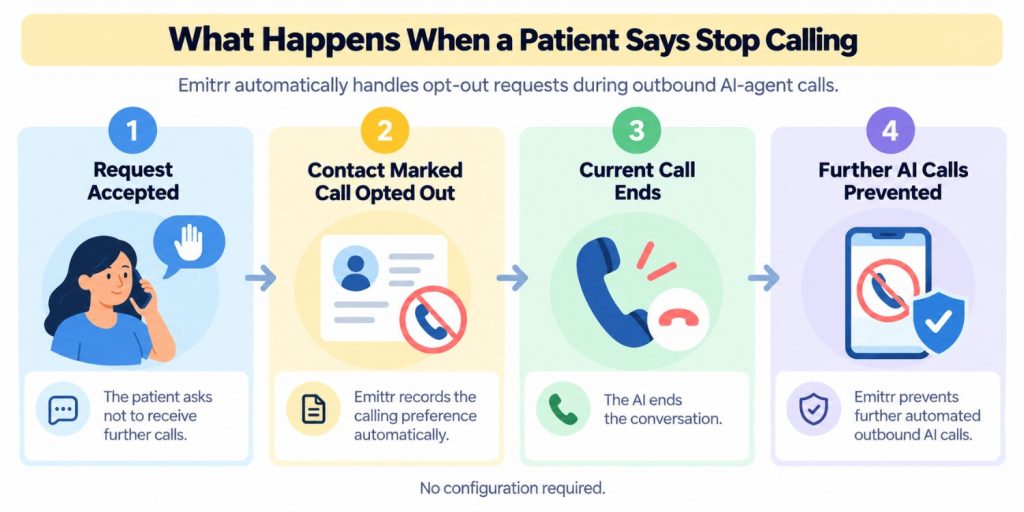
Emitrr automatically handles opt-out requests during all outbound calls made by the AI agent. When someone asks not to receive further calls, the AI accepts the request and applies the documented opt-out sequence.
Nothing needs to be configured on the platform for this behavior. Here is what the Emitrr call opt-out feature does during the interaction.
Accept the request to stop calling
When a patient asks the outbound AI voice agent not to call again, the AI accepts the request within the conversation.
For example, the patient might say, “Please don’t call me anymore.” The request is handled during that interaction rather than requiring a staff member to review the conversation and manually apply the documented opt-out behavior afterward.
Mark the contact as call opted out
Emitrr marks the contact call opted out so further automated outbound AI calls are prevented.
This step matters because ending a conversation does not, by itself, change whether another call can occur. Recording the call-opt-out status applies the preference beyond the current interaction. No manual staff update is required for this documented behavior.
End the current call
After accepting the request, the AI ends the call. The original outreach conversation does not continue after the request has been accepted.
For the patient, this addresses the immediate expectation: they asked the agent to stop calling, and the interaction ends.
Prevent further automated AI calls
Emitrr prevents further automated outbound AI calls for the opted-out contact. This automated call suppression addresses the patient’s expectation that they should not have to repeat the request during another AI call.
The complete AI call opt-out sequence is:
- Accept the request to stop calling.
- Mark the contact call opted out.
- End the current call.
- Prevent further automated AI calls.
This behavior supports TCPA compliance by respecting opt-out requests within the documented calling scope. It does not establish suppression for SMS, email, external dialers, or other numbers associated with the person.
When evaluating Emitrr’s AI agent, consider this behavior alongside the other requirements of your outbound calling workflow.
What Staff Should Know After a Patient Opts Out
Once automated AI calling has stopped, your team may still need to resolve the original patient request. Keep that work separate from the calling preference.
- Keep unresolved patient tasks open: A call opt-out does not complete a referral, cancel a visit, or settle a billing question. Track the outstanding need until it is resolved.
- Check permission before using another channel: Do not assume that stopping calls automatically authorizes texts or emails. Confirm the requested communication change and applicable permission before continuing outreach.
- Coordinate with separate outreach systems: If your practice uses another dialer or platform, confirm how the relevant preference is handled there. Do not assume that Emitrr’s documented AI calling suppression updates external tools.
- Document later preference changes: A new appointment or imported contact list should not be treated as automatically restoring calling permission. Use an established process to record and assess any subsequent change.
If another team owns the unresolved task, pass along the relevant information through your internal process. Tools such as team messaging can support that handoff, while the patient’s communication preference remains a separate consideration.
Key Takeaways
A useful opt-out process changes future calling behavior, not just the current conversation.
- Call opt-out requests need to affect whether subsequent automated calls occur.
- Accepting the request, recording the preference, ending the call, and preventing further calls are distinct actions.
- Emitrr performs the documented sequence automatically during outbound AI-agent calls, without platform configuration.
- Patient communication preferences and appointment actions remain separate.
- TCPA call opt-out handling supports a broader calling process rather than guaranteeing complete compliance.
FAQs
Call opt out means someone has asked an organization to stop further calls. It concerns future calling rather than simply ending the current conversation.
Yes. A person can ask to stop further calls during the conversation. Emitrr accepts these requests during outbound AI-agent calls and applies its automatic opt-out sequence.
Emitrr accepts the request, marks the contact call opted out, ends the current call, and prevents further automated outbound AI calls.
No. It runs automatically for outbound calls made by the AI agent. Nothing needs to be configured on the platform.
The documented feature prevents further automated AI calls. Text-message preferences and the applicable scope of the request need to be assessed separately.
No. It supports opt-out handling, but other applicable calling requirements still need to be addressed, including the basis for initiating the call.
Conclusion
When a patient says, “Please stop calling me,” they expect action. Effective TCPA call opt-out handling means recording the request and preventing further calls within the relevant scope, rather than simply ending the conversation.
Emitrr automatically accepts the request, marks the contact call opted out, ends the call, and prevents further automated outbound AI calls. Your team can then focus on any unresolved patient need while respecting the updated calling preference.
Book a demo to see how Emitrr handles opt-out requests during outbound AI calls.

 4.9 (400+
reviews)
