
Introduction
For years, healthcare SEO followed a fairly simple goal:
Get your practice to rank higher on Google.
If you appeared on the first page for searches like “dentist near me” or “physical therapist in Austin,” you had a good chance of attracting new patients.
While that’s still important, search is evolving.
Today, patients aren’t just typing questions into Google. They’re also asking AI tools like ChatGPT, Google AI Overviews, Gemini, and Perplexity for recommendations, explanations, and comparisons.
Instead of showing a long list of links, these tools often provide direct answers.
That means healthcare organizations need to think beyond traditional rankings.
The good news?
If you’ve followed the strategies in the previous guides, building a strong website, optimizing your Google Business Profile, creating helpful content, and earning patient trust, you’re already laying the foundation for AI search.
In this guide, we’ll explore what AI search means for healthcare organizations and how you can prepare for it.
Chapter 1: How Healthcare Search Is Changing
Think about how you searched for healthcare providers a few years ago.
You probably typed something like:
“Dermatologist near me”
Then you compared a few websites before booking an appointment.
Today, someone might instead ask:
“Who is the best dermatologist near me for acne treatment?”
Or:
“Which physical therapy clinic has good reviews and online booking?”
Instead of displaying ten blue links, AI may summarize the answer, compare providers, and recommend a few options.
Patients still make the final decision, but AI increasingly helps narrow their choices.
That’s the biggest shift.
AI Doesn’t Replace Google
It’s important to understand that AI search isn’t replacing Google overnight.
In fact, many AI tools use information that originates from Google, trusted websites, business listings, and other public sources.
Think of AI as another way patients discover healthcare providers, not a replacement for traditional search.
That means local SEO is still essential.
AI simply changes how your information is presented.

Chapter 2: What AI Looks For
Unlike traditional search engines, AI isn’t just looking for pages that contain the right keywords.
Its goal is to answer a user’s question as accurately as possible.
To do that, AI looks for information that is:
- Clear
- Consistent
- Accurate
- Well-structured
- Trusted across multiple sources
For healthcare organizations, this means AI wants confidence that your practice is legitimate and that the information it shares is reliable.
For example, if your website says one thing, your Google Business Profile says another, and healthcare directories list outdated information, AI has a harder time deciding what to trust.
Consistency matters more than ever.
Chapter 3: Build a Brand, Not Just Rankings
Traditional SEO often focused on ranking individual pages.
AI is different.
It tries to understand your practice as a whole.
Instead of asking:
“Does this page mention dental implants?”
AI asks questions like:
- Is this clinic known for dental implants?
- Do multiple trusted sources mention that specialty?
- Is the information consistent?
- Do patients speak positively about the practice?
This is why brand authority is becoming increasingly important.
Healthcare organizations that consistently publish helpful content, maintain accurate information, and build strong patient trust are more likely to be referenced by AI systems.
Chapter 4: Content That Works in the AI Era
Many organizations think AI search means they need to publish more content.
That’s not necessarily true.
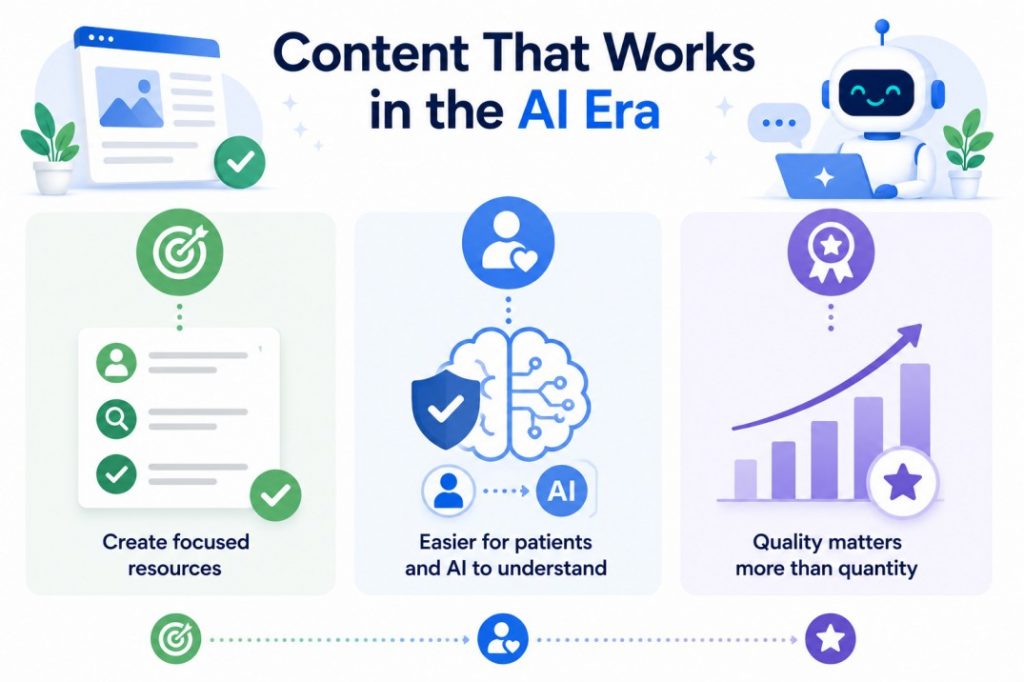
Instead of creating dozens of average articles, focus on creating fewer pieces of content that genuinely answer patient questions.
For example, instead of writing a generic article titled:
“Everything About Knee Pain”
Create focused resources such as:
- When should you see a doctor for knee pain?
- Common causes of knee pain while climbing stairs.
- What happens during your first physical therapy appointment?
Specific, helpful content is easier for both patients and AI systems to understand.
Quality matters far more than quantity.
Chapter 5: Make Your Information Easy to Understand
AI works best when information is organized clearly.
That doesn’t mean adding complicated code or technical features.
It means writing in a way that’s easy to read.
Some simple practices include:
- Use descriptive page titles.
- Organize content with headings.
- Answer common questions directly.
- Keep provider and location information updated.
- Avoid unnecessary medical jargon.
If a patient can quickly understand your website, AI usually can too.
Chapter 6: Think Beyond Your Website
Years ago, your website was the primary source of information about your practice.
Today, patients and AI learn about your organization from many different places.
These include:
- Google Business Profile
- Healthcare directories
- Review platforms
- Social media
- News articles
- Community websites
- Educational content
The more consistent your information is across these platforms, the easier it becomes for AI to understand your organization.
That’s another reason why reputation management and local SEO continue to matter.
Chapter 7: What Should Healthcare Organizations Do Today?
The good news is that preparing for AI search doesn’t require starting from scratch.
If you’re already following good SEO practices, you’re on the right track.
Continue to focus on:
- Publishing accurate, patient-friendly content.
- Keeping your Google Business Profile updated.
- Maintaining a fast, user-friendly website.
- Earning authentic patient reviews.
- Updating provider and location information regularly.
- Building trust through consistent communication.
These aren’t new strategies, they’re the same fundamentals that support both traditional search and AI-powered search.
The difference is that AI relies on them even more.
Chapter 8: Common Misconceptions About AI Search
As AI becomes more popular, a few myths have started to circulate.
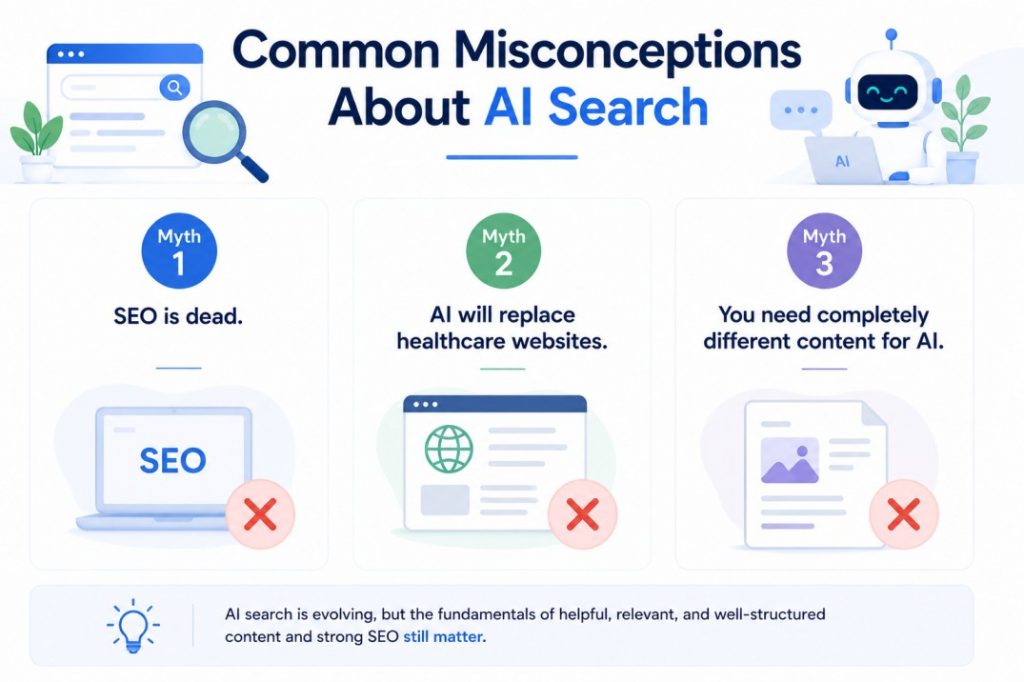
Myth 1: “SEO is dead.”
Not true.
SEO is evolving, not disappearing.
Practices still need websites, helpful content, and strong local visibility.
Myth 2: “AI will replace healthcare websites.”
Patients still visit websites to:
- Learn about providers.
- Verify insurance information.
- Book appointments.
- Find clinic locations.
- Contact the practice.
Your website remains one of your most valuable digital assets.
Myth 3: “You need completely different content for AI.”
You don’t.
The same content that helps patients usually helps AI too, as long as it’s accurate, well-structured, and easy to understand.
Conclusion
AI is changing how patients discover healthcare providers, but it isn’t changing what patients value.
They still want:
- Accurate information.
- Trusted providers.
- Positive patient experiences.
- Easy appointment booking.
And AI wants the same thing.
Rather than chasing every new AI trend, healthcare organizations should continue building a strong digital foundation:
- Create genuinely helpful content.
- Keep information consistent across every platform.
- Build a trustworthy online reputation.
- Make it easy for patients to find and choose your practice.
Those principles have always been good for healthcare SEO.
Now, they’re becoming just as important for AI search.
Final Thoughts
Think of AI search as the next evolution of local healthcare SEO, not a replacement for it.
Practices that invest in trust, clarity, and patient experience today will be in the strongest position as search continues to evolve.


 4.9 (400+
reviews)
4.9 (400+
reviews)