

Introduction
Pharmacies today are under constant pressure, with rising prescription volumes, limited staff, and increasing patient expectations. But the real issue isn’t just volume but inefficient processes. Manual tasks, constant phone calls, and fragmented systems often slow down pharmacy workflow, leading to delays in prescription processing, staff burnout, and poor patient experience.
The good news? With the right approach to pharmacy workflow optimization, pharmacies can significantly improve efficiency, reduce errors, and streamline operations without overloading their teams.
In this blog, we’ll break down practical, actionable tips to improve pharmacy workflow efficiency and help you build a faster, more scalable system.
AI Summary
- Pharmacy workflow inefficiencies are often caused by manual processes and poor communication
- Pharmacy workflow automation can reduce repetitive tasks like refill requests and refill reminders
- Reducing phone calls and adopting digital communication improves pharmacy operations efficiency
- Streamlining prescription intake helps minimize delays in the prescription fulfillment process
- Real-time updates and notifications enhance patient experience and reduce follow-ups
- Better workload distribution improves pharmacy staff productivity
- Using data and analytics helps identify and fix pharmacy workflow challenges
- The right pharmacy workflow solutions can significantly improve speed, accuracy, and overall operations
Common Pharmacy Workflow Challenges
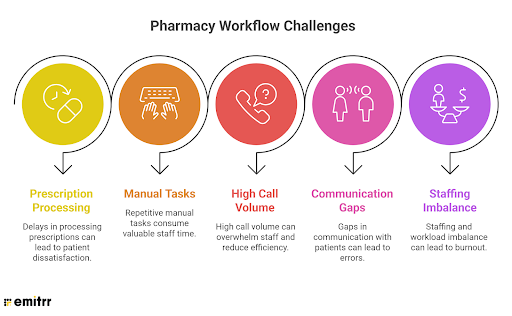
Even small inefficiencies in daily operations can quickly add up, making it harder to maintain consistent pharmacy workflow management. Over time, these gaps create delays, increase workload, and directly impact overall pharmacy operations efficiency.
Prescription Processing Delays
Unstructured intake, insurance verification, and approval steps often slow down the prescription fulfillment process. When there’s no standardized flow, even simple prescriptions get stuck in back-and-forth, increasing wait times and frustrating patients.
Manual & Repetitive Tasks
Pharmacy staff spend a large portion of their day handling routine tasks like refill requests, reminders, and basic inquiries. These manual pharmacy processes not only reduce pharmacy staff productivity but also increase the chances of errors and missed follow-ups.
High Call Volume
A significant number of incoming calls are related to prescription status, refills, or store hours. Constant interruptions from these calls make it difficult for staff to focus, slowing down overall pharmacy workflow optimization.
Learn about more reasons why patients keep calling about prescription refills.
Communication Gaps with Patients
When patients don’t receive timely updates about their prescriptions, they tend to call or visit the pharmacy repeatedly. These pharmacy communication gaps create unnecessary workload and negatively impact the patient experience.
Staffing & Workload Imbalance
Peak hours often lead to uneven workload distribution, where some staff are overwhelmed while others are underutilized. Without proper planning, this imbalance creates bottlenecks and reduces overall pharmacy operations efficiency. Learn about how automated prescription refills reduce staff burnout.

Tips to Improve Your Pharmacy Workflow
Improving your pharmacy workflow comes down to fixing the right gaps with the right processes. Here are practical, high-impact ways to drive better pharmacy workflow optimization:
Automate Repetitive Tasks to Improve Pharmacy Workflow Efficiency
Repetitive tasks like refill requests, reminders, and prescription status updates take up a significant portion of staff time. Using pharmacy workflow automation reduces manual effort, minimizes human errors, and allows staff to focus on critical tasks that require attention.
Streamline Prescription Intake and Fulfillment Process
A disorganized intake process is a major cause of delays in the prescription fulfillment process. Streamline your prescription refill workflow, sandardizing how prescriptions are received, verified, and processed helps reduce back-and-forth and speeds up turnaround time.
Reduce Pharmacy Call Volume with Digital Communication
Handling high call volumes for basic queries slows down the overall efficiency of the pharmacy operations. Shifting to SMS, automated responses, or digital communication tools helps reduce interruptions and improve workflow continuity.
See how SMS can reduce prescription call volume.
Improve Pharmacy Staff Productivity with Better Task Management
Lack of clear task ownership leads to confusion and missed steps. Defining roles and improving internal coordination help teams work more efficiently and strengthen overall pharmacy workflow management.
Use Real-Time Prescription Updates to Reduce Follow-Ups
Patients often call or visit the pharmacy due to a lack of updates. Sending real-time notifications about prescription status helps reduce follow-ups and improves the patient experience while helping streamline pharmacy workflow.
Optimize Staffing to Handle Peak Pharmacy Workload Efficiently
Uneven workload distribution during peak hours creates bottlenecks. Planning shifts based on demand and assigning role-based responsibilities improves pharmacy staff productivity and ensures smoother operations.
Use Data and Analytics to Identify Pharmacy Workflow Bottlenecks
Without visibility into operations, it’s hard to fix inefficiencies. Tracking metrics like turnaround time, refill requests, and call volume helps identify pharmacy workflow challenges and continuously improve processes.
Implement Pharmacy Workflow Solutions to Reduce Errors and Delays
Using the right pharmacy workflow solutions, such as automation tools, communication platforms, and AI systems like Emitrr helps reduce manual errors, improve accuracy, and create a more reliable workflow.
How Technology Fixes Pharmacy Workflow Gaps
Most pharmacies struggle with inefficiencies not because of workload, but because their systems aren’t built for modern pharmacy workflow management. Traditional setups rely heavily on manual processes, disconnected tools, and reactive communication, making it difficult to scale operations.
Key gaps in traditional pharmacy systems:
- Limited pharmacy workflow automation, leading to heavy reliance on manual work
- High dependency on phone calls, increasing interruptions and slowing workflows
- Lack of real-time prescription status updates for patients
- Disconnected systems causing delays in the prescription fulfillment process
- Minimal visibility into bottlenecks and performance metrics
These gaps directly impact both efficiency and patient experience. Staff spend more time handling repetitive tasks, while patients are forced to follow up multiple times for updates, reducing overall pharmacy operations efficiency.
This is where modern technology changes the game.
With the right pharmacy workflow solutions, pharmacies can automate routine tasks, streamline operations, and significantly reduce manual workload.
How technology improves pharmacy workflow:
- Automates refill requests, reminders, and routine workflows
- Uses AI to handle calls, queries, and high-volume interactions
- Enables two-way digital communication to reduce call dependency
- Provides real-time updates to minimize patient follow-ups
- Offers analytics to identify and fix pharmacy workflow challenges
In short, technology doesn’t just support your workflow, it transforms it into a faster, more scalable system built for efficiency.
How Emitrr Helps Improve Pharmacy Workflow
One of the biggest bottlenecks in any pharmacy workflow is handling prescription refill requests. What seems like a simple task often turns into a multi-step, manual process that slows down operations and increases staff workload.
What the Current Prescription Refill Workflow Looks Like
Most pharmacies and clinics follow a fragmented and manual process:
- Patients request refills via calls, voicemail, or patient portals
- Requests come in across multiple channels with no centralization
- Staff manually reviews each request to check eligibility
This includes verifying:
- If the patient is established
- Whether the medication is eligible for refill
- If an appointment is required
- Whether labs or vitals are overdue
- If it’s a controlled substance
- Based on this, providers approve or deny the request
- Approved requests are sent to the pharmacy
- Denied requests require patient follow-up and appointment scheduling
This entire process creates delays in the prescription fulfillment process, increases back-and-forth, and adds significant manual effort, impacting overall pharmacy workflow management.
How Emitrr’s AI Agent Automates Prescription Refill Workflows
Emitrr replaces this fragmented system with an AI-powered, automated workflow designed to improve pharmacy workflow efficiency.
Here’s how it works:
- An AI virtual assistant handles incoming refill requests via calls automatically
- It collects key patient details like name, DOB, medication, dosage, and preferred pharmacy
- All information is captured in a structured format and synced into your system
What happens next:
- If the details match existing records → refill request can be processed instantly
- If there’s a mismatch → a case is automatically created for review
- Every interaction includes a call recording, transcript, and AI-generated summary
Impact on Pharmacy Workflow:
- Eliminates manual intake and reduces staff workload
- Speeds up refill processing and reduces delays
- Minimizes errors with structured data capture
- Reduces call volume and interruptions
- Improves overall pharmacy operations efficiency
By automating one of the most time-consuming workflows, Emitrr helps pharmacies streamline pharmacy workflow and handle higher volumes without increasing staff.
Key Takeaways
- Pharmacy workflow inefficiencies are often caused by manual processes and communication gaps
- Reducing prescription phone calls is one of the fastest ways to improve pharmacy operations efficiency
- Pharmacy workflow automation can significantly cut down repetitive tasks and errors
- Real-time updates play a key role in improving patient experience and reducing follow-ups
- Better workload distribution improves pharmacy staff productivity and reduces burnout
- Using the right pharmacy workflow solutions can transform operations without increasing staff
Frequently Asked Questions
You can improve pharmacy workflow efficiency by automating refill requests, reducing call volume, streamlining prescription processing, and using better communication tools.
Common pharmacy workflow challenges include prescription delays, manual processes, high call volume, communication gaps, and inefficient task management.
Pharmacy workflow automation reduces manual tasks like refills and reminders, speeds up operations, and minimizes errors, leading to better efficiency and faster service.
Pharmacies can reduce call volume by using SMS, automated responses, and real-time updates for prescription status, which helps streamline pharmacy workflow.
Delays in the prescription fulfillment process are usually caused by manual verification, incomplete information, communication gaps, and unstructured workflows.
The best pharmacy workflow solutions, like Emitrr, include automation tools, AI-powered call handling, and patient communication platforms that reduce manual work and improve efficiency.
By providing real-time updates, faster prescription processing, and better communication, pharmacies can improve both patient experience and pharmacy workflow efficiency.
Yes, AI can handle refill requests, manage calls, collect patient information, and automate routine tasks, making pharmacy workflow management more efficient and scalable.
Conclusion
From manual refill processes to constant phone calls and communication gaps, small issues can quickly turn into major operational bottlenecks.
By focusing on pharmacy workflow optimizationthrough automation, better communication, and smarter processes, pharmacies can significantly improve speed, accuracy, and patient experience.
Tools like Emitrr take it a step further by eliminating manual work, reducing call volume, and streamlining critical workflows like prescription refills, helping you run a more efficient and scalable operation.
Want to see how it works? Book a demo with Emitrr and start improving your pharmacy workflow today.

 4.9 (400+
reviews)
4.9 (400+
reviews)