
Introduction
The healthcare industry is constantly changing, and one of the biggest shifts we’ve seen over the last decade is the move toward digital patient engagement. Patients no longer want to wait on hold, fill out paper forms, or make unnecessary clinic visits just to access basic information. Instead, they expect instant, online access to their healthcare data and providers.
This is where patient portals come in.
Among the many Electronic Health Record (EHR) systems available today, eClinicalWorks stands out as one of the most widely used platforms in the healthcare industry. Its patient portal is designed to bridge the gap between providers and patients by offering a centralized platform for communication, records access, and administrative tasks.
But while the portal offers several useful features, it’s not without its limitations.
In this guide, we’ll take a deep dive into the eClinicalWorks Patient Portal, covering key features, benefits for providers and patients, limitations, challenges, and more!!
What is the eClinicalWorks Patient Portal?
The eClinicalWorks Patient Portal is a secure, web-based platform that allows patients to interact with their healthcare providers digitally.
It is tightly integrated with the eClinicalWorks EHR system, meaning that any updates made by providers, such as lab results, prescriptions, or visit summaries, can be reflected in the portal in near real-time.
Core Purpose of the Portal
- Improve patient engagement
- Streamline administrative workflows
- Enhance communication between patients and providers
- Provide convenient access to healthcare information
Key Features of eClinicalWorks Patient Portal
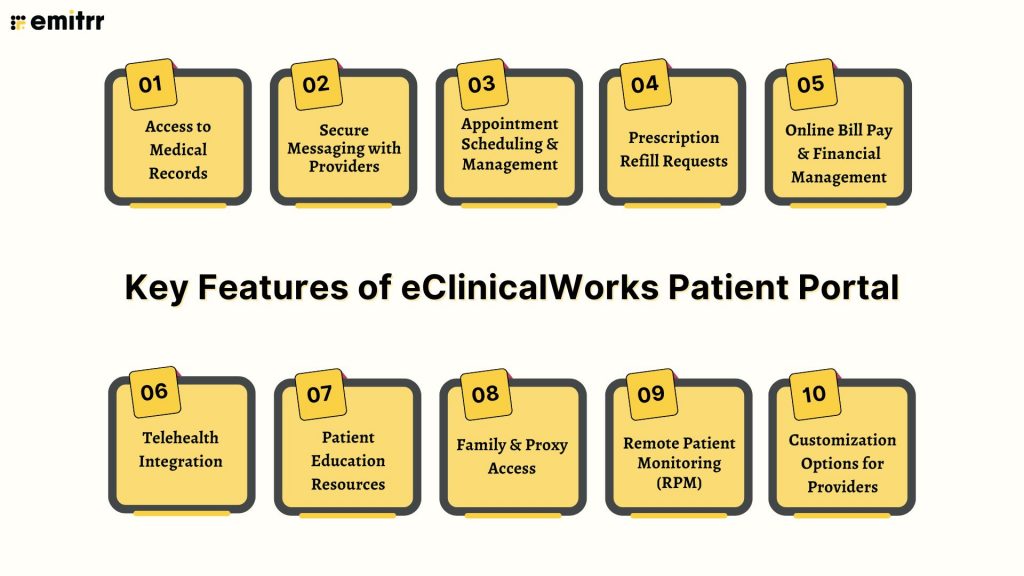
Let’s explore the major features in detail.
Access to Medical Records
With the Eclinicalworks patient portal, patients can securely access lab results, diagnoses, medications, allergies, immunization history, and more. This transparency empowers patients to take control of their health and make informed decisions.
Secure Messaging with Providers
The portal offers HIPAA-compliant texting that enables patients to ask follow-up questions, clarify prescriptions, and share updates with providers. This reduces the need for phone calls and in-person visits.
Appointment Scheduling & Management
Patients can also book appointments online, reschedule or cancel visits, and receive reminders. This reduces front-desk workload and improves scheduling efficiency.
Prescription Refill Requests
Patients can request medication refills directly through the portal. Patients can select the medication they need, submit a request, and track its status without making a phone call. This not only saves time but also ensures that patients do not miss doses due to delays in communication.
Online Bill Pay & Financial Management
Patients can view their outstanding balances, access invoices, and make payments directly through the portal. This level of transparency reduces confusion and improves trust in the billing process.
Telehealth Integration
The eClinicalWorks Patient Portal integrates telehealth capabilities, allowing patients to join virtual consultations directly from the platform.
This feature is particularly beneficial for patients in remote areas or those with mobility challenges. It also reduces no-show rates, as virtual visits are easier to attend than in-person appointments.
Patient Education Resources
With eClinicalWorks, patient portal providers can share educational materials, treatment guides, and preventive care information. This helps patients better understand their conditions.
Family & Proxy Access
Healthcare is often a shared responsibility, especially when it comes to children, elderly parents, or individuals with chronic conditions. The portal supports this through family and proxy access features. Patients can manage healthcare for children, elderly parents, and dependents. This is especially useful for caregivers.
Remote Patient Monitoring (RPM)
Some implementations of the eClinicalWorks Patient Portal support integration with remote monitoring devices. This allows patients to track vital signs such as blood pressure, glucose levels, and heart rate from home.
Customization Options for Providers
Healthcare practices can customize certain aspects of the portal to align with their workflows and branding. This includes configuring features, setting access controls, and tailoring the user experience.
Feature Summary Table
| Feature | What It Does | Benefit |
|---|---|---|
| Medical Records Access | View health data | Better patient awareness |
| Secure Messaging | Communicate with providers | Reduces calls |
| Appointment Scheduling | Book/reschedule visits | Saves admin time |
| Prescription Refills | Request medications | Improves adherence |
| Bill Pay | Online payments | Faster collections |
| Telehealth | Virtual visits | Improves accessibility |
| Education Resources | Health information | Better patient understanding |
| Proxy Access | Manage family accounts | Easier caregiving |
| RPM Integration | Track vitals remotely | Proactive care |

Benefits of eClinicalWorks Patient Portal
Improved Patient Engagement
Improved patient engagement is perhaps the most significant benefit. When patients have easy access to their health information and communication tools, they are more likely to stay involved in their care.
Better Communication
Effective communication is at the heart of quality healthcare, and the eClinicalWorks Patient Portal significantly enhances this through secure, HIPAA-compliant messaging. Secure texting ensures faster responses, fewer misunderstandings, and better continuity of care
Operational Efficiency
The eClinicalWorks Patient Portal plays a crucial role in improving operational efficiency in healthcare practices by automating several administrative tasks that would otherwise require manual effort. Administrative tasks like online appointment scheduling, medical billing, and prescription requests are automated, saving time and reducing staff workload.
Increased Patient Satisfaction
Convenience leads to happier patients and higher patient satisfaction, which directly impacts retention and reviews. When patients no longer need to wait on hold, visit the clinic for minor queries, or deal with complex administrative processes, their satisfaction naturally increases. This convenience translates into better patient retention and loyalty.
Enhanced Care Outcomes
When patients stay informed about their health, follow treatment plans, and maintain consistent communication with their providers, they are more likely to achieve better results. The portal supports this by providing continuous access to important health information and enabling timely interactions.
Limitations of the eClinicalWorks Patient Portal
Despite its advantages, the eClinicalWorks Patient Portal has several limitations that can impact user experience, patient engagement, and overall healthcare efficiency.
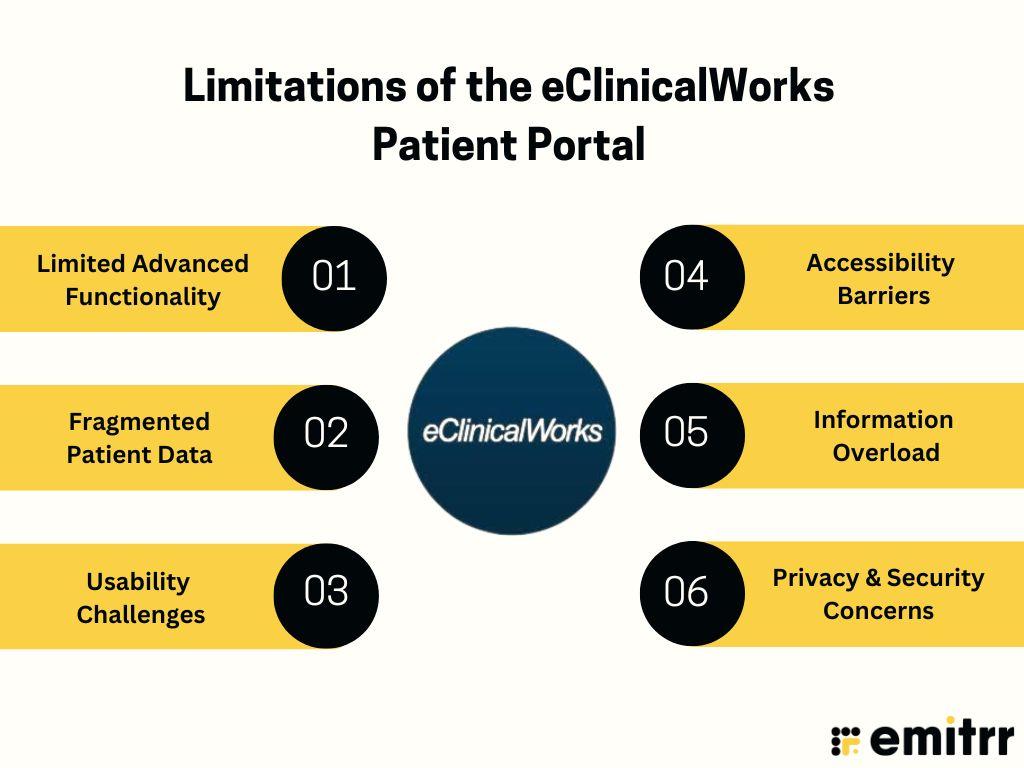
Limited Advanced Functionality
The eClinicalWorks Patient Portal primarily focuses on core features like viewing medical records, appointment scheduling, and secure messaging. However, it lacks advanced capabilities such as automated patient workflows, personalized patient engagement, and AI-driven healthcare communication.
Fragmented Patient Data
One major drawback is the lack of seamless healthcare interoperability, which can lead to fragmented patient records. Patients who consult multiple providers may not see a complete medical history within the portal, resulting in incomplete health data visibility. This gap can create confusion and inefficiencies, especially in systems that rely on integrated electronic health records (EHRs).
Usability Challenges
The portal’s interface can sometimes feel outdated, with users reporting complex navigation and non-intuitive workflows. Tasks that should be simple, like booking appointments or accessing reports, may require multiple steps. This impacts adoption rates and highlights the importance of user-friendly patient portal design and healthcare UX optimization.
Accessibility Barriers
While patient portals promote digital convenience, they may not be accessible to everyone. Elderly patients, individuals with low digital literacy, or those without reliable internet access may struggle to use the system effectively. This creates a gap in digital healthcare accessibility and patient inclusivity, limiting the portal’s overall reach.
Information Overload
The portal often presents medical data using complex terminology and clinical language, which can be difficult for patients to understand. Without simplified explanations, users may feel overwhelmed or confused when reviewing their health information. This highlights the need for patient-friendly communication and simplified health data presentation in modern healthcare systems.
Privacy & Security Concerns
Although the portal is designed with HIPAA-compliant security measures, storing sensitive patient data online always carries risks. Concerns around healthcare data security, data breaches, and unauthorized access can affect patient trust. Ensuring robust cybersecurity practices is essential to maintaining confidence in digital health platforms.
Limitations Summary Table
| Limitation | Impact on Practice | Impact on Patients |
| Limited Features | Requires additional tools | Basic experience |
| Fragmented Data | Incomplete insights | Confusing records |
| Poor Usability | Staff inefficiency | Frustration |
| Accessibility Issues | Lower adoption | Exclusion of some users |
| Information Overload | More support needed | Confusion |
| Passive Engagement | Missed opportunities | Low engagement |
Common Challenges Reported by Users
Healthcare providers often highlight:
- Too many clicks for simple tasks
- Slow performance at times
- Limited flexibility compared to modern tools
How to Maximize the Value of the eClinicalWorks Patient Portal
For Healthcare Providers
- Enable all features (messaging, billing, telehealth): Activating all available features ensures you get the full value of the eClinicalWorks Patient Portal. It helps streamline workflows while improving patient engagement and digital healthcare delivery.
- Train staff and patients: Proper training ensures both staff and patients can use the portal efficiently without confusion or errors. This improves adoption rates and enhances the overall patient experience.
- Encourage portal adoption during visits: Promoting the portal during in-person visits helps patients understand its benefits and increases usage. Higher adoption leads to better communication and reduced administrative workload.
- Combine with external engagement tools: Integrating the portal with tools like Emitrr adds automation and proactive patient communication. This enhances patient engagement through SMS, reminders, and real-time interactions.
For Patients
- Regularly check the portal: Frequently logging in helps patients stay updated on lab results, appointments, and treatment plans. This encourages active participation in their healthcare journey.
- Use messaging instead of calling: Using secure messaging saves time and allows for clear, documented communication with providers. It also reduces wait times compared to traditional phone calls.
- Stay updated on medical records: Reviewing medical records regularly helps patients better understand their health conditions. This leads to improved decision-making and adherence to treatment plans.
Traditional Portals vs Modern Patient Engagement Platforms
While tools like the eClinicalWorks Patient Portal provide a solid foundation for digital interaction, they often fall short when compared to modern patient engagement platforms that focus on automation, personalization, and proactive communication.
Key Differences at a Glance
| Capability | eClinicalWorks Portal | Modern Patient Engagement Platforms |
| Communication | Portal-based (login required) | SMS, email, chat, voice (omnichannel) |
| Automation | Limited workflows | Advanced automation & triggers |
| Personalization | Minimal | Highly personalized journeys |
| Engagement | Passive (patient-initiated) | Proactive (system-initiated) |
| Accessibility | Requires login | Instant, no-login communication |
| Appointment Reminders | Basic | Automated, multi-channel reminders |
| Patient Follow-ups | Manual | Automated recall & reactivation campaigns |
| Response Speed | Slower | Real-time communication |
| User Experience | Moderate | Intuitive and mobile-friendly |
| Analytics & Insights | Limited | Advanced reporting & performance tracking |
What This Means for Healthcare Practices
Traditional portals rely heavily on patients taking the first step, logging in, checking updates, and initiating communication. In contrast, modern platforms like Emitrr shift the approach from reactive to proactive by reaching patients where they already are on their phones.
This difference is critical in today’s healthcare environment, where patient expectations are shaped by instant communication, convenience, and personalization. Practices that adopt modern engagement tools can significantly improve patient response rates, reduce no-shows, and deliver a more seamless experience.
Enhance eClinicalWorks Patient Portal with Emitrr
This is where platforms like Emitrr come in, helping healthcare practices go beyond traditional portals by enabling proactive, automated, and multi-channel patient communication.
- Automated Appointment Reminders: Emitrr sends timely SMS and email reminders to patients, reducing missed appointments and last-minute cancellations.
- Two-Way Text Messaging: With real-time two-way texting, practices can instantly communicate with patients for confirmations, follow-ups, and queries. This increases response rates and makes communication faster and more convenient than calls.
- Review Management: Emitrr automates SMS review requests after visits, helping practices consistently collect patient feedback. This boosts online reputation and improves visibility on platforms like Google.
- AI-Powered Communication: AI-driven responses help handle common patient queries instantly without manual intervention. This reduces staff workload while ensuring quick and accurate communication.
- Multi-Channel Engagement: Emitrr enables communication across SMS, email, and voice from a single platform. This ensures patients are reached on their preferred channel, improving engagement and response.
- Appointment Scheduling via Text: Patients can book or reschedule appointments directly through text messages. This simplifies the booking process and reduces dependency on phone calls.
- Patient Recall & Reactivation Campaigns: Automated campaigns help bring back inactive patients with reminders for follow-ups or checkups. This improves patient retention and increases revenue opportunities.
- Centralized Inbox for All Conversations: All patient interactions are managed in one unified inbox, making it easy for staff to track and respond efficiently. This eliminates communication gaps and improves team productivity.
- Integration with EHR & Practice Management Systems: Emitrr integrates seamlessly with systems like eClinicalWorks, syncing patient data and workflows. This ensures a smooth and connected healthcare communication ecosystem.
- Broadcast & Bulk Messaging: Practices can send bulk messages for announcements, alerts, or health campaigns. This is useful for reaching a large patient base quickly and efficiently.
Frequently Asked Questions
The portal includes features like medical records access, secure messaging, appointment scheduling, prescription refills, online bill pay, telehealth integration, and patient education resources.
It improves patient engagement, enhances communication, streamlines administrative workflows, increases patient satisfaction, and supports better healthcare outcomes.
The portal has limitations such as limited automation, lack of personalization, usability challenges, fragmented data, and a passive engagement model that requires patients to log in.
Yes, the portal is designed with HIPAA-compliant security measures to protect patient data, though general concerns around data privacy and cybersecurity still exist.
It enables secure messaging between patients and providers, allowing faster responses, better clarity, and improved continuity of care without relying on phone calls.
Practices can use platforms like Emitrr to enable automated reminders, two-way texting, and proactive outreach, improving engagement and response rates.
Patient portals are typically passive and require login, while modern platforms offer proactive, omnichannel communication like SMS and email with automation and personalization.
Conclusion
The eClinicalWorks Patient Portal is a valuable tool that provides easy access to medical records, secure communication, and basic administrative functionality. However, it also has clear limitations, including a lack of advanced engagement features, usability challenges, and a passive interaction model
For healthcare practices looking to deliver modern, patient-centric experiences, relying solely on a portal is no longer enough.
By combining eClinicalWorks with advanced communication platforms like Emitrr, practices can improve patient engagement, streamline workflows, and deliver better healthcare experiences
Want to know more? Book a demo now!

 4.9 (400+
reviews)
4.9 (400+
reviews)