
Introduction
Chronic disease management programs bring together ongoing clinical care, patient education, monitoring, and follow-up for people with long-term conditions. Their value comes from helping patients understand what they need to do between appointments and giving them support to complete recommended care. For your practice, that means connecting the care plan with the everyday work of scheduling, answering questions, and following up.
That work becomes harder when patients need several services or see multiple providers. A patient may leave a visit with instructions to arrange monitoring, attend a specialist appointment, and return for a review, yet struggle to complete those steps. Separate reminders from different teams can add confusion, while unanswered questions and practical barriers leave care unfinished.
In this blog, we will help you understand what chronic disease management programs include, how to support patient participation, when to conduct outreach, and how to track care gaps through completion. You will also see how Emitrr helps your team manage reminders, follow-ups, education, appointment outreach, adherence communication, and staff escalation around clinician-led care.
AI Summary
- Chronic disease management programs combine individualized care plans, recurring reviews, education, and care coordination.
- Chronic disease patient engagement helps people understand recommendations, raise concerns, and participate in their care.
- Chronic disease outreach supports appointments, monitoring, referrals, and overdue follow-up.
- Comorbidities and multimorbidity increase the need to coordinate messages and responsibilities across teams.
- Chronic disease care gaps require verified completion of recommended care before they are closed.
- Emitrr supports recurring communication and staff handoffs around the clinical program.
What are Chronic Disease Management Programs
Chronic disease management programs are structured approaches to providing ongoing care and support for people with long-term conditions. They bring together individualized care plans, regular reviews, recommended monitoring, education, and follow-up. These chronic disease management services help patients understand their next steps and give care teams a consistent way to support them between appointments.
The main components typically include:
- An individualized care plan covering the patient’s needs, goals, recommended care, and involved providers.
- Scheduled reviews and monitoring based on clinical recommendations and the patient’s circumstances.
- Medication reviews with qualified clinicians, including opportunities to discuss side effects, questions, and access difficulties.
- Self-management education that helps patients understand their condition and carry out agreed daily activities.
- Care coordination across primary care, specialists, community services, and other involved teams.
- Ongoing follow-up to address outstanding actions, changing needs, and barriers to participation.
To put these components into practice, give each part of the program a clear owner. Clinicians direct assessment and treatment, while nurses and care managers may coordinate reviews and reinforce approved instructions. Patient navigators and community health workers can help with scheduling and access to support. Patients and authorized caregivers contribute their priorities, questions, and experience of following the plan.
It also helps to understand how related programs differ. Broad chronic condition management programs may support one or several conditions, while chronic disease self-management programs focus on the knowledge, skills, and confidence patients need in daily life. A Medicare chronic care management program delivers a defined service with specific eligibility and service requirements. If your practice plans to offer that service, address those requirements alongside the operational steps for implementing a chronic care management program.

How Program Needs Differ Across Chronic Conditions
Use the patient’s care plan to decide what support and outreach they need. Someone attending regular reviews may need preparation reminders, while someone with an outstanding referral may need help arranging an appointment. Clinical teams determine appropriate tests, review intervals, and escalation criteria; your communication process should help patients act on those recommendations.
| Condition or patient group | Recurring care needs | Engagement focus | Outreach example |
| Diabetes | Recommended monitoring, follow-up visits, medication reviews, and self-management education | Help patients understand next steps and discuss barriers | Remind a patient to book a recommended review and ask whether they need scheduling help |
| Hypertension | Scheduled reviews, medication discussions, and home-reading reviews when requested | Make monitoring and follow-up instructions easy to understand | Send a visit reminder with instructions to bring requested blood pressure readings |
| Heart disease or heart failure | Ongoing reviews, specialist appointments, and follow-up after care transitions | Clarify the next appointment and the team responsible for questions | Follow up on an outstanding cardiology appointment and route questions to the care team |
| Asthma | Regular reviews, inhaler education, and clinician-approved action-plan guidance | Encourage questions about prescribed treatment and care instructions | Invite the patient to schedule a recommended asthma review |
| Chronic obstructive pulmonary disease, or COPD | Follow-up visits, treatment education, and relevant specialist or rehabilitation referrals | Identify difficulties attending appointments or accessing recommended care | Send a referral reminder and offer scheduling assistance |
| Comorbidities | Care for an index condition alongside additional conditions | Coordinate related appointments and instructions | Combine related diabetes and hypertension outreach where appropriate to avoid duplicate requests |
| Multimorbidity | Ongoing care for several long-term conditions across providers | Keep next steps manageable and involve authorized caregivers where appropriate | Coordinate reminders and direct questions to a named care coordinator |
Comorbidities refers to additional conditions considered alongside an index condition.
Multimorbidity considers multiple long-term conditions together, without necessarily treating one as the main condition. Both can create overlapping appointments and instructions, so review the patient’s wider care needs before adding another separate outreach sequence.
For example, a patient receiving requests from primary care and a specialist may need help understanding which appointment to arrange first. Give them a named contact who can clarify those next steps and coordinate unresolved questions. This addresses one of the recurring chronic disease management challenges: care becomes fragmented when each team manages its part without considering the patient’s overall workload.
How Patients Participate in Chronic Disease Management Programs
Chronic disease patient engagement helps people understand their care and take an active role in it. To support participation, make the next action clear, give patients a way to ask questions, and respond when they report a difficulty. Care plan follow-through depends on whether patients can put the recommendation into practice between visits.
Make the Care Plan Understandable
Turn the chronic disease management care plan into instructions the patient can use after leaving your practice. Explain what needs to happen next, when it is needed, and whom to contact for help. For example, “Please arrange your recommended follow-up before the end of next month” gives a clearer action than “Continue routine follow-up.”
Build shared care goals around the patient’s priorities and circumstances. Someone balancing shift work and caregiving may need a workable appointment time before they can follow through. Two-way patient communication lets them explain that need, while asking them to describe the next step in their own words can reveal confusion. This is how communication in chronic disease outcomes connects clinical recommendations with actions patients understand.
Support Day-to-Day Self-Management
Patient self-management includes the activities a person carries out between visits under the plan agreed with their clinical team. Deliver self-management education around an immediate need, such as preparing for a review, understanding approved instructions, or knowing how to raise a question. Patient education is easier to use when you explain why the information matters and avoid overwhelming people with unrelated resources.
Patient activation describes the knowledge, skills, and confidence a person has to participate in managing their health. Help patients build that confidence by discussing difficulties and agreeing on manageable actions. Medication adherence communication may uncover refill access problems or uncertainty about instructions. Route those questions to qualified staff and use appropriate strategies for medication adherence in chronic care to address the reported barrier.
Address Barriers to Participation
When a patient misses follow-up, ask what made the next step difficult. Transportation, affordability, work schedules, limited digital access, and unclear instructions can all affect participation. Patient-centered chronic care gives your team a process for responding to those barriers, whether that means offering another appointment time, arranging a callback, or connecting the patient with a navigator.
Social determinants of health describe the wider conditions affecting health and access to care. Health-related social needs are individual needs, such as transportation or food insecurity, that may require community support. Health literacy and language access also influence whether patients can act on instructions. Use multilingual patient outreach and accessible wording for routine contact, with qualified language assistance available for clinical discussions when needed.
Federally Qualified Health Centers, or FQHCs, often serve patients facing several access barriers. FQHC chronic disease management benefits from clear patient communication for FQHCs and coordination between clinical staff, navigators, and community services. Rural chronic care may require phone-based assistance when travel distances or unreliable internet limit other options. Appropriate caregiver engagement, with patient permission, can also help underserved populations manage appointments and instructions, supporting health equity through more accessible participation.
As you involve caregivers and communicate across channels, patient privacy remains essential. Watch these common HIPAA mistakes to identify communication practices your team should review:
When to Contact Patients During Chronic Disease Management
Plan chronic disease outreach around a specific care need rather than sending the same message to every patient. Each contact should explain why you are reaching out, what the patient can do next, and how to get help. Assign responsibility for replies before starting outreach so requests do not sit unanswered.
Enrollment and the First Follow-Up
At enrollment, explain the program’s purpose, how patients can reach the team, and what happens next. Confirm contact details, preferred language, communication channels, and any authorized caregiver arrangements. Establishing these details early gives your team a reliable way to follow up and helps patients recognize future messages from the practice.
Start appointment outreach when the first recommended visit remains unbooked. Identify the practice, explain that a follow-up needs to be arranged, and offer scheduling assistance. A defined patient communication workflow should establish when that contact happens, who handles replies, and what staff do if the patient does not respond.
Routine Reviews and Recommended Monitoring
Use patient recall for recommended care that has not yet been scheduled. Once the patient books, move to appointment reminders, preparation instructions, and confirmations. Keeping these stages separate helps you avoid asking someone to schedule a visit they have already arranged.
Automated patient outreach can support routine timing, while SMS outreach gives patients a convenient way to confirm or request help. Add suitable alternatives through multichannel patient outreach when texting does not meet their needs. Include relevant preventive services when they form part of the care plan, using the clinical recommendation to determine the message and timing.
Missed Appointments and Overdue Care
Use missed appointment follow-up to help patients return to care and identify what prevented attendance. Ask whether they need another time or assistance with a practical barrier. If someone reports a transportation problem, assign it to the appropriate staff member before sending another scheduling request.
Overdue patient follow-up can also support patient reactivation when someone has fallen out of contact. Keep separate records of reconnecting with the patient, booking a visit, and completing recommended care. That distinction is particularly useful for teams managing chronic disease management in small clinics, where the same people may handle incoming calls, scheduling, and follow-up lists.
Referrals and Changes in Care
Use referral reminder outreach to find out whether the patient has arranged the recommended service and what help they need. Some patients need contact details, while others are waiting for the receiving office or seeking clarification. Coordinated chronic care requires a clear owner for those unresolved questions, supported by documented chronic care workflows.
Changes in care, including hospital discharge, may create additional appointments and instructions within the ongoing program. Help patients arrange recommended follow-up and direct questions to the responsible clinician. Broader efforts to reduce hospital readmissions in chronic patients require clinical coordination, with outreach helping patients act on the transition plan.
How Programs Help Close Chronic Disease Care Gaps
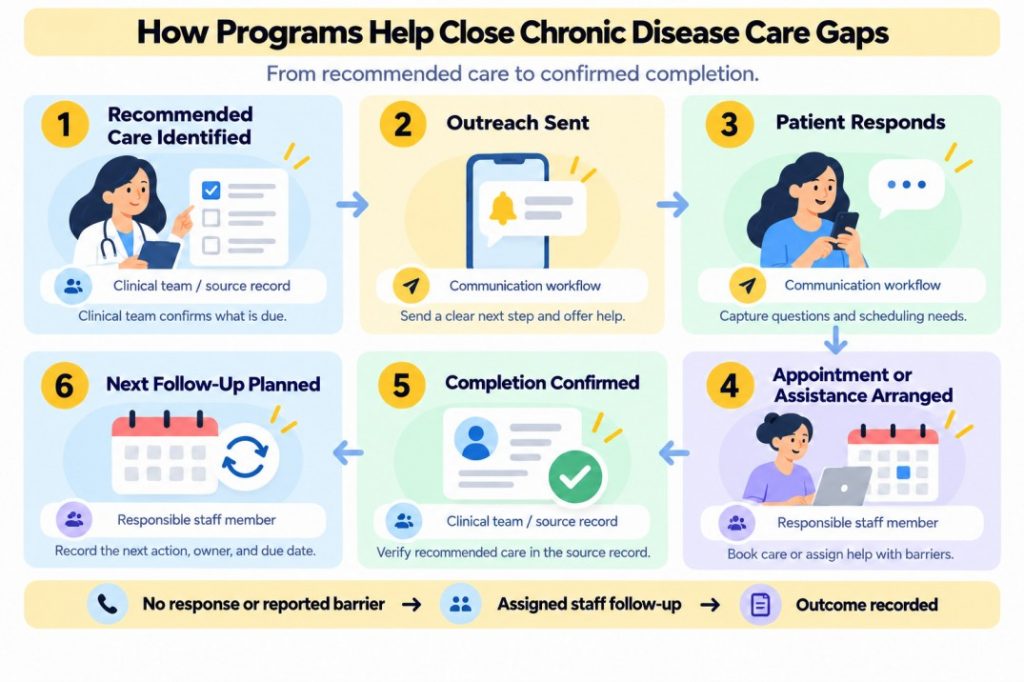
Chronic disease care gaps occur when recommended care remains outstanding. To manage them, track the patient’s progress from the identified need through outreach, assistance, and confirmed completion. Make unresolved work visible so a reply such as “I could not get an appointment” leads to staff action rather than being counted as a completed follow-up.
Identify the Recommended Action
Start with a specific recommendation from the clinical team or an appropriate source system. Establish what is due, when it is needed, and which patients require follow-up. Examples include overdue monitoring, an outstanding review, an incomplete referral, or preventive care gaps relevant to the patient’s care plan.
Before starting care gap outreach, check whether the action was completed elsewhere or whether the recommendation has changed. This helps your team avoid unnecessary requests and contact patients whose care is still outstanding. Clear care coordination also establishes who can confirm outside care and resolve conflicting information.
Track the Response and Next Action
Track each patient’s response, the action still outstanding, and who will follow up so your team can see which care gaps need attention. Depending on your systems, care gap tracking may use statuses such as not contacted, contacted, booked, declined, and needs assistance. Add a next action and follow-up date to unresolved items.
For patients with multimorbidity, review overlapping requests before sending another message. One coordinated conversation may resolve several scheduling questions and reduce repeated contact. Care gap workflows should also account for patients who decline or defer care, with their response documented and routed through your practice’s process for further review.
Confirm Completion Before Closing the Gap
Define what evidence your team needs before closing care gaps. A booking shows that care is planned, while attendance shows that the patient arrived. An external referral may require confirmation from the receiving organization, and monitoring may require a documented result or review before the recommended action can be considered complete.
Update outreach lists when reliable completion information becomes available. Care gap automation can support reminders, timing, and staff follow-up, but message delivery, patient replies, and submitted forms record communication progress. Use the relevant clinical or administrative record to establish whether the care gap can be closed.
How Emitrr Supports Chronic Disease Management Programs
Emitrr supports the communication layer across recurring chronic-care workflows. Your team can use it for reminders, appointment outreach, approved education, adherence communication, and staff follow-up. Clinical teams and their systems remain responsible for assessment, treatment decisions, care plans, and identifying clinical care gaps.
When evaluating patient engagement tools for chronic care, consider what happens after a message is sent. Patients need a way to ask for help, and staff need the context and ownership to respond. That connection between outreach and follow-up is where communication tools support the wider program.
Reminders and Confirmations for Recurring Care
Emitrr supports automated appointment reminders and two-way communication around upcoming visits. Patients can respond to reminders or request scheduling assistance, giving your team visibility into appointments that need attention. Staff can focus on those requests instead of manually contacting every patient for the same confirmation.
Supported electronic health record, or EHR, integrations connect relevant appointment information with communication workflows. Available synchronization and appointment-status updates depend on the integration and setup. For recurring chronic-care visits, this helps your team keep reminders aligned with scheduled care and manage patient replies through an established process.
Recall and Reactivation for Overdue Follow-Up
Emitrr’s text campaigns support targeted, multistep outreach for recall and follow-up. Your practice can contact appropriate patient lists or use supported workflow criteria to invite patients back for recommended visits. The clinical team or reliable source data determines who is due, while the campaign supports the communication needed to arrange care.
AI voice or SMS agents can assist with configured outreach conversations and supported scheduling tasks. Their available actions depend on the agent setup and scheduling integration. This gives your team a repeatable way to conduct appointment outreach while directing exceptions and unresolved requests to staff.
Want to see how scheduling assistance fits into patient outreach? Watch Emitrr’s AI Scheduling Assistant in action and explore how it can support your appointment-booking workflow:
Two-Way Messaging for Education and Adherence Follow-Up
Use two-way messaging to share clinician-approved education and next-step instructions while giving patients a way to respond. Someone who does not understand a preparation instruction or cannot obtain a refill can raise the issue in the same conversation. Staff can address the administrative question or direct it to the appropriate clinical team member.
Medication adherence outreach becomes more useful when patients can explain a difficulty rather than simply receive another reminder. Supported translation tools can assist with routine multilingual communication, using suitable channels and procedures for the information shared. Build HIPAA-compliant messaging for chronic care management into your approach while keeping prescribing and treatment changes with qualified clinicians.
Shared Inbox and Escalation for Care-Team Follow-Up
Emitrr brings calls, texts, and voicemails into a shared conversation environment so staff can review patient communication in context. Use assignments, tags, internal notes, and team collaboration to establish ownership of unresolved requests. For example, a patient asking for referral assistance can be assigned to the person responsible for arranging that follow-up.
Define who reviews reported concerns and when they need attention through your practice’s escalation process. The shared inbox supports the handoff and preserves conversation context, helping staff continue the discussion without asking the patient to start again. Clinical assessment and decisions remain with the care team.
Connected Workflows for Consistent Outreach
EHR-integrated communication can connect supported appointment activity with relevant reminders and follow-ups. Emitrr’s configured workflows support communication sequences, routing, and responses, helping your team carry out recurring tasks consistently. Where supported and configured, reply-aware SMS sequences can stop further messages within the response window and route replies for staff attention.
Form-status branches can also support missing-information follow-up. For example, digital intake forms may collect requested information before a review, with reminders directed to incomplete submissions. A completed submission advances the administrative workflow, while the care team determines whether the information is sufficient and what clinical action is needed.
Use automation in chronic disease management to make repeated communication tasks more consistent and reduce manual follow-up. Available triggers, branching, and write-backs depend on the supported integration and workflow setup. Keep those communication milestones separate from verified care completion when reviewing program progress.
How to Measure Chronic Disease Program Performance
Measure where patients stop progressing so your team can address unanswered outreach, booking difficulties, or incomplete care. Track communication, participation, and completion separately to see which part of the process needs attention. This gives you more useful information than a campaign delivery rate alone.
- Reach shows whether your practice has usable contact details and can successfully contact patients. Review failed messages, outdated numbers, and channel preferences.
- Engagement shows replies, questions, reported barriers, and unresolved conversations. Check whether staff have acted on responses that require assistance.
- Participation shows appointments booked and attended. Compare these stages to identify where scheduling progress does not lead to attendance.
- Care completion shows recommended actions confirmed through the appropriate records. Define the evidence needed before counting an item as complete.
- Clinical outcomes show condition-specific results selected and assessed by the care team. These require clinical information and appropriate interpretation.
Patient outreach reporting can highlight unanswered conversations, repeated attempts, and campaign activity. Clinical records establish whether recommended care occurred, while program-wide financial performance requires a broader assessment of staffing, costs, and reimbursement. Use the appropriate source for each question rather than expecting communication reports to measure the whole program.
Review these measures together when deciding how to improve chronic disease management outcomes. Strong reach with low booking may indicate scheduling barriers or unclear instructions. High booking with low attendance may call for a closer look at appointment timing, preparation, or access difficulties.
Key Takeaways
- Chronic disease management programs combine clinical care, education, coordination, and recurring follow-up.
- Patient engagement helps people understand recommendations and participate in their care.
- Outreach should reflect the next recommended action and the patient’s circumstances.
- Comorbidities and multimorbidity require coordinated appointments, instructions, and responsibilities.
- Care gaps remain open until the recommended action is verified as complete.
- Emitrr supports recurring communication, patient responses, and staff escalation around clinician-led care.
Frequently Asked Questions
Chronic disease management programs organize ongoing care for people with long-term conditions. They combine individualized care plans, reviews, education, coordination, and follow-up to support recurring needs.
Chronic disease management programs broadly support ongoing care for one or more conditions. Medicare Chronic Care Management is a defined service with specific eligibility, care-planning, documentation, and service requirements.
Patient engagement helps people understand recommendations, discuss concerns, and take the next step in their care. It also helps teams identify barriers that could prevent follow-through.
Programs coordinate appointments, instructions, and responsibilities across providers. A named contact and appropriate caregiver involvement help patients manage overlapping care needs.
Teams identify outstanding recommended care, record outreach and responses, assign unresolved actions, and verify completion through the relevant records before closing the gap.
Emitrr supports reminders, recall campaigns, two-way messaging, approved education, adherence communication, and staff follow-up. Supported integrations connect relevant appointment information with configured communication workflows.
Conclusion
Chronic disease management programs deliver practical value when patients understand what comes next and can get help completing it. Start by making the next recommended action clear, giving patients a way to respond, and assigning unresolved needs to someone who can follow up. Confirm completion through reliable records so your team knows where further support is needed.
Emitrr helps your practice manage the recurring communication around that work, from appointment reminders and recall outreach to education, adherence messages, and staff handoffs. By connecting outreach with patient responses, your team can spend less time repeating routine communication and give patients a clearer path back to care.
Book a Demo to see how Emitrr supports chronic disease outreach and follow-up.

 4.9 (400+
reviews)
