
Introduction
A patient just moved to a new city. She opens Google, types “family doctor near me,” and scans the results. She books with the first practice that lets her pick a slot. The second one on the list required a phone call. She never made it.
The third practice, which was actually closest to her apartment and probably the best fit, never appeared in search at all. Its Google Business Profile had an old address. Google had quietly stopped surfacing it months ago.
Three practices. Three different outcomes. None of them involved clinical quality, bedside manner, or wait times. The patient never got that far.
This is how most independent medical practices lose new patients: not to a better competitor, but to friction in their own digital front door. It almost always happens in two places: getting found, and getting booked.
The Gap Nobody Audits
Independent practices audit clinical quality constantly. They chart reviews, peer review, and quality metrics. Very few audit the five seconds after a patient lands on the homepage.
Most practices treat their website like a business card, not like the first real interaction a new patient has with the practice.
We looked at the public websites of 225 independent medical practices running on athenahealth: a mix of primary care, specialty care, and urgent care, all small to midsize. For each one, we checked what a prospective patient would actually encounter, from how the practice appears in search results to what happens when someone tries to book.
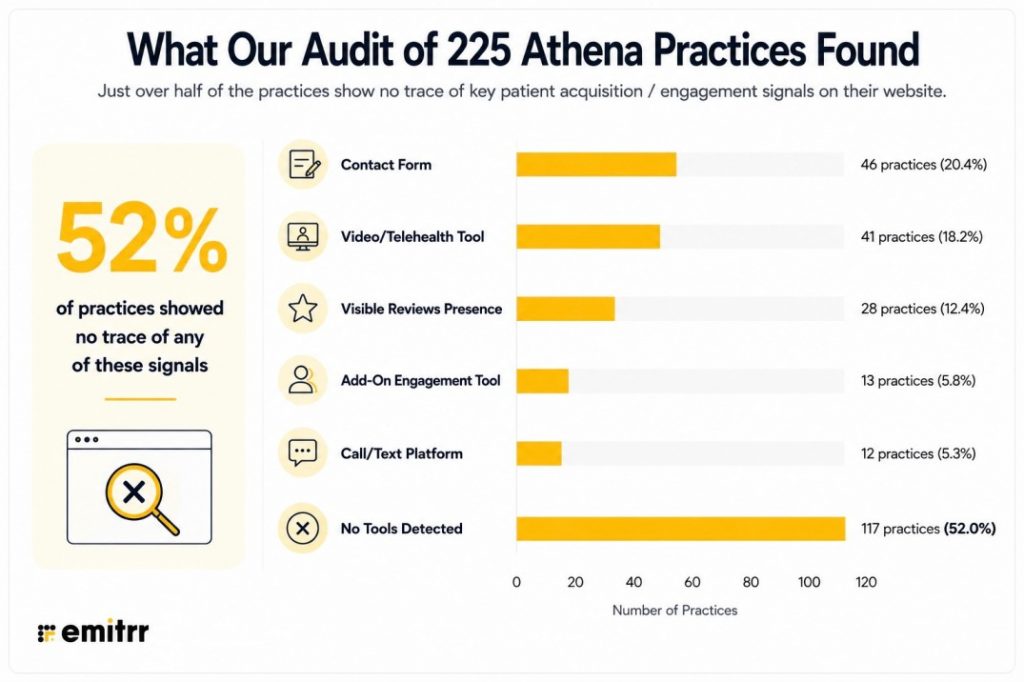
Just over half the practices in our dataset show no trace of any of these five signals on their public website at all. Not a bad version of a booking flow or a review widget. Nothing.
And where the signals do show up, they rarely show up together. Only 6 practices combine a review-platform presence with any kind of online form. Only 3 pair a review presence with a dedicated engagement tool. Whatever investment these practices have made in their digital front door, it tends to be one isolated fix, not a connected system.
Problem 1: Patients Can’t Find You In Search
Search is where the modern patient journey starts, and it’s how patients find doctors online now, well before they ever dial a number. In a December 2024 survey of over 1,000 U.S. adults, 84% said they check online reviews before choosing a new provider (How Patients Choose Their Doctors, 2025).
Showing up starts with the basics: a complete, accurate Google Business Profile, correct hours, current photos, and the same name, address, and phone number everywhere you’re listed, what’s known as NAP consistency.
Get these right, and you show up in the local pack, the map and three-listing block above the regular results, which is where most local searches get decided. Google treats a mismatched listing as a trust problem, not a typo.
A Quick Local Search Fix:
- Claim and verify your Google Business Profile. Check that the address, hours, and phone number are still accurate today, not from whenever it was first set up.
- Refresh your photos and service list at least once a quarter so the listing doesn’t read as abandoned.
- Match your name, address, and phone number everywhere: your website, your Google Business Profile, and every directory you’re listed in.
- Ask for a Google review as a normal part of checkout, not as an afterthought.
- Respond to every review within a few days, good or bad. Google and patients both notice.
Are Stale Ratings Killing Your Conversions?
Only 28 of the 225 practices we studied, 12.4%, had any review-platform tool detectable on their website at all. That’s not a claim about star ratings or review volume; it’s a sign that reputation management, as a practice habit, simply isn’t on most independent practices’ radar. In a separate 2026 survey, 75% of patients said they won’t book with a provider rated below 4.0 stars (2026 Patient Choice Report).
A four-star average built mostly from 2023 reviews reads, to a patient in 2026, like a practice that stopped paying attention. Recency and frequency matter as much as the review count itself.
AI Search Is Already Part Of This
Patients aren’t only typing into Google anymore. AI-driven search and assistant tools are increasingly part of how people research a new doctor, and the practices that show up there tend to be the ones with clean, structured, up-to-date information everywhere else. Medical SEO is becoming part of that same foundation, and the fundamentals that support local search also help AI systems understand and surface a practice: a complete profile, consistent listings, and a website that clearly explains who you are and what you treat.
Problem 2: When They Do Find You, They Hit a Wall
Visibility solves half the problem. The other half starts the moment a patient lands on your website.
A patient trying to book outside office hours finds no way to request an appointment until the next morning. A patient who reaches voicemail usually doesn’t leave a message. They just call the next practice on the list. Missed calls are the clearest symptom of a practice’s booking gap, and most independent practices have no system built to catch them. None of this shows up in a monthly revenue report, but it shows up in how many new patients never make it onto the schedule.
The Booking Gap: A Form, Not A Button
Among the 225 practices we studied, 46 (20.4%) had a contact form on their site. That’s better than nothing, but it’s a different promise than booking. A form says “tell us how to reach you, and we’ll follow up.” It doesn’t confirm anything.
A form asks a patient to hand over their information and wait. A phone call asks them to be available during business hours and wait for a response. A patient comparing your practice to one where the process takes fifteen seconds is going to notice, even if they can’t name why.
The opportunity is to connect athenahealth with a patient-facing communication layer that can make this process more direct. Real-time online self-scheduling can let patients move from searching for an appointment to selecting a time without having to call the practice.
The same approach can extend beyond scheduling. After-hours patient messages can be managed without overwhelming staff, rather than leaving requests to sit until morning.
Quick Tips To Implement Self-Serve Booking On Your Website:
- Put a real-time patient self-scheduling button on your homepage and every service page, not buried under “Contact Us.”
- Let patients request appointments after hours instead of forcing them to wait for morning. Booking behavior across the industry consistently skews later than office hours; Experian Health’s 2024 State of Patient Access survey found 89% of patients consider anytime scheduling important.
- Add a chat option, live or AI-assisted, so a patient with a quick question doesn’t have to call and wait.
- Route missed calls to an automatic text-back instead of straight to voicemail, so a patient who couldn’t get through still gets a way to respond.
- Enable two-way texting so patients can receive confirmations and reminders and respond directly by text, instead of relying only on phone or email.
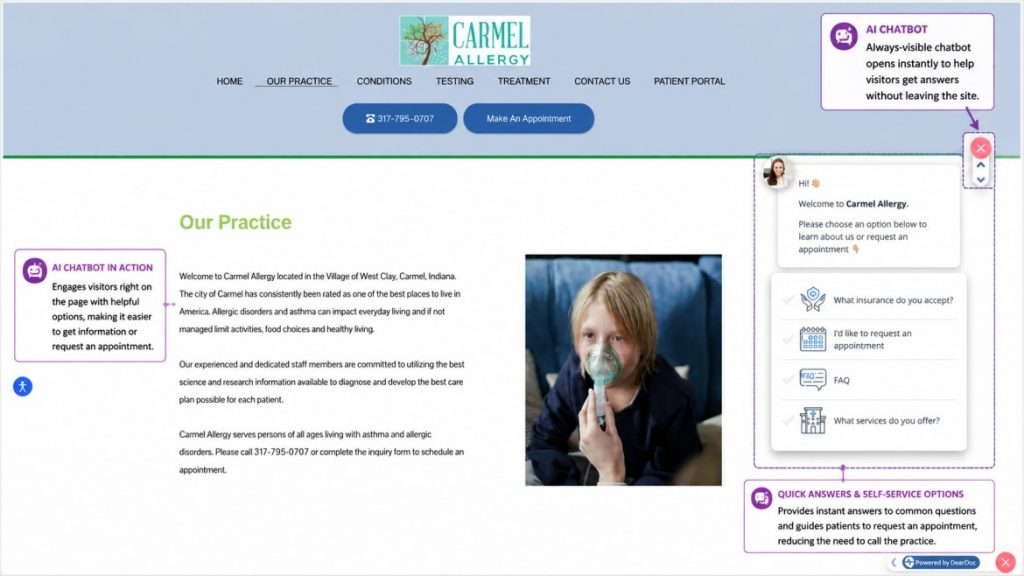
For example, Carmel Allergy uses an AI chatbot on its website to answer common patient questions and guide visitors toward requesting an appointment. This gives patients a way to get help without having to call the practice or wait for a response.
What Athena Was Built For, and What It Wasn’t
Athena is a strong clinical and billing system, built to run the parts of a practice patients never see: charting, coding, claims, compliance. What it wasn’t built to be is your front door. But the front door is where patient acquisition for medical practices actually happens now.
That gap doesn’t go unnoticed. 5.8% of the 225 practices, 13 sites, had already added a separate patient-engagement tool (PatientPop or Klara) on top of athena. That’s a sign some practices felt this friction was enough to go shopping for a fix themselves. Interestingly, none of those 13 practices also had a communication-first platform tool or a contact form, so even the practices investing in a fix tend to bolt on one piece, not a full system. The engagement-tool adopters also skewed toward specialty care, especially women’s health and OB-GYN practices, more than primary care.
Most practices haven’t gotten even that far. They’re still running exactly what athena gives them.
Athena alone was never going to solve this. It isn’t a gap in athena’s clinical or billing capability, it’s simply outside what that system was built to do. The fix isn’t replacing athena, and it isn’t waiting on athena to become something it isn’t. It’s building the layer that sits in front of it, on the website, the one a patient meets before they ever become an athena record. An athenahealth native integration that handles scheduling, review requests, and missed-call recovery is how a practice closes both gaps without adding work for front-desk staff, turning the EHR practices already trust into the patient acquisition engine it was never built to be on its own.
The Practices That Did Something About It
The practices that stood out in our dataset weren’t spending more or staffing up. They’d made a small number of decisions and executed them. Here’s what separated them, based only on what we could verify from their public websites.
On Getting Found:
The practices with a visible review presence tended to combine it with something else on the page, most often a way to submit an inquiry. Only 6 of the 225 practices paired a review-platform tool with a contact form, and those pairings clustered in specialty care rather than general primary care. That’s a small number, but it’s a meaningful signal: visibility and responsiveness tend to move together, or not at all.
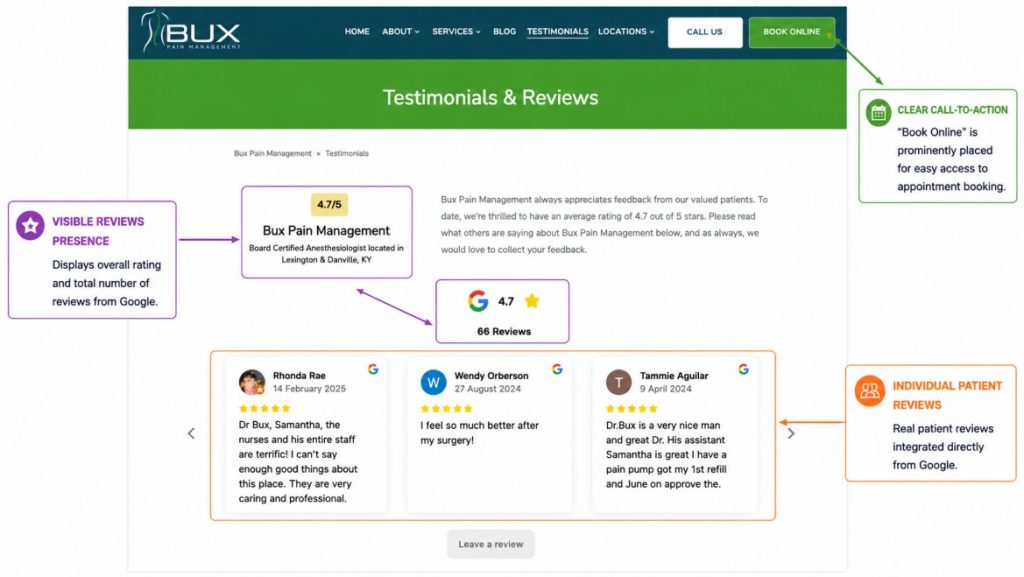
Example: Bux Pain Management makes patient reviews highly visible while keeping “Book Online” accessible from the main navigation.
On Getting Booked: What the Highest-Converting Sites Did
The 13 practices that had already added a dedicated patient-engagement tool on top of athena represent the clearest example of practices treating their website as more than a brochure. All 13 made a deliberate choice to layer on something athena doesn’t provide out of the box. What’s notable is what they didn’t also do: none of them combined that tool with a communication platform or an online form, which suggests even the more proactive practices in our dataset are solving this one piece at a time rather than building a connected patient-acquisition system.
For example, Sound Medical Weight Loss uses its website to guide new patients through a digital intake process before they move further into the appointment journey. The screening flow asks whether the visitor is a new or returning patient and moves them through the intake process step by step.
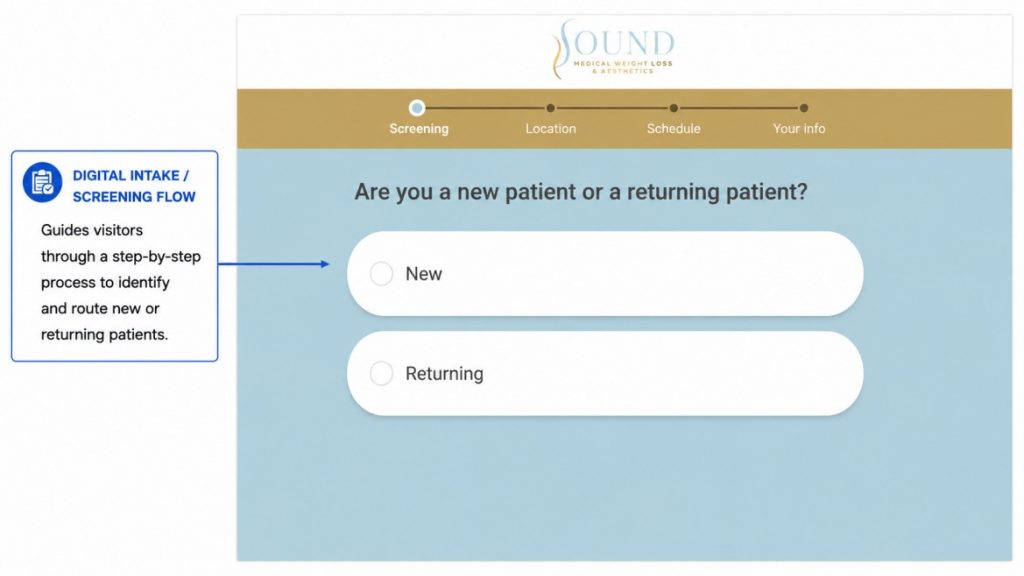
It’s a simple example of how a practice can turn its website into an active part of the patient journey rather than just a place to display information.
That’s the opportunity most of the 225 haven’t acted on yet: not a bigger budget, but a system where visibility, booking, and follow-up work together instead of as separate, disconnected fixes.
In Conclusion
The audit shows that having a website isn’t enough. Patients need a clear path from discovering a practice to taking the next step, whether that’s booking an appointment, asking a question, or getting a response.
For independent practices using athenahealth, the answer isn’t replacing the systems already in place. It’s creating a more connected patient experience around them. Emitrr works alongside athenahealth to help practices turn that experience into a smoother path from discovery to engagement.
Want to see what that could look like for your practice? Book a demo with Emitrr.


 4.9 (400+
reviews)
4.9 (400+
reviews)