

Introduction
The days after hospital discharge are among the riskiest in a patient’s care. New medications arrive, old ones change, follow-up tests are pending, and the patient is home with a stack of instructions and nobody to ask. Transitional care management (TCM) exists to close that gap. It pays a practice to make contact quickly, reconcile medications, and see the patient soon after discharge.
The service has strict timing rules. The practice must reach the patient within two business days, see them within 7 or 14 days, and document each step. Miss the window, and the claim fails. Worse, the patient may have gone home without anyone checking on them.
Most TCM programs do not fail on clinical skill. They fail on logistics: nobody knew the patient was discharged, the first call went to voicemail, the visit landed on day 16, or the attempts were never written down. This guide covers the requirements, the CPT codes and billing rules, a day-by-day workflow, and how to make the two-day patient outreach reliable.
What Transitional Care Management Services Cover
Transitional care management services support a patient’s move from an inpatient or facility setting back into the community. They combine quick outreach, care coordination, medication management, and a timely visit into one billable service for the 30 days after discharge.
Qualifying discharge settings include:
- Inpatient acute care hospital
- Long-term acute care hospital
- Skilled nursing or nursing facility
- Inpatient rehabilitation facility
- Hospital observation status
- Partial hospitalization
The community setting the patient returns to is typically home, an assisted living facility, or a similar residence.
The 30-day service period starts on the date of discharge and runs for the next 29 days. A patient discharged on the 1st is in the TCM period through the 30th.
Which patients and practices it suits. TCM fits patients with a meaningful need for follow-up: new or changed medications, pending tests, multiple conditions, or limited support at home. Primary care practices, specialty practices that manage the patient’s ongoing care, and other qualifying clinicians can offer it, provided they can meet the contact and visit deadlines.
What TCM is not:
- It is not a discharge-day service. The hospital’s discharge management is separate.
- It is not ongoing chronic care. TCM covers one defined 30-day transition. Chronic conditions that require ongoing management fall under programs such as chronic care management.
Transitional Care Management Requirements: The Three Required Elements
Every TCM claim rests on three elements. All three must happen, in order, within the deadlines, and all three must be documented.
| Element | Requirement | Who Can Perform It | What to Document |
| Interactive contact | Contact the patient or caregiver within 2 business days of discharge, or make two timely, documented attempts | Physician, qualified practitioner, or clinical staff under general supervision | Date and time, person who made contact, method, summary, and each attempt |
| Non-face-to-face services | Care coordination, education, and follow-up during the 30 days | Practitioner for clinical review; clinical staff for coordination, education, and adherence support | What was done, by whom, and when |
| Face-to-face visit | Within 7 days (99496) or 14 days (99495) of discharge | The billing practitioner | Visit date, decision-making rationale, and medication reconciliation date |
Interactive Contact Within 2 Business Days
The practice must make interactive contact with the patient or caregiver within two business days of discharge. Business days are Monday through Friday, excluding holidays. A discharge on a Friday means the deadline is the following Tuesday.
The contact can be by phone, email, or face-to-face. It must allow a real exchange about the patient’s status and needs, not just a scheduling message. Per Medicare contractor guidance, automated tools such as chatbots and voice assistants do not count as direct contact, so a person must complete the interactive exchange. A physician, qualified practitioner, or clinical staff can make it. Administrative staff cannot.
If the first two attempts fail, keep trying until contact succeeds.
Non-Face-to-Face Services During the 30 Days
Throughout the period, the practice provides services that support the transition. There is no minimum time requirement, but the work must be documented.
The practitioner typically:
- Obtains and reviews the discharge information
- Reviews the need for follow-up on pending tests and treatments
- Interacts with other clinicians who will assume care
- Educates the patient, family, or caregiver
- Establishes or re-establishes referrals
- Helps arrange follow-up with community providers and services
Clinical staff typically:
- Communicate with home health agencies and community services
- Educate the patient and caregiver on self-management
- Assess and support treatment adherence, including medication management
- Identify community and health resources
- Help the patient access care and services
The Face-to-Face Visit (7 or 14 Days) and Medication Reconciliation Deadline
The billing practitioner must see the patient in person (or by telehealth, if it meets Medicare telehealth rules) within 7 calendar days for 99496 or 14 calendar days for 99495.
Medication reconciliation and management must be completed on or before the date of the face-to-face visit. Many practices handle reconciliation by phone or during pre-visit prep so the clinician starts the visit with a current list. This step is clinical work. Staff can collect what the patient is taking, but the clinician or qualified staff reconcile it against the discharge medication list.

Transitional Care Management CPT Codes and TCM Billing Requirements
99495 vs. 99496: Medical Decision-Making and Visit Timing
Two CPT codes cover TCM. The difference is the complexity of decision-making and how soon the visit happens.
| Code | Decision-Making Complexity | Visit Window | Contact Window |
| 99495 | At least moderate | Within 14 days of discharge | Within 2 business days |
| 99496 | High | Within 7 days of discharge | Within 2 business days |
A patient who qualifies for 99496 on complexity but is seen on day 10 can only support 99495, assuming moderate complexity criteria are also met. Choose the code that the documentation supports, not the one that pays more.
Who Can Bill, One Provider Per Period, and Same-Period Billing Restrictions
Physicians of any specialty can bill TCM, along with nurse practitioners, physician assistants, clinical nurse specialists, and certified nurse midwives, within their state scope of practice.
Only one provider can bill TCM for a given discharge, and Medicare pays only the first eligible claim. The face-to-face visit is part of the TCM service and cannot be billed separately on top of it.
Some other services can be billed in the same period if they are medically necessary and the time is not counted twice. Chronic care management is a common example. Other services, such as care plan oversight, cannot be billed by the same practitioner during the period. Billing rules shift over time, so check the current CMS guidance and your payer policies before building a billing process around them.
Claim Timing and Date-of-Service Rules (CMS Guidance vs. Payer Variations)
CMS guidance allows practices to report the date of service as the date of the face-to-face visit and to submit the claim once that visit occurs, without waiting for the 30 days to end. Some commercial payers and Medicaid plans follow different rules, such as requiring the claim date to match day 30 or requiring different documentation. Confirm each major payer’s policy and build the differences into your billing workflow.
What an Audit-Ready TCM Record Contains
Keep these items in the chart, in one findable place:
- [ ] Discharge date and discharging facility or setting
- [ ] Source of the discharge notification and the date it was received
- [ ] Date, time, person, method, and summary of the interactive contact
- [ ] Every contact attempt, with date, time, method, and outcome, if contact was not made on the first try
- [ ] Review of the discharge information
- [ ] Non-face-to-face services provided, with date and staff member
- [ ] Face-to-face visit date and location
- [ ] Medical decision-making rationale supporting 99495 or 99496
- [ ] Medication reconciliation date
Where TCM Claims Get Denied
- Missed 2-business-day contact. No contact and no documented second attempt within the window.
- Visit outside the window. The visit happened on day 9 for a 99496 claim, or day 15 for a 99495 claim.
- A second provider billing. Another practice submitted a TCM claim first for the same discharge.
- Readmission mid-period. The patient returned to the hospital before the process finished, and the claim does not match the new circumstances. A readmission does not always end the opportunity, but the billing path depends on the timing, so work with your billing lead.
- Incomplete documentation. The note lacks the contact details, the reconciliation date, or the decision-making rationale.
The Transitional Care Management Workflow, Day by Day
A TCM workflow turns the requirements into assigned tasks with deadlines. The table below shows one version. Adjust the owners to your staffing.
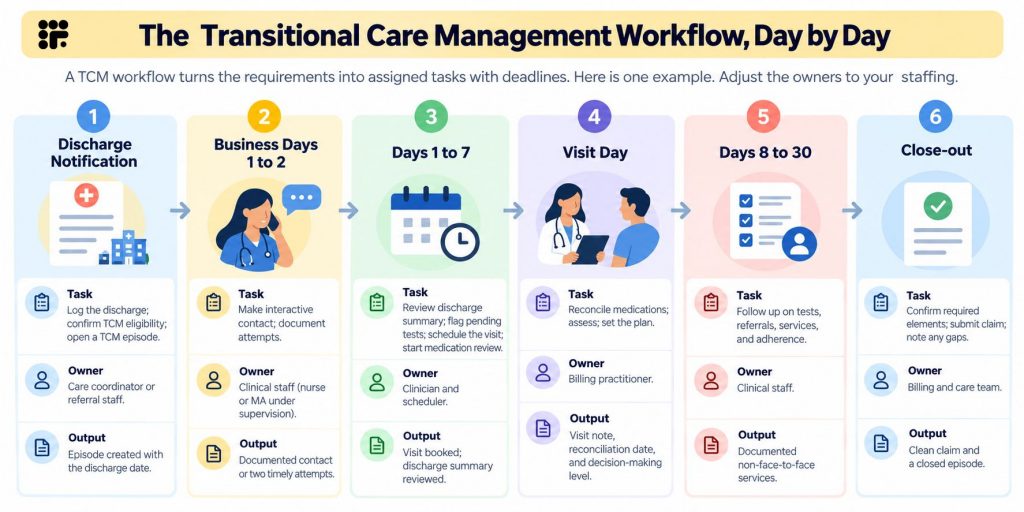
Finding Out a Patient Was Discharged
The clock starts at discharge, but your practice only knows when someone tells you. Common notification sources:
- ADT feeds (admit, discharge, transfer alerts) from hospitals or a regional network
- Health information exchange notifications
- Hospital or SNF calls to the practice or the care team
- Faxed discharge summaries
- Payer lists of recent discharges
- Patient or caregiver reports, often the slowest source
If the discharge is not known, the clock cannot start in your workflow. A faxed summary that arrives on day 4 leaves two business days already gone. The most effective fix is to set up the fastest feed available and assign one person to check every source each morning.
Who Does What: Clinical Staff, Clinician, and Scheduler
- Clinical staff (nurse or medical assistant under general supervision) make the two-day contact, run the follow-up call, collect medication details, and handle non-face-to-face coordination.
- The clinician reviews the discharge summary, decides on medical decision-making complexity, reconciles medications, performs the visit, and documents the rationale.
- The scheduler books the visit within 7 or 14 days, confirms transportation or telehealth options, and sends reminders.
Writing this down avoids the common failure where each person assumes someone else has the next step.
Transitional Care Management Patient Outreach: Making the Two-Day Contact Count
The first contact is the part patients feel. A well-run call finds a medication problem before it becomes a readmission. A rushed one checks a box.
Contact Methods and the Two-Attempt Rule
The contact can be by phone, email, or face-to-face. Phone is the most common and the most reliable for older patients.
If the patient cannot be reached, document at least two separate, timely attempts within the two-business-day window. Space them out and vary the time of day. Then keep trying until you succeed. CMS guidance allows the service to be reported when timely attempts were unsuccessful, and all other requirements are met, but the attempts must be recorded, with date, time, method, and who made them. A claim without that record is difficult to defend.
What a Transitional Care Management Follow-Up Call Should Cover
Use a consistent script so no call skips a topic. Each topic below has a question to ask and a red flag that sends the case to a clinician for review.
- Symptoms.
Ask: “How are you feeling compared to when you left the hospital?”
Red flag: new or worsening symptoms, chest pain, shortness of breath, fever, confusion. - Medications.
Ask: “Did you pick up all your medications? Can you read me the labels?”
Red flag: a missing prescription, a duplicate, an old medication still in use, or confusion about doses. - Pending tests and referrals.
Ask: “Do you know of any tests or appointments still pending?”
Red flag: results that need clinician follow-up, or no scheduled specialist visit. - Home health and equipment.
Ask: “Has the home health agency contacted you? Did your equipment arrive?”
Red flag: services not started, or equipment missing. - Transportation and caregiver support.
Ask: “Who is helping you at home? How will you get to your visit?”
Red flag: no caregiver, no ride, or a caregiver who is overwhelmed. - Who to call and when.
Ask: “Do you know who to call if something changes?”
Red flag: the patient cannot name a contact or does not know when to seek urgent care.
Staff collects the answers and flags concerns. Interpretation and decisions stay with the clinician.
Reaching Patients Who Don’t Pick Up
Many patients do not answer unknown numbers, and a discharge-week phone call is often with a caregiver or out of battery. Tactics that help:
- Send a text prompt before the call. A short message such as “[Practice] will call you today about your recent hospital stay” tells the patient who is calling and why. Keep it brief and follow the rules covered in this guide to TCPA SMS compliance.
- Contact the caregiver. With the patient’s permission, record a caregiver as an approved contact and try them next.
- Limit voicemail content. Leave your name, the practice name, and a call-back number. Keep clinical details out, in line with a HIPAA-compliant voicemail script.
- Pick call-back windows. Try morning and late afternoon, and note when the patient said they are available.
- Keep voice in the mix. Some older and lower-income patients opt out of texting because of plan limits or comfort with the technology. For them, a phone call is the primary channel, and the tips for communicating with elderly patients help staff make the call more effective.
Check-Ins Between the First Contact and Day 30
The two-day call is the start. Plan additional touchpoints:
- A reminder the day before the visit, with what to bring (all medication bottles, discharge papers)
- A check on pending test results and referral appointments
- A mid-period check on how the patient is managing at home
- A final check near day 30 to confirm nothing is left open
These follow-ups give staff a chance to catch problems early, and they feed into an effective post-discharge follow-up workflow.
Why TCM Programs Fall Short of What They Could Capture
Practices that offer TCM often capture only a fraction of the eligible discharges. The pattern is consistent:
- Unknown discharges.
Cause: no notification feed, or the feed arrives late.
Fix: use ADT or HIE alerts and review every notification source daily. - Late contact.
Cause: the call is assigned to whoever has time, and the clock runs out.
Fix: name an owner and set a task due date tied to the business-day deadline. - Visit scheduling gaps.
Cause: the patient is reached, but the visit is not booked, or the next opening is on day 12.
Fix: reserve TCM slots each week and book during the first call. - Medication discrepancies.
Cause: the discharge list and the home list differ, and nobody catches it.
Fix: collect medications during the call and have the clinician reconcile before the visit. - Undocumented attempts.
Cause: calls happen, but the notes do not capture times and outcomes.
Fix: use a structured template with required fields. - No one owning day 30.
Cause: after the visit, nobody tracks the remaining services or the claim.
Fix: assign a close-out owner and a checklist.
Metrics for Judging a TCM Program
Track a short list of numbers each month, and review them with the care team.
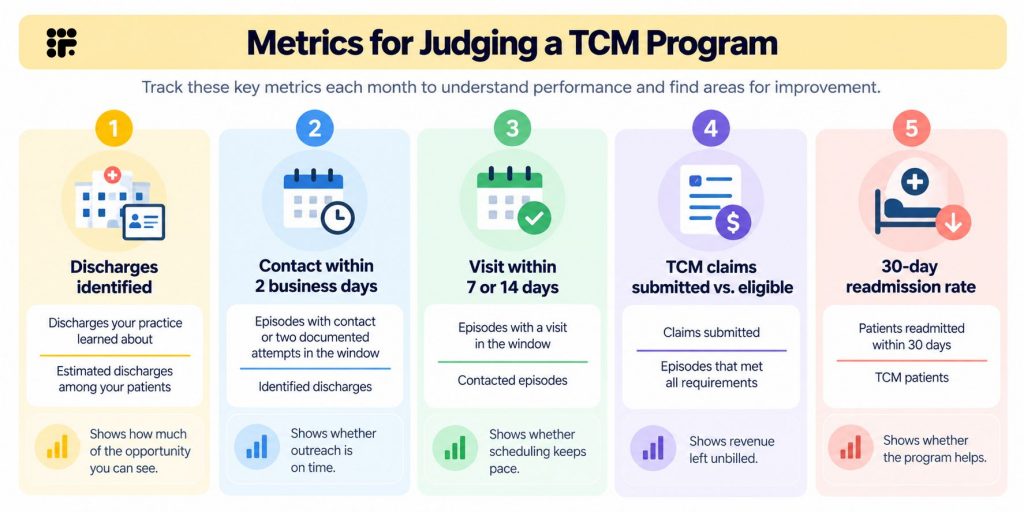
- Discharges identified. Discharges your practice learned about divided by estimated discharges among your patients. It shows how much of the opportunity you can see.
- Contact within 2 business days. Episodes with contact or two documented attempts in the window divided by identified discharges. It shows whether outreach is on time.
- Visit within 7 or 14 days. Episodes with a visit in the window divided by contacted episodes. It shows whether scheduling keeps pace.
- TCM claims submitted vs. eligible. Claims submitted divided by episodes that met all requirements. It shows revenue left unbilled.
- 30-day readmission rate. Patients readmitted within 30 days divided by TCM patients. It shows whether the program helps, though many factors affect it.
Compare the numbers with a baseline from before the program, and look at where episodes drop out of the funnel. Practices can find additional ideas in these strategies to reduce hospital readmissions with automation.
How Emitrr Supports Transitional Care Management Outreach
A successful TCM workflow depends on reaching patients quickly after discharge and staying connected throughout the 30-day transition. Emitrr can support the communication layer around that workflow by helping teams trigger outreach, coordinate follow-ups, collect non-clinical information, manage responses, and maintain a documented history of patient communication. The clinical contact, assessment, medication reconciliation, and medical decisions remain with qualified staff.
Trigger the Two-Day Outreach Workflow
When a discharge is identified, the workflow can create an outreach task for the appropriate staff member with a deadline tied to the two-business-day requirement. Where supported by the EHR integration, the workflow can begin from the discharge event; otherwise, staff can initiate it manually.
Prepare Patients Before the TCM Contact
Rather than using every outreach attempt just to find out whether the patient is available, two-way texting can help confirm a suitable time for the call and handle simple questions. Digital forms can also collect information such as medication pickup, symptoms, and transportation needs before staff speaks with the patient.
Keep Follow-Up Going Beyond the First Contact
TCM requires continued coordination throughout the 30-day period. Patient follow-up workflows can help schedule subsequent check-ins and automated reminders for appointments, tests, referrals, and other outstanding tasks, giving staff a structured way to manage the transition after the initial contact.
Make the Appointment Window Easier to Manage
The TCM visit has a defined 7- or 14-day window depending on the applicable code. AI appointment scheduling assistant can help patients find available appointment slots and reduce the back-and-forth involved in getting the visit booked within the required timeframe.
Keep Every Outreach Attempt Documented
Calls, messages, patient replies, and assigned tasks can stay connected in the patient’s communication history with timestamps and ownership. This gives the team a clearer record of what happened during the TCM episode and supports the documentation needed around outreach.
Let Automation Handle the Follow-Up, Not the Clinical Decision
The value is in reducing the administrative work around TCM rather than replacing clinical care. Emitrr can handle prompts, reminders, replies, routing, and communication records, while qualified staff remains responsible for the interactive contact, clinical assessment, medication reconciliation, and medical decision-making.
See how overwhelmed healthcare front desks manage growing patient communication demands, and how Emitrr helps streamline the work
Key Takeaways
- TCM is a 30-day service that begins on the discharge date and runs 29 days after.
- Three elements are required: interactive contact within 2 business days, non-face-to-face services, and a face-to-face visit within 7 or 14 days.
- CPT 99496 needs high-complexity decision-making and a visit within 7 days. CPT 99495 needs at least moderate complexity and a visit within 14 days.
- Only one provider can bill TCM per discharge, and the visit is part of the service.
- Automated tools cannot replace the interactive contact. A qualified person must complete it.
- If contact fails, document at least two timely attempts and keep trying.
- Most denials trace back to missed windows, late visits, duplicate billing, or incomplete records.
- Programs improve when someone owns each deadline and every attempt is recorded in one place.
Frequently Asked Questions
TCM requires interactive contact with the patient or caregiver within 2 business days of discharge, non-face-to-face care coordination services during the 30-day period, and a face-to-face visit within 7 or 14 days. Medication reconciliation must be completed on or before the visit date, and medical decision-making must be at least moderate complexity.
Both codes require the 2-business-day contact. CPT 99495 requires at least moderate-complexity decision-making and a visit within 14 days of discharge. CPT 99496 requires high-complexity decision-making and a visit within 7 days.
The interactive contact must occur within 2 business days of discharge. Business days are Monday through Friday, excluding holidays, so a Friday discharge generally means the deadline falls on the following Tuesday.
A physician, qualified practitioner, or clinical staff under general supervision can make the contact. Administrative staff cannot. Automated tools such as chatbots and voice assistants do not count as direct contact.
Document at least two separate, timely attempts within the window and keep trying until you reach the patient. CMS guidance allows the service to be reported when timely attempts were unsuccessful, and all other requirements are met, but each attempt must be recorded with the date, time, method, and person.
No. Only one provider can bill TCM for a given discharge, and Medicare pays the first eligible claim. Other clinicians can still bill separate medically necessary services, but not a second TCM claim for the same discharge.
Conclusion
Transitional care management rewards practices that run the basics well: know about the discharge, call within two business days, book the visit, reconcile medications, and write everything down. Each of those steps is simple. The failures come from gaps between them, where no one owns the next deadline.
Start by mapping your notification sources, naming an owner for the two-day clock, and using a structured call template and record. Then track how many eligible discharges you identify, contact on time, and see within the window, and fix the step where patients drop out.
Make the two-day call count. Book a demo to see how Emitrr helps your team start outreach on time and keep every attempt documented.

 4.9 (400+
reviews)
