

Introduction
Telehealth software is no longer just a virtual visit tool. In 2026, it is the foundation of hybrid healthcare delivery, combining HIPAA-compliant video conferencing, secure patient messaging, automated scheduling, remote patient monitoring, and EHR integration into one unified platform.
If you’re evaluating telehealth platforms for your practice, this 2026 guide will walk you through:
- What telehealth software means, why it is important and the benefits it offers
- How telemedicine differs from telehealth
- The compliance requirements of telehealth software (a must-have)
- A complete list of features to look for in a telehealth software
- A detailed roadmap of the setup and implementation of your telehealth software
- Insights into the ROI and revenue with regard to telehealth software
- The industry-specific use cases of telehealth software
- Dos and don’ts of using a telehealth software
- How Emitrr delivers an end-to-end virtual care infrastructure
What Is Telehealth Software?
Telehealth software is a HIPAA-compliant digital platform that enables healthcare providers to deliver clinical and non-clinical services remotely through secure video conferencing, messaging, automation, and integrated workflows.
Unlike basic video apps, modern telehealth platforms include a range of capabilities such as:
- HIPAA-compliant video conferencing
- Secure two-way patient texting
- Online appointment scheduling
- Automated appointment reminders
- Digital intake and consent forms
- Remote patient monitoring (RPM)
- EHR/EMR integration
- Telehealth billing support
- Reporting and analytics dashboards
In 2026, telehealth software acts as a complete patient communication and virtual care platform, not just a telemedicine tool.
Telehealth vs Telemedicine
A telehealth software is different from a telemedicine platform. While telehealth covers digital healthcare in its entirety, telemedicine is a part of this ecosystem. Here’s a complete breakdown of telehealth vs telemedicine:
What is Telehealth?
Telehealth refers to the broader ecosystem of digital healthcare services, including:
- Virtual consultations
- Preventive outreach
- Remote patient monitoring
- Secure messaging
- Digital patient education
- Administrative communication
What is Telemedicine?
Telemedicine refers specifically to clinical services delivered remotely, such as:
- Online diagnosis
- Video-based treatment consultations
- Remote prescribing
- Clinical follow-ups
| Category | Telehealth | Telemedicine |
| Scope | Clinical + operational | Clinical only |
| Video Consultations | Yes | Yes |
| Secure Messaging | Yes | Limited |
| Remote Monitoring | Yes | Rare |
| Scheduling Automation | Yes | Sometimes |
| Billing Tools | Yes | Limited |
| Patient Engagement | Yes | No |
| Full Practice Infrastructure | Yes | No |
Telemedicine is a component of telehealth, not a replacement for it.
Emitrr is designed as a complete telehealth communication platform, not just a video tool.
Why Telehealth Software Is Essential in 2026
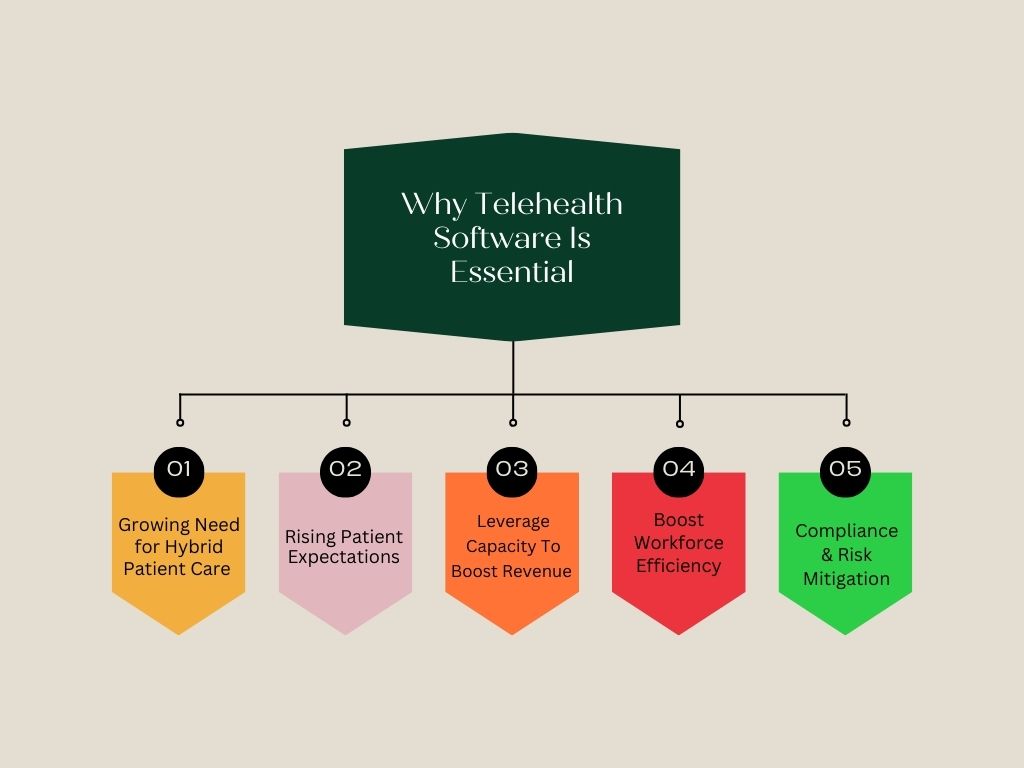
Growing Need for Hybrid Patient Care
Patients expect both in-person and virtual visit options. Practices without online scheduling and video visits lose a competitive advantage.
Hybrid models allow providers to:
- Reduce physical room dependency
- Offer extended hours
- Serve rural populations
- Increase appointment density
Rising Patient Expectations
With advances in technology, patients now demand:
- Same-day telehealth appointments in case of emergencies
- Mobile-first, one-click appointment scheduling
- Automated appointment reminders
- Secure two-way texting with providers
- Digital intake forms to avoid filling out forms in the waiting room
Manual, phone-heavy systems no longer meet such expectations, which is why a telehealth software is the communication solution you need.
Leverage Capacity To Boost Revenue
Telehealth software helps you:
- Reduce no-shows by 30-50%
- Expand your geographical reach
- Offer specialty care through virtual clinics
- Generate revenue through after-hours telemedicine support
- Get faster appointment turnover
As a practice, you blur the boundaries between you and your patients, thereby increasing revenue without expanding square footage.
Boost Workforce Efficiency
If you’re looking forward to lowering staff burden and operational costs, a telehealth software will help you automate routine tasks. Automation will help:
- Tackle high call volumes
- Manage reminder calls
- Make patient intake paperless
- Eliminate manual EHR/EMR entry
Compliance & Risk Mitigation
Purpose-built telehealth software includes encryption, audit logs, role-based access, and BAA protection. Non-compliant tools expose practices to:
- HIPAA violations
- Financial penalties
- Legal risk
- Reputational damage

What Makes Telehealth Software HIPAA-Compliant?
Not all video conferencing software is healthcare-safe. A HIPAA-compliant telehealth platform must include:
- End-to-End Encryption: Protects PHI during transmission and storage.
- Signed Business Associate Agreement (BAA): A legal requirement for any vendor handling protected health data.
- Role-Based Access Controls: Ensures only authorized users have access to sensitive data.
- Multi-Factor Authentication (MFA): Prevents unauthorized access.
- Audit Logs: Tracks user activity for compliance audits.
- Secure Data Storage: HIPAA-compliant cloud infrastructure with redundancy.
- Digital Consent Documentation: Tracks telehealth consent and patient authorization.
Emitrr provides a signed BAA and built-in compliance controls to eliminate regulatory risk.
Core Features of Modern Telehealth Software
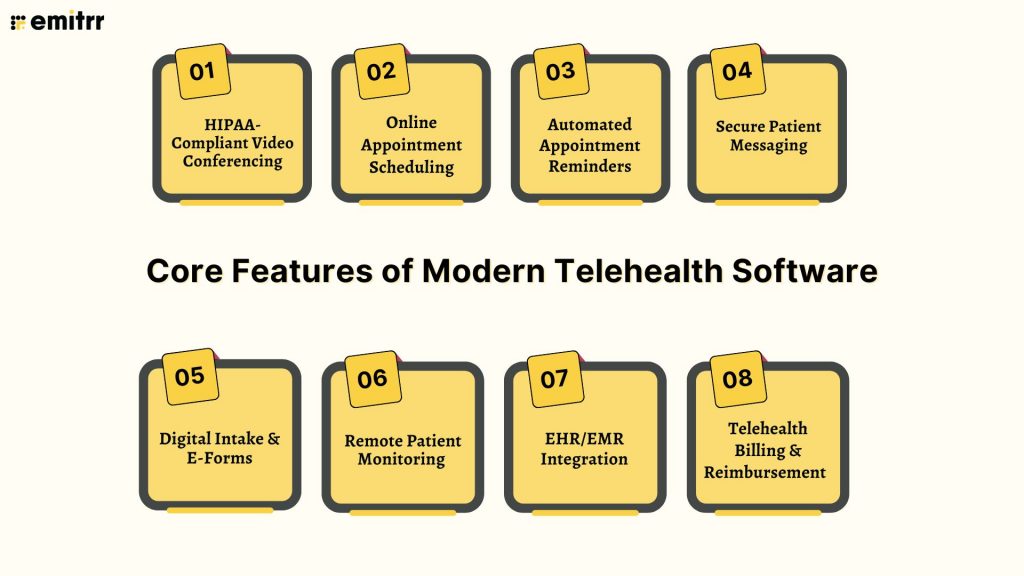
HIPAA-Compliant Video Conferencing
If you’re looking for a HIPAA-compliant telehealth software, video conferencing is one of the first features that it must encompass. Video conferencing would enable:
- Browser-based access
- Virtual waiting rooms
- Screen sharing
- Multi-provider sessions
- Session encryption
No downloads required for patients.
Online Appointment Scheduling
One-click online appointment scheduling is not just a feature, it’s a convenience for you if you want to reduce call volume and no-shows. Look for a telehealth software that offers:
- Self-booking
- Provider selection
- Appointment type configuration
- Automated confirmations
- Rescheduling links
Automated Appointment Reminders
If you want to reduce no-shows by 30-50%, you need to ensure that your telehealth vendor offers automated appointment reminders that includes:
- SMS reminders
- Email reminders
- Two-way confirmation
- Same-day alerts
- Cancellation automation
Secure Patient Messaging
Your chosen telehealth software must be HIPAA compliant in nature, which means it should offer secure, two-way patient communication. This will not just ensure compliance, but will also boost digital patient engagement. Look for these features when you evaluate secure messaging:
- Encrypted texting
- Image/file sharing
- Group messaging
- Automated responses
- Consent tracking
Digital Intake & E-Forms
Reduce paperwork dramatically and speed up the check-in process with digital patient intake. Make sure that your chosen HIPAA-Compliant telehealth software offers the following with regard to digital patient intake:
- Medical forms
- Insurance uploads
- E-signatures
- Pre-visit questionnaires
- Automatic EHR sync
Remote Patient Monitoring
Remote patient monitoring is essenttial for value-based care models. While evaluating your telehealth software, look for:
- Device integrations
- Vitals tracking
- Alert notifications
- Chronic care dashboards
EHR/EMR Integration
Your telehealth platform must sync seamlessly with your EHR/EMR software to ensure seamless bi-directional sync of contacts, messages, etc; and also eliminate duplicate data entry. Look for the following:
- Demographic sync
- Appointment updates
- Clinical documentation transfer
- Billing data alignment
Telehealth Billing & Reimbursement
When it comes to billing and payments, your telehealth software should integrate seamlessly with your billing workflows.
Telehealth billing requires:
- Correct CPT codes
- Modifier usage
- Location documentation
- Time tracking
- State licensing compliance
Telehealth software should support:
- Superbill generation
- Insurance eligibility checks
- Documentation templates
- Telehealth-specific coding assistance
Emitrr simplifies billing workflows by integrating scheduling and visit documentation data.
15 Benefits of Using Telehealth Software
Below are the core benefits of implementing a modern, HIPAA-compliant telehealth software platform like Emitrr Connect. Each benefit directly impacts revenue, efficiency, patient satisfaction, or compliance.
Reduced No-Show Rates
Automated appointment reminders via SMS, email, and two-way confirmations significantly decrease missed appointments. Lower no-shows directly increase provider utilization and predictable monthly revenue.
Increased Revenue Per Provider
Virtual visits reduce downtime between appointments and allow flexible scheduling blocks. Providers can see more patients per day without increasing physical infrastructure.
Expanded Geographic Reach
Telehealth platforms allow providers to serve patients across cities, rural areas, and statewide (where licensed). This expands your patient base without opening new physical locations.
Improved Patient Engagement
Secure patient messaging and easy video access encourage faster communication and follow-ups. Engaged patients are more likely to adhere to treatment plans and return for future visits.
Lower Administrative Costs
Online appointment scheduling and digital patient intake forms reduce front-desk call volume and paperwork. Automation decreases staffing pressure and minimizes operational overhead.
Enhanced HIPAA Compliance & Risk Protection
Built-in encryption, audit logs, and role-based access protect protected health information (PHI). This reduces regulatory risk and safeguards your practice against costly compliance violations.
Faster Appointment Turnaround
Self-scheduling and automated rescheduling links quickly fill canceled time slots. This keeps provider calendars optimized and revenue leakage minimized.
Better Chronic Care Management
Remote patient monitoring software enables continuous tracking of vitals and health trends. Early intervention improves clinical outcomes and supports value-based reimbursement models.
Improved Patient Satisfaction Scores
Convenient online doctor visits and mobile-friendly communication create a frictionless care experience. Higher patient satisfaction leads to better online reviews, referrals, and long-term retention.
Scalable Practice Growth
Cloud-based telehealth software grows with your practice by easily adding providers, services, or locations. There is no need for additional physical infrastructure to expand capacity.
Stronger Competitive Advantage
Offering HIPAA-compliant video conferencing and secure patient communication differentiates your practice. Patients increasingly choose providers that offer convenient virtual care options.
Streamlined Billing & Reimbursement
Integrated telehealth billing workflows simplify CPT coding, documentation, and insurance submission. Accurate documentation improves reimbursement rates and reduces claim denials.
Business Continuity & Disaster Readiness
Virtual care infrastructure ensures continuity during emergencies, weather disruptions, or facility closures. Your practice can continue generating revenue even when in-person visits are limited.
Data-Driven Decision Making
Telehealth analytics dashboards provide insight into no-show rates, patient engagement, and visit volume. Real-time data helps practices optimize operations and improve ROI.
Increased Patient Retention
Consistent digital communication and easy access to providers strengthen long-term relationships. Retained patients generate recurring revenue and improve lifetime patient value.
Who Should Use Telehealth Software? (Expanded Breakdown for 2026)
Telehealth software is no longer limited to large hospital systems or venture-backed telemedicine startups. In 2026, nearly every healthcare specialty can leverage a HIPAA-compliant virtual care platform to improve patient communication, operational efficiency, and revenue performance.
Below is a detailed breakdown of which healthcare organizations benefit most from telehealth software and how they use it.
Primary Care Clinics
Primary care practices are among the biggest beneficiaries of telehealth platforms. Primary care often requires frequent, shorter follow-ups that do not always need physical exams. Telehealth software enables same-day virtual appointments, automated reminders to reduce no-shows, secure messaging for better clinical care, and digital intake forms to streamline workflows. This increases appointment capacity without adding exam rooms or staff.
Mental Health & Behavioral Health Practices
Telehealth has become foundational in mental and behavioral healthcare. Telhealth software is ideal for individual therapy sessions, group counseling, psychiatric evaluations, medication management, and substance use disorder programs. Behavioral health services rely heavily on conversation-based therapy, making video conferencing highly effective.
Telehealth software provides HIPAA-compliant video conferencing, secure patient messaging, recurring appointment scheduling, and automated session reminders. Virtual therapy often improves attendance rates and reduces patient anxiety around clinic visits.
Dermatology Practices
Dermatology is uniquely suited for telehealth due to its visual nature. Telehealth software with image-sharing and digital intake forms significantly improves workflow. Patients can upload high-quality images via secure messaging, allowing providers to conduct asynchronous consultations, reduce unnecessary in-office visits, and speed up prescription adjustments.
Pediatric Clinics
Parents prioritize convenience, which makes telehealth extremely valuable in pediatrics. Parents often struggle to bring children into clinics during work hours. Telehealth platforms offer flexible appointment scheduling, after-hours virtual consultations, secure communication and digital questionnaires; which improves patient retention and family satisfaction. Peadiatric practitioners use telehealth platforms for minor illnesses, behavioural consultations, ADHD medication management, prenatal guidance and post-vaccination follow-ups.
Specialty Practices
Many specialty providers use telehealth for ongoing care management and consultations. Specialties like Cardiology, Endocrinology, Neurology, Gastroenterology, Rheumatology, and Oncology use telehealth platforms for chronic condition monitoring, test result reviews, pre- and and post-procedure consultations, and second opinion appointments. Telehealth software integrated with EHR systems ensures seamless documentation and billing workflows.
Physical Therapy & Rehabilitation Centers
Tele-rehab has grown significantly with advancements in video quality and guided exercise technology. A telehealth platform can help physical therapists and rehab centers with injury recovery monitoring, conducting virtual demonstration sessions and mobility assessments, and providing post-surgical rehab. Virtual rehab sessions increase adherence and continuity of care.
Multi-Location Healthcare Groups
Healthcare organizations with multiple locations benefit from centralized telehealth platforms. As a multi-location practice, you can use telehealth software for unified appointment scheduling across locations, Centralized patient communication, standardized compliance controls, and shared analytics dashboards. Telehealth software reduces fragmentation and improves operational visibility.
Rural & Community Health Centers
Rural clinics often face provider shortages and transportation challenges. Telehealth software enables remote specialty consultations, reduced patient travel burden, faster appointment availability, and expanded care access. This further improves healthcare equity and patient outcomes.
Direct-to-Consumer (DTC) Telemedicine Startups
Virtual-first healthcare businesses depend entirely on scalable telehealth infrastructure. With capabilities such as HIPAA-compliant video conferencing, online appointment booking, automated intake workflows, secure patient messaging, and payment integration; a fully integrated telehealth platform supports growth without operational bottlenecks.
Urgent Care & Same-Day Clinics
Urgent care providers can triage patients virtually before recommending in-person visits. A telehealth platform for urgent care will help reduce lobby crowding, speed up the triage process, help manage virtual prescriptions, and will enable after-hours consults. Telehealth software reduces operational strain while increasing service accessibility.
Chronic Care Management (CCM) & Remote Patient Monitoring (RPM) Programs
Practices offering chronic care programs rely heavily on digital infrastructure. A telehealth platform in the case of CCM and RPM is ideal for diabetes monitoring, hypertension management, cardiac care, and COPD tracking. Telehealth platforms with RPM integrations allow continuous vitals tracking, automated alerts, secure messaging for intervention, and reimbursement optimization. This further supports value-based care models and preventive medicine.
Solo Practitioners & Small Practices
Telehealth software is especially beneficial for smaller practices with limited administrative staff. If you are a solo practitioner, using a telehealth platform will help reduce phone call volume, automate scheduling and reminders, eliminate paper intake, and expand patient access. Small practices like yours will be able to compete with larger health systems by offering modern digital care options.
How to Choose & Implement Telehealth Software
Implementing telehealth software is not just a technical upgrade — it’s an operational transformation. A successful rollout requires alignment between clinical workflows, administrative processes, compliance requirements, and patient communication strategies.
Below is a detailed, practical roadmap to help healthcare practices implement a HIPAA-compliant telehealth platform smoothly and profitably.
Step 1: Assess Your Current Workflow & Identify Gaps
Before selecting or configuring a telehealth platform, evaluate your existing processes. Ask yourself these questions:
- What percentage of patient visits could be converted to virtual appointments?
- How are patient appointments currently scheduled?
- How are reminders sent (if at all)?
- Is patient intake digital or paper-based?
- Are no-shows impacting my revenue?
- Is secure patient messaging available? If yes, how do I implement it?
To get answers to these questions document your end-to-end appointment flow, administrative bottlenecks, inefficiencies with communication, and compliance vulnerabilities.
This assessment will ensure that your telehealth implementation solves real operational problems, not just adds video capability.
Step 2: Define Your Telehealth Visit Types
Not every appointment should be virtual. Define clear use cases for telehealth visits. Here are some common telehealth appointment types:
- Follow-up visits
- Medication management
- Lab result reviews
- Minor acute conditions
- Behavioral health sessions
- Chronic disease check-ins
Create structured appointment categories within your online scheduling system to avoid confusion.
Step 3: Evaluate your HIPAA-Compliant Telehealth Platform Options
After assessing your workflows, identifying gaps, and defining appointment types, it is time to choose a HIPAA-compliant telehealth platform that can help solve your pain points. Your telehealth software must include the following:
- HIPAA-compliant video conferencing
- Signed Business Associate Agreement (BAA)
- Secure patient messaging
- Online appointment scheduling
- Automated appointment reminders
- Digital intake and consent forms
- EHR integration capabilities
- Audit logs and role-based access
Avoid using generic video conferencing apps that lack healthcare compliance protections. Emitr is a secure, HIPAA-compliant telehealth software that encompasses all the aforementioned capabilities and caters to healthcare practices across all domains and sizes.
Step 4: Review HIPAA & Compliance Requirements
Do not skip this step. Once you finalize your telehealth partner, confirm the following:
- BAA is signed with your vendor
- Telehealth consent forms are digitized
- Access permissions are role-based
- Multi-factor authentication is enabled
- Data storage meets HIPAA encryption standards
- Audit logs are activated
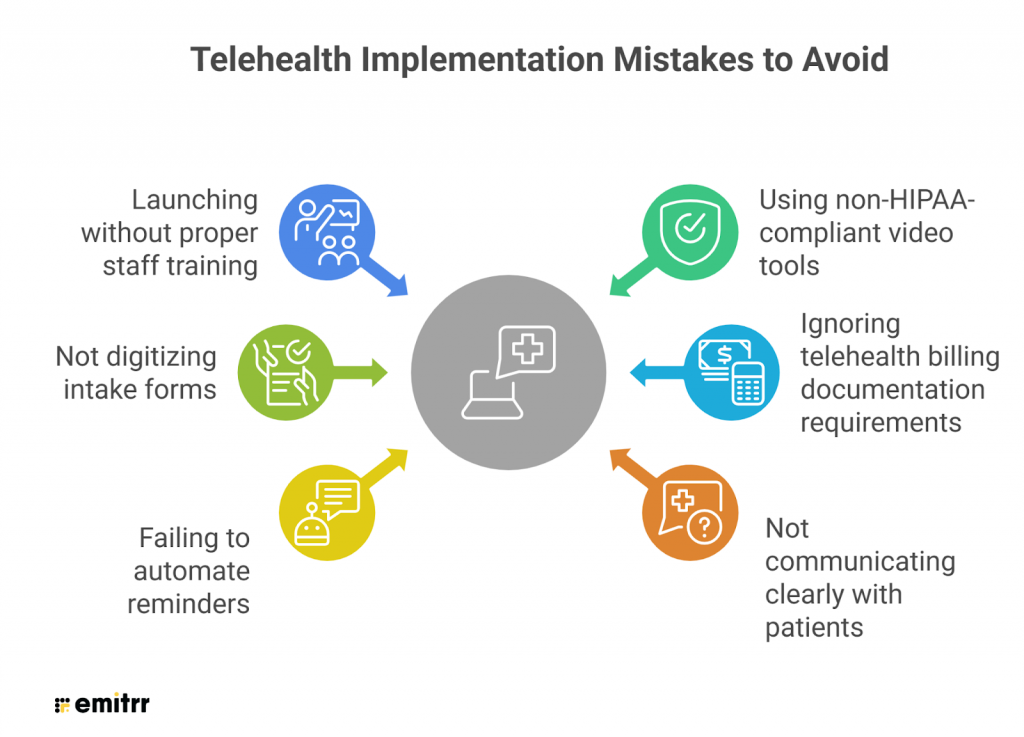
Compliance should be validated before the first patient visit is scheduled.
Step 5: Integrate With Your EHR/EMR System
EHR integration is critical for operational efficiency. With seamless integration, you will not need to switch between tabs, as all contacts and other important information will be synced into your EHR. Moreover, your staff will not need to enter data manually, which will further reduce any scope for error. The telehealth platform integration should enable:
- Automatic patient demographic sync
- Appointment updates
- Clinical note documentation
- Billing data transfer
Step 6: Configure Scheduling & Automation Workflows
This step determines how smoothly your telehealth system operates. Automation significantly reduces no-shows and front-desk call volume. Make sure to configure the following:
- Provider availability for virtual visits
- Appointment buffers
- Cancellation policies
- Automated SMS and email reminders
- Two-way appointment confirmations
- Auto-rescheduling links
Step 7: Build Digital Intake & Consent Workflows
Replace paper forms with secure digital workflows. Make sure to digitize the following:
- Telehealth consent forms
- Medical history intake
- Insurance uploads
- E-signatures
- Pre-visit questionnaires
Send forms automatically via SMS after appointment booking to reduce pre-visit friction.
Step 8: Train Providers & Administrative Staff
Technology adoption fails without proper training.
- Starting and joining video visits
- Managing secure messaging
- Documenting telehealth visits
- Handling technical issues
- Using analytics dashboards
Clear standard operating procedures (SOPs) ensure consistency and reduce confusion.
Step 9: Educate Patients on Virtual Care Access
Patient adoption is equally important. Use automated email and SMS campaigns to announce the launch of your virtual care platform. Make sure to educate your patients on the basics of your platform, for example:
- How to schedule telehealth appointments
- How to join video visits
- Device/browser requirements
- Privacy and HIPAA compliance assurances
- When telehealth is appropriate
Step 10: Test Before Full Launch
Make sure to do a test run before launching. Testing prevents day-one operational issues. Here’s how you can conduct internal testing:
- Run mock video visits
- Test appointment confirmations
- Validate reminder workflows
- Check secure messaging functionality
- Confirm EHR sync accuracy
Step 11: Launch in Phases (Optional but Recommended)
Instead of launching telehealth for all appointment types at once:
- Start with follow-up visits
- Expand to chronic care
- Introduce new specialty services
- Add remote patient monitoring later
Phased implementation reduces risk and improves adoption.
Step 12: Monitor KPIs & Optimize
Track measurable outcomes after launch. Here are some key telehealth metrics that you need to keep an eye on:
- No-show rate
- Appointment volume
- Revenue per provider
- Patient satisfaction scores
- Secure messaging response times
- Intake completion rate
Doing so will help you optimize scheduling density and patient communication workflows.
Frequently Asked Questions
Telehealth software is a HIPAA-compliant virtual care platform that enables healthcare providers to deliver online consultations, secure patient messaging, and digital workflows through encrypted systems. A modern telehealth software solution typically includes HIPAA-compliant video conferencing, online appointment scheduling, digital intake forms, remote patient monitoring, and telehealth billing support. It works by securely connecting patients and providers through web or mobile devices while integrating with EHR systems to streamline documentation and compliance.
No, telehealth software and a telemedicine platform are related but not identical. Telemedicine platforms primarily focus on clinical services like virtual diagnosis and treatment via HIPAA-compliant video conferencing. Telehealth software, on the other hand, is broader and includes secure patient messaging, automated appointment reminders, remote patient monitoring, digital intake workflows, and telehealth billing support. In short, telemedicine is a subset of telehealth within a comprehensive virtual care platform.
Telehealth software is considered HIPAA-compliant when it includes end-to-end encryption, role-based access controls, audit logs, and a signed Business Associate Agreement (BAA). A compliant telemedicine platform must also support secure patient messaging, encrypted HIPAA-compliant video conferencing, and protected cloud storage for patient data. Without these safeguards, healthcare providers risk exposing protected health information (PHI) and facing compliance penalties. Always verify encryption standards and BAA availability before choosing a telehealth solution.
Telehealth software reduces no-shows by automating online appointment scheduling, sending SMS and email reminders, and enabling two-way appointment confirmations. By offering flexible telemedicine appointments through a virtual care platform, practices make it easier for patients to attend visits. Secure patient messaging and digital intake forms further reduce friction before appointments. Together, these features improve provider utilization, stabilize monthly revenue, and increase overall telehealth ROI.
Telehealth software is ideal for primary care clinics, mental health practices, specialty providers, urgent care centers, and telemedicine startups seeking scalable virtual care infrastructure. Any healthcare organization that requires HIPAA-compliant video conferencing, secure patient messaging, online appointment scheduling, and telehealth billing support can benefit. Practices managing chronic conditions may also leverage remote patient monitoring to improve outcomes while expanding access to care through a comprehensive telehealth platform.
Key Takeaways
When you choose your preferred telehealth software and implement it in your practice, you will see a significant reduction in call volume, automated appointment workflows, a drastic drop in no-show rates, faster intake processing, improved patient communication, and higher patient satisfaction. Implementing telehealth software is not just about enabling video visits. Now that you have a comprehensive idea of what a telehealth platform is, how it works, and the features it must encompass, you will be able to make an informed decision. Once you implement telehealth into your practice, you will be able to transform your practice by leaps and bounds.

 4.9 (400+
reviews)
4.9 (400+
reviews)